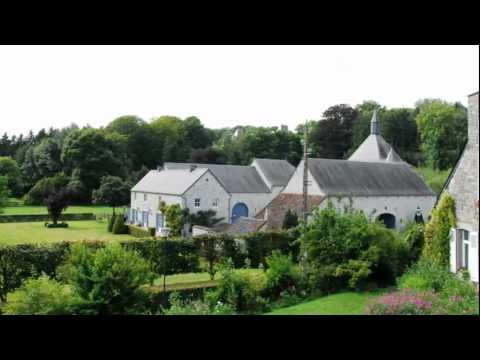
historic Condroz farms, a living castle estate and Goyet caves
Mozet is a village in Gesves municipality, in Belgium’s province of Namur. Limestone farms, slate roofs and a church on its mound form a protected historic centre beside the Tronquoy stream. The castle estate now provides residential and educational activities. Nearby Goyet adds a different landscape along the Samson, with prehistoric caves whose history must be distinguished from that of the present village.
| Municipality | Gesves |
|---|---|
| Municipal registered population at 1 January 2026 | 7,452 |
| Municipal area, WalStat revision of 22 May 2026 | 65.03 km² |
National Register figure for the whole municipality, including its other settlements. It is not a count of the historic village alone.
Ancient occupation and the medieval village
Goyet’s caves preserve evidence of prehistoric occupation, while the wider territory also has Roman remains. These discoveries concern people using the area, rather than establishing an exact prehistoric or Roman foundation of today’s settlement.
The estate’s historical account records references to Mozet in 747 and 953. A family of local lords became prominent in the medieval village near the boundary between Namur and the Principality of Liège.
The property later passed through conflicts and different ownership. In 1790 it served as a hospital and prison during the Brabant Revolution. Nineteenth-century alterations preceded its present educational and social use.
Understanding the farms
Douxflamme and Royer are major landmarks in a settlement whose economy depended on farmland and substantial agricultural premises. Their scale shows how work and resources were concentrated in large complexes.
Royer’s entrance tower dates from the early seventeenth century and carries the year 1614. Levels, openings and its slate roof combine practical access with the status of a former seigneurial residence.
Smaller houses provide a contrasting view of rural life. Rue Pieltain and the surrounding streets reveal dwellings, former animal accommodation, formal frontages and yards. Local stone gives them a shared character without making their functions identical.
Saint-Lambert and the centre
Saint-Lambert Church occupies the cemetery mound above the village core. The classical building was rebuilt in 1775 and enlarged in 1853. Its square tower and tall windows are visible from several approaches.
Older funerary stones survive in the external walls. Furnishings from different periods demonstrate how rebuilding a church could preserve objects inherited from earlier arrangements.
An interpretation circuit of approximately four kilometres connects these landmarks with the farms and Tronquoy landscape. Allow time for the panels and architectural details rather than treating it only as a measured walk.
A castle estate with present-day uses
The castle retains defensive features adapted through successive alterations. Its gatehouse-dovecote, former drawbridge traces and towers help explain those changes; the entire complex does not belong to one medieval building phase.
Domaine de Mozet now operates as a meeting and residential centre. Schools, families, associations and youth organisations book stays and environmental activities. Its rooms and grounds are used for those purposes.
Nature programmes add another way to discover the site. Workshops and interior access follow the estate’s actual arrangements, rather than a permanent museum route through every room.
Goyet caves outside the village core
The caves are in the Goyet area, away from central Mozet. Guided visits explore underground galleries and the people and animals associated with them long before the medieval village developed.
The operator’s ordinary 2026 visitor season ended on 8 November, with reservations required. It has therefore finished at the time of writing. Private or group visits need separate confirmation; Sunday opening should not be assumed throughout winter.
The Samson valley is also an outing for its landscape. Goyet and Mont-Sainte-Marie are separate nearby stops, rather than attractions all clustered around Saint-Lambert Church.
Walking and family activities
Small ridges, valleys, woodland and pasture create the Condroz landscape. Paths around Mozet reveal how the farms and settlement occupy that terrain.
The estate offers nature discovery and environmental education, while heritage routes lead towards the hamlets. Workshops and holiday programmes have specific dates, so organise a family stay around the current edition.
Namur provides a complementary urban excursion. A rural base here allows a day in the city to alternate with nearby walking, rather than requiring a long drive for every outing.
Accommodation choices
The Domaine accommodates groups of different sizes and offers half- or full-board arrangements on request. It is a residential centre rather than a conventional hotel where every room is independently bookable without coordination.
Le Petit Pont in Goyet advertises studios and a loft alongside its restaurant. They are in the Samson valley, outside Mozet’s historic core. Château de Goyet also provides group stays and reserved services.
These options suit different needs: collective accommodation, self-catering or an entire property for an occasion. Include the precise location when planning visits and an evening return journey.
Two named places to eat
Le Petit Pont in Goyet specialises in meat dishes beside the Samson. Its own information gives evening restaurant service from Thursday to Sunday, with telephone reservations.
Garde Manger occupies the former Samson cheese premises on Chaussée de Gramptinne in Goyet. Its postal address uses Mozet, but the restaurant is in the hamlet near the caves, rather than among houses surrounding the village church.
Meals at the Domaine belong to the reserved residential arrangement. Comparing these options involves their setting, service and travel as much as the menu.
Connections with Namur and daily life
The Domaine places Mozet approximately fourteen kilometres south-east of Namur. That city is a useful rail arrival point, followed by an onward local connection. Check current schedules, especially for Sunday travel.
The estate’s road directions use the Wierde exit from the E411 or an approach from the N4, followed by local roads through Wierde. Liège offers another major-city approach along the motorway network towards Namur.
For a possible move, assess actual work, school and shopping journeys. The statistical table covers the whole of Gesves municipality. A house in central Mozet, accommodation in Goyet and an outlying property provide different everyday arrangements.
Sources
- Domaine de Mozet : archives, occupations anciennes et histoire du château
- Parcours patrimonial : Saint-Lambert, fermes et architecture
- Village classé, Tronquoy et itinéraires
- Château : transformations et ancien pont-levis
- Grottes de Goyet : visite et calendrier 2026
- Domaine : nature, activités et parcours autour de Mozet
- Domaine : formules d’hébergement et de pension
- Le Petit Pont : restaurant et hébergements à Goyet
- Garde Manger : restaurant à Goyet et situation exacte
- Château de Goyet : séjours de groupes sur réservation
- Domaine : situation par rapport à Namur et accès routier
- Belgian National Register: municipal figures, 1 January 2026
- IWEPS / WalStat: superficies communales (2026)