village portraits, mountain crafts and woodland paths
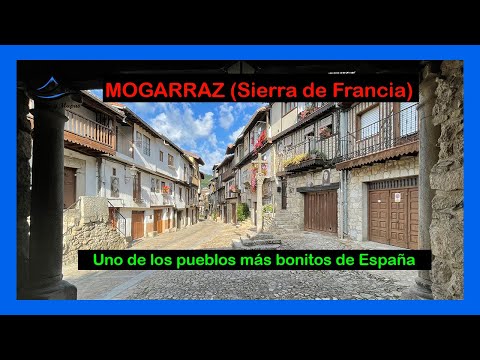
Mogarraz occupies a hillside in the Sierra de Francia, south of Salamanca. Timber-framed houses and cobbled lanes preserve a way of building adapted to mountain terrain. On their façades, Florencio Maíllo’s painted portraits reconnect the village with the people who lived here. Outdoor art, small museums, regional cooking and walks through neighbouring valleys provide reasons to stay beyond a brief photographic stop.
| Municipal population at 1 January 2026 | 236 |
|---|---|
| Area of the municipality | ≈ 9.05 km² |
INE Annual Population Census, reference 1 January 2026, released on 24 November 2026. The IGN area covers the whole municipality, not only the built-up centre.
A medieval settlement in the territory of Miranda
Mogarraz developed within the medieval resettlement of the Sierra de Francia under the kings of León. Its history is connected with Miranda del Castañar and the communities that organised these slopes. The present street pattern follows uneven ground and the spaces between houses rather than the grid of a planned Roman city.
The village subsequently passed from royal jurisdiction into the county of Miranda. Material preserved in the municipal archive describes its acquisition of independent jurisdiction during the seventeenth century. Local accounts also explain how residents contributed to religious buildings, with the church and detached tower incorporating work from different periods above earlier structures.
Historic ensemble designation followed in 1998. The heritage extends beyond individual monuments to a continuous fabric of homes, passageways, fountains and public spaces. Together they reveal the relationship between work, housing and community life.
Houses, lanes and the main square
Stone, timber framing and adobe infill characterise the regional building tradition known as tramonera. Upper floors display balconies and projecting sections that made use of restricted space. Walking slowly reveals these details more clearly than searching only for a distant panorama.
Plaza Mayor provides a useful starting point. Narrow streets lead towards Nuestra Señora de las Nieves Church and its separate bell tower. The Humilladero chapel and fountains add further stops. Changing levels and angles create a varied walk within a relatively compact centre.
These are residential streets as well as visitor attractions. Doorways, balconies and narrow passages remain part of everyday life. Anyone needing step-free access should ask about gradients and surfaces: a short distance on the map may involve steps and uneven cobbles.
The people behind Retrata2-388
Florencio Maíllo based his project on photographs taken by Alejandro Martín Criado in 1967 for residents’ identity documents. In 2012, Retrata2-388 brought that archive back into the streets, placing painted faces beside homes associated with the people portrayed.
Maíllo used encaustic painting on metal sheets. These are individual portraits connected with names, addresses and family memories. The installation expanded after its original presentation; regional visitor information now describes more than eight hundred works.
Differences in clothing, age and expression reward a closer look. A façade becomes more than an architectural example when it is associated with a particular life. Visitors can encounter the paintings without following a fixed route, although a guided explanation adds context about the photographic archive and its artistic transformation.
Craft collections and mountain embroidery
The Casa de las Artesanías explores trades that helped support Mogarraz. Embroidery, leatherwork and jewellery demonstrate that the local economy involved more than farming. Tools and finished objects reveal the skills behind both everyday and ceremonial belongings.
The separate Embroidery Interpretation Centre in Calle Pozo Barrero focuses on the regional textile tradition. Displayed pieces, audiovisual material and interpretive resources introduce patterns and techniques. Bordado serrano received protected intangible cultural heritage status in 2022.
Check the two centres’ visiting arrangements individually. Opening periods and booked visits differ from those of a large city museum. For visitors interested in craft, these collections provide a worthwhile complement to the much more immediately visible portraits.
Walking between Mogarraz and Monforte
The Camino del Agua connects Mogarraz with Monforte de la Sierra on a circular route listed by the regional tourist organisation as PRC-SA 55, approximately 6.3 kilometres long. Artworks appear among vegetation, watercourses and valley paths. Monforte is a separate village rather than a district of Mogarraz’s old centre.
Allow time for stops and gradients, and take care on wet sections after rain. The provincial authority publishes temporary notices, including restrictions linked to authorised hunting activity. Check the actual date of any warning before setting out rather than assuming an undated notice applies indefinitely.
Chestnuts, oaks, orchards, olives and vines form part of the surrounding Sierra de Francia landscape, within the wider Sierras de Béjar y Francia Biosphere Reserve. La Alberca and Miranda del Castañar are possible additions to a longer stay, with mountain driving time needed between villages.
Staying and eating in the village
Hotel Spa Villa de Mogarraz provides accommodation in Mogarraz itself, with rooms and a spa area. Its Asador Don Mauro offers a dining option without travelling to another town. Confirm parking and whether spa access is included in the chosen room rate.
Mirasierra, in Calle Miguel Ángel Maíllo, opened in 1974 and continues to feature regional produce and recipes. Its menu includes patatas meneás and grilled meats alongside other mountain dishes. Reserve directly and check kitchen hours for the intended day.
Tourism accompanies small businesses, crafts and agricultural activity. Anyone considering a move should visit outside the busiest season to assess daily services, shopping journeys and property access. A pedestrian lane can be attractive while still requiring practical arrangements for deliveries, luggage or regular car travel.
Connections through Salamanca
Salamanca is the main rail and motorway gateway. A road approach runs through Vecinos and Tamames towards La Alberca before the local turn to Mogarraz. Allow for the winding final sections rather than relying on straight-line distance.
Journeys from Madrid or Valladolid can be planned through Salamanca, with a separate onward transfer. Autocares Cosme serves the surrounding area; check which services actually call at Mogarraz, on which days, and how to return. There is no railway station in the village.
The historic centre is explored on foot. A car or arranged transfer offers more flexibility for accommodation outside the centre, several villages in one trip or walks beginning elsewhere. Use the indicated parking areas during busy periods and continue into the old streets on foot.
Sources
- Turismo Sierra de Francia: patrimonio, retratos y accesos
- Archivo municipal: historia de Mogarraz y su jurisdicción
- Archivo municipal: Florencio Maíllo y el proyecto Retrata2-388
- Casa de las Artesanías: colecciones y oficios
- Centro de Interpretación del Bordado Serrano
- Camino del Agua: recorrido y ficha técnica
- Diputación de Salamanca: avisos temporales del Camino del Agua
- Hotel Spa Villa de Mogarraz y Asador Don Mauro
- Restaurante Mirasierra: historia, carta y dirección
- Autocares Cosme: transporte de viajeros en la comarca
- INE: Annual Population Census, 2026
- IGN: municipal area