A small town below a royal skyline
Loches is best approached from the banks of the Indre. The river bends below a high, walled promontory, and the skyline gathers a keep, the royal residence and the church of Saint-Ours above the lower streets. That view can make the town seem like a monument first and a place to live second. The distinction disappears on a walk: school routes, cafés, shopfronts and the twice-weekly market continue below the old walls, while the historic centre is still part of an active departmental service town.
INSEE counted 6,234 municipal residents across the whole commune in 2023. In the same year, it recorded 4,883 jobs located in the commune: 41.1% were in public administration, education, health and social action; 37.9% in commerce, transport and services; and 15% in industry. These are workplace statistics, not a count of residents employed in those fields. They show how Loches serves the southern part of Indre-et-Loire as well as visitors drawn by the royal city. The market is one easy place to see that everyday role.
A fortress shaped by the rivalry of medieval powers
The oldest major monument is the keep, built between 1013 and 1035 by Foulques III Nerra, count of Anjou, according to the Cité royale’s historical account. Its position on the rocky spur made it a defensible point in the competition between the counts of Anjou and Blois and, later, between Capetian and Plantagenet powers. New walls, towers and artillery works accumulated around it over several centuries. The town itself became a royal city in 1249, under Louis IX, and the walled upper town remained a fortified landscape rather than a single château.
The royal lodge grew at the northern end of the spur from the late fourteenth century. Charles VII used Loches from 1418 and made it one of his principal strongholds. Joan of Arc met him there in May 1429 after the victory at Orléans. In the 1440s, the king often stayed with Agnès Sorel, whose story is part of the residence’s history but should not turn the whole town into a romantic court anecdote. Anne of Brittany’s small flamboyant-Gothic oratory is another tangible trace of the Valois court. After the royal household shifted back toward Île-de-France, the lodge lost its residential role; parts of the fortress were later used as a prison, and the departmental prison remained in the keep until 1926.
Loches also carries legends that deserve a careful reading. Popular stories about Louis XI’s iron cages have often been repeated as images of cruelty. The Cité royale’s interpretive material notes that the objects commonly called “fillettes du roi” were neck restraints, not the large cages of popular imagination. Looking for the evidence behind a story is part of visiting a place with such a long and often embellished reputation.
Beyond the keep: Saint-Ours and the lower town
The walled city is more than its two royal buildings. The former collegiate church of Notre-Dame, now Saint-Ours, stands beside the royal lodge. Its two hollow, octagonal pyramidal domes—locally called “dubes”—make the roofline unlike that of a conventional church. The church was originally associated with the relic of the Virgin’s belt and a college of canons; it became the parish church of Saint-Ours during the Revolution. Restoration work has been a continuing municipal concern, so check current access before building a visit around the interior.
Below the promontory, old gates, lanes and houses follow the curve of the river and the former defensive walls. The Porte Royale leads into the upper city; the lower town has its own churches, civic buildings and quieter streets. The CIAP, the interpretation centre for architecture and heritage, gives context to these layers and the town’s designation as a Ville d’Art et d’Histoire. An unhurried circuit can begin at the market, climb to the collegiate church and royal lodge, continue to the keep, then return through the lower streets toward the Indre. Expect slopes and uneven paving in the upper city.
Market mornings and the Lochois countryside
Loches’s market takes place on Wednesday and Saturday mornings in the town centre. The municipality describes it as one of Touraine’s larger markets, with between 50 and 100 traders depending on the season. Local foods include géline de Touraine, Sainte-Maure-de-Touraine goat cheese, rillons and rillettes de Tours, alongside vegetables, fish, bread, flowers and other produce. It is both a practical shopping place and a chance to understand the agricultural region around the town. The number of stalls and exact layout vary, so check municipal notices for special dates or changes.
The Indre valley gives the town a softer counterpoint to its stone walls. Paths and streets look toward the river, and beyond the commune the Lochois landscape opens into villages, farms and woodland. Nearby Beaulieu-lès-Loches has its own abbey heritage across the river; farther out, Montrésor and other villages of the southern Touraine make reasonable day trips. Loches is a useful base for combining a royal residence with the slower scale of local markets and rural roads, rather than trying to cover every Loire Valley château in one day.
Getting there and planning a visit
Rémi trains connect Loches with Tours; the regional operator lists journeys of under 58 minutes for some services, but train frequency and journey time depend on the day. The station is close to the lower town, from which the upper city can be reached on foot. Regional coaches also connect Loches with Tours and Châteauroux. Check the current timetable before travelling, especially on Sundays and public holidays. Once in town, a car is useful for the wider countryside but not necessary for the main historic circuit.
The Cité royale includes the keep and royal lodge; their ticketing, opening hours, temporary exhibitions and guided visits are managed by the Department and may change by season. A fuller visit pairs those two monuments with Saint-Ours, the CIAP, a market morning and a walk beside the Indre. Loches is not just a stage for famous names. Its lasting appeal is the close fit between a defensive ridge, a living town and the landscape that connects them.
 Loches en trois vidéos : ville, parcours royal et jardins
 The Cité royale’s 2018 video introduces a then-new visitor route built around 15 spaces and 700 square metres of interpretation. Its focus is how the site explains its history through sound and video, rather than a complete account of every royal episode. It is a period record of the interpretation offer; check the current site for today’s route and opening information.
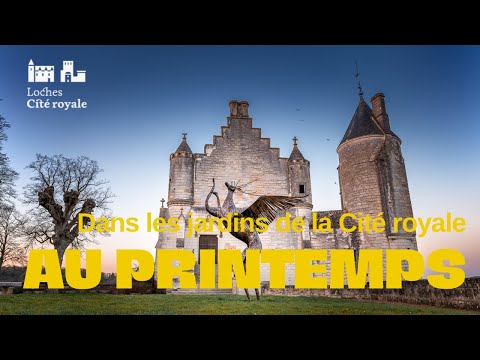 This film follows the gardens around the keep and royal lodge as spring begins. Its attention to planting and the spaces between the buildings provides a quieter counterpoint to Loches’ military and court history. The video description identifies both the keep and royal lodge gardens; use it as a visual preview, while checking the current Cité royale information for access, seasonal closures and any works.