A service town with a lake at its heart
Ljusdal is the municipality’s working centre rather than a village preserved as a set piece. Shops, cafés, restaurants, the Rio cinema, library, museum and municipal offices make it a useful base in north-western Hälsingland, while Kyrksjön and the Ljusnan valley keep water and woodland close. The station and bus interchange anchor the newer centre; the older parish settlement lies about a kilometre west. Statistics Sweden counted 7,125 residents in the statistically defined built-up locality, or tätort, of Ljusdal on 31 December 2023 (code 2161TC107). That figure describes the continuous urban area, not all of Ljusdal municipality or nearby communities such as Järvsö and Färila. The town’s own character comes from that meeting of service life, rail history and everyday access to outdoor space.
Two centres, then an industrial chapter
The municipal account places the older local centre around Ljusdal Church and the village of Vi, significant in north-western Hälsingland from the Middle Ages through the late nineteenth century. The Northern Main Line reached the area in 1880. The focus shifted roughly one kilometre east, where a station settlement grew across former fields in Gärde, Tälle and Slotte. The Ljusdal–Hudiksvall railway opened in 1889, when the settlement became a municipalsamhälle; in 1914 it was made a köping. Östernäs then gave the railway town an industrial backbone: its sawmill operated from 1887 to 1995 and was the municipality’s largest twentieth-century industry, employing around 150 people at its peak. The mill’s timber, rail access and water power fed the local economy and even helped provide street lighting and other infrastructure. Its working life has ended, but the former industrial waterfront is being reshaped as a park and mixed-use neighbourhood.
Church, collections and murals
Ljusdal Church stands in Vi, the older settlement. The parish dates its earliest church to the twelfth or thirteenth century; the building was enlarged in the late Middle Ages, damaged in the 1753 fire and given much of its present interior during a restoration begun in 1913. A Flemish altarpiece linked to Antwerp and dated 1503 is among its notable survivals. The parish suggests that the place-name Vi points to a pre-Christian cult site, but this is an interpretation of a name, not proof of a particular rite. In the newer centre, Ljusdalsbygdens museum preserves objects, photographs, films, archives, stories and traditional craft from north-western Hälsingland. Bagargränd provides a contrasting outdoor gallery: during Artscape in August 2019, sixteen artists produced murals, yarn work and installations, and the municipality says most murals remain. A small illuminated map behind the municipal building links public art with landmarks including Folkparken and Älvvallen.
Walk the lake, then follow the river
Kyrksjön gives Ljusdal a close-to-centre green circuit. Hälsans stig loops around the lake, with twelve exercise signs spaced roughly 250–350 metres apart; Östernäs adds a skatepark, dirt track and open recreation areas. On Kyrksjönäset, the local heritage farm, Folkparken, swimming area and Älvvallen form a cultural landscape as well as a place for sport and family outings. The covered stand at Älvvallen, completed in 1939, is a rare, well-preserved example of functionalist sports architecture. For a longer walk, the Ljusnanleden section to Färila is about 12 kilometres: it begins at Måga exercise trails, 2.5 kilometres west of the centre, follows the river’s north bank past Henriksforsen and continues through Ygsbo. The first stretch is outside the centre, so plan transport and check the current map. Ljusdal also works as a base for separate municipal destinations such as Järvsö and Färila. Before setting out, confirm museum and church access, bus and train times, trail conditions and seasonal facilities; these details can change.
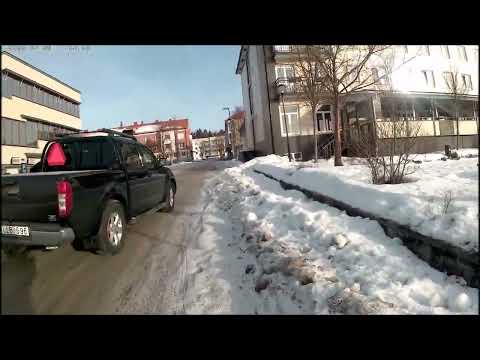 Three Ljusdal videos: town walk, Kyrksjön and local museum
 ‘Runt Kyrksjön i Ljusdal’, also published by Peder af Sweden, runs 7:51 and is dated 6 January 2023. Its title focuses on the lake circuit, a distinct outdoor strand of the town rather than another general centre overview. The municipality describes Hälsans stig around Kyrksjön and activity signs along the route, while Östernäs adds recreation areas on the shore. The upload is useful for choosing a waterside outing; check the official map and current trail access instead of assuming the route has not changed.
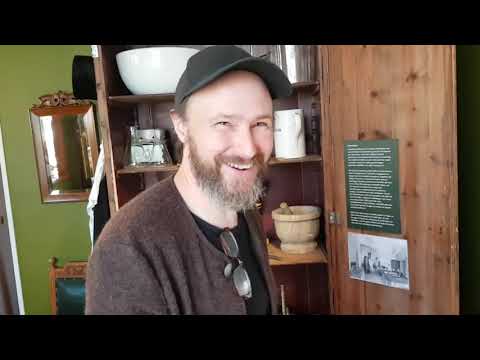 BerntHenrik Wallin’s ‘Ljusdalsbygdens museum, guidad tur med Anders Assis’ was published on 10 October 2021 and runs 14:10. Its title identifies a guided tour with Anders Assis at Ljusdalsbygdens museum, a separate cultural subject from the street walk and lakeside circuit. The municipal museum describes its remit as preserving objects, archives, photographs, film and traditional craft from north-western Hälsingland. The upload provides a way into that local-history theme, but cannot confirm current admission or access; consult the museum’s live information before visiting.