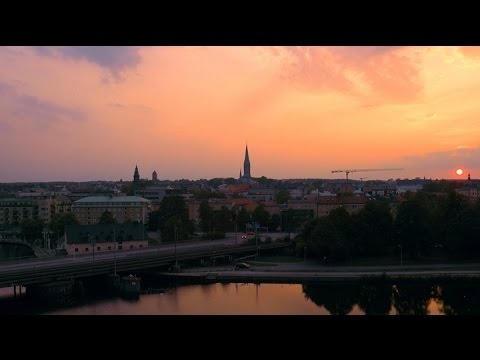
Linköping is a substantial regional city in Östergötland, but its centre still reads through a few strong landmarks: the cathedral tower above the old streets, the Stångån waterway to the east, and the railway station linking the city to the wider region. Statistics Sweden counted 116,851 residents in the mapped urban locality on 31 December 2023, across 3,967 hectares. This is the statistical tätort, not the municipality; the municipal population covers a wider area and should not be substituted for the town figure.
A cathedral and a crossing
Linköping's long history is documented most clearly in its church and civic records. The diocese's cathedral account traces an earlier Romanesque church, followed by the enlargement of the building from the thirteenth century. Construction continued in stages and the Gothic cathedral reached completion in the early sixteenth century; its present tower reflects much later rebuilding. The result is not a single-period monument but a layered building whose fabric records changing resources, styles and religious life. Visitors can approach it as an active church as well as a major historic interior, so services, concerts and visitor access may affect entry.
The city's location also makes sense at the river. Stångån was a practical crossing and route through the landscape, and municipal heritage material describes how trade and movement helped establish settlement around Nykvarn. Some details of the earliest route are reconstructions informed by maps and archaeological finds; they should be understood as careful historical interpretation rather than a surviving medieval street plan. Linköping became an administrative centre in the seventeenth century. The bridge built at Stångebro in 1646 and the town planning that followed redirected important traffic and helped shape the city that grew around the old centre.
Work, study and invention
Modern Linköping is known for aerospace and engineering, yet the economy is broader than one industry. The municipality's own account connects aviation to Malmen: Carl Cederström flew there in 1911, the Swedish Air Force was established in 1926, and Saab began in Linköping in 1937. Those milestones explain the city's manufacturing identity without suggesting that every visitor site is aviation-themed. Today, advanced technology, research, the university, health care, public administration, commerce and services all contribute to daily life. Linköping University and its research partnerships bring a student and laboratory presence into the city, while the hospital and public institutions serve a wider regional catchment.
Ways to spend a day
The compact historic centre rewards walking between the cathedral, squares, cafés and riverside paths. A longer visit can pair the cathedral with Gamla Linköping, an open-air museum where historic buildings and garden settings create a distinct, quieter excursion. Parks, cultural venues and sports facilities widen the choice beyond heritage, and the Stångån and Kinda Canal corridor offers water, locks and paths through the urban landscape. These places are separated by real distances: allow time between them and use current local transport information rather than assuming everything lies beside the cathedral.
The railway station is a natural arrival point for regional and intercity trains. Local buses and cycling routes can extend a visit toward the museum area, parks and outer districts, but line patterns, detours and seasonal services can change. Check the operator's live journey planner before departure. For museum, church and event visits, confirm opening hours and admission arrangements directly on the venue's current pages; holidays, worship and special events may alter access. For a first orientation, choose one historic anchor and one neighbourhood or green route rather than trying to cover every attraction in a single day.