a Touraine village, painted château galleries and woodland routes
Gizeux lies in wooded countryside in north-western Indre-et-Loire, where Touraine meets Anjou. The approach to its château reveals a long, inhabited residence; the village church and washhouse provide a more intimate scale. With only a few hundred residents, the commune remains rural, while the château’s remarkable painted interiors give it a distinctive place among Loire Valley destinations.
| Municipal population, 2023 reference | 382 |
|---|---|
| Area of the commune | ≈ 21.09 km² |
Population at 1 January 2023, within municipal boundaries at 1 January 2025; official figure in force from 1 January 2026. The area covers the whole commune, not only the built-up centre.
A medieval estate shaped over centuries
The château developed from a medieval estate, enlarged and altered over several periods. The du Bellay family arrived in 1334 and remained associated with it for around three hundred and fifty years. Their importance to the local heritage should not be confused with a claim that the poet Joachim du Bellay personally lived here throughout that history.
The older castle, Renaissance residential block and eighteenth-century service buildings represent different phases. Owners adapted the estate for accommodation, household work and social display. This architectural sequence does not establish a foundation date for the village, but does explain the lordship’s longstanding place in the rural landscape.
The estate entered the present owners’ family history in 1786. Protected as a historic monument in 1945, it opened to visitors in 1993. Restoration, public visits and guest accommodation now help maintain a residence that is still lived in.
Painted galleries and furnished rooms
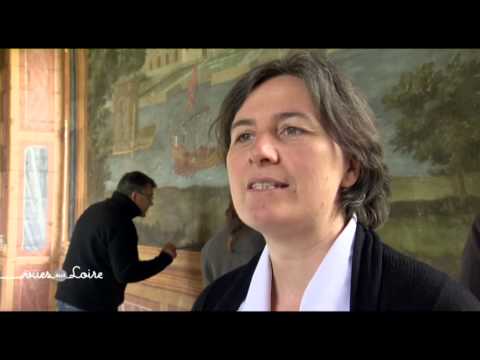
Two major galleries preserve wall paintings associated with late-sixteenth- and seventeenth-century decoration. The Galerie François-Ier and Galerie des Châteaux du Roy are more than rooms with framed pictures: their walls become architectural scenes, landscapes and references to royal authority. The latter gallery includes royal residences represented inside a provincial family home.
Allow time to look closely. An overview reveals the scale, while individual scenes reward attention to painted buildings and perspective. Conservation work also shows why these decorated surfaces need care. Furnished rooms, kitchen, cellars, chapel and service spaces then connect the galleries with the everyday organisation of the estate.
Scheduled guided historical visits are in French. Written material and an audio guide are available in several other languages, including English, German, Dutch, Spanish and Italian. The audio route works on a phone using a code or link supplied on arrival, allowing a different pace from an accompanied visit.
Village heritage beyond the estate
Notre-Dame Church contains seventeenth-century white-marble kneeling figures of the du Bellay family, attributed by the municipality to sculptor Simon Guillain. They extend the family history into the village itself. Stained glass associated with the Lobin workshop in Tours provides another feature to examine.
The washhouse dates from 1872 and was restored in 1993, recalling practical routines rather than aristocratic life. A separate Notre-Dame chapel dates from 1779 and should not be confused with the chapel inside the château. These smaller buildings and the village houses restore a sense of local scale after the grand interiors.
Trees, walking and cycling
The interpretation trail L’arbre, des racines à la cime covers around four kilometres, including an arboretum. It introduces tree species, bark and ways of estimating age. The château lies on the route, so the walk can complement an interior visit while remaining an activity in its own right outside the monument’s visitor season.
Cycle circuit 24, Entre forêt et château, starts at Gizeux and covers twenty-seven kilometres through the woodland landscape between Touraine and Anjou. The château provides facilities for cyclists, including parking, storage and a repair kit. Take the route file and check the terrain even though the circuit is described as easy.
A motorhome service area near the town hall provides a separate option for stopping in the village. Service and overnight parking facilities are not the same as a fully equipped campsite; confirm current conditions and space with the municipality.
Planning around the visitor season
The château’s 2026 calendar ran from 1 April to 1 November, with days and sessions varying by season. Groups have separate reservation arrangements. On 26 November, the owners’ website explicitly states that the monument is closed for winter, so ordinary walk-in access should not be assumed.
Family activities, costumed visits and workshops follow a programme, while candlelit evenings take place on selected summer dates. They are not daily year-round events. Consult the next calendar before choosing a post-winter trip rather than relying on a previous season’s dates.
Accommodation and meals
The estate provides guest rooms and suites, a self-catering apartment and other accommodation including a tree cabin in the grounds. These are different arrangements offered by the owners, rather than standard hotel categories necessarily available throughout the year. The seasonal announcement states that guest rooms operated until 15 November 2026, so the next opening and availability need direct confirmation at this update.
Dining options include a table d’hôtes and picnic baskets under the conditions of a stay. The Orangerie tea room is another service connected with visiting the château. None should be treated as a village restaurant automatically serving unreserved dinners every evening. Agree meal arrangements with your host, especially outside the busy period.
Local life also involves municipal services, the community postal agency, library and associations. Anyone considering a move should visit on an ordinary weekday and assess travel towards Bourgueil and nearby towns. A château holiday does not by itself demonstrate which everyday facilities are within walking distance of each outlying home.
Approaches from Tours, Saumur and Angers
The owners give indicative road distances of about 47 kilometres from Tours, 33 from Saumur and 70 from Angers. These refer to approaches to the château, rather than straight-line distances or guaranteed journey times. They help identify a useful urban gateway according to your wider Loire Valley itinerary.
The railway gateways listed are Port-Boulet, around fifteen kilometres away, and Langeais, around twenty kilometres away. From Paris, plan connections through the Tours and Loire corridor and arrange the final road transfer. There is no rail arrival at the painted galleries themselves; an outward train booking only becomes a complete itinerary when the last leg and return are also organised.
Sources
- Château de Gizeux : familles et histoire
- Château de Gizeux : parties médiévales, Renaissance et communs
- Val de Loire : du Bellay et galeries peintes
- La Demeure Historique : histoire familiale et sauvegarde
- Commune : église, sculptures, lavoir et patrimoine
- Château : visite guidée et audioguides
- Château : calendrier 2026 et activités
- Château : annonce de fermeture hivernale et saison des chambres
- Château : chambres, gîte et table d’hôtes
- Touraine : sentier d’interprétation de quatre kilomètres
- Touraine : boucle cyclable numéro 24
- Touraine : aire de services du village
- Château : distances, gares et accès cyclistes
- Commune : services et vie locale
- INSEE: official 2023 reference population
- French administrative API: municipal geography and area