A lagoon town made of three connected places
Frontignan is not just a beach resort with a town behind it. The commune stretches across three distinct settings: the old centre, La Peyrade around the Rhône–Sète canal, and Frontignan-Plage on a narrow strip between the Mediterranean and the lagoons. They share one municipal life, but each tells a different story. INSEE counted 24,136 municipal residents across the commune in 2023; that reference population took effect on 1 January 2026. It is the population of the whole commune, not the summer crowd or the beach neighbourhood alone.
Walk the rings of the medieval centre
The earliest surviving written mention of Frontignan is in the cartulary of Aniane, in the 1030s. The town took shape in the Middle Ages around a castle on a low rocky rise. Its successive circular enclosures still influence the street plan: lanes curve around the former centre, and medieval houses preserve the pattern known locally as a circulade. A later, pentagonal wall incorporated the parish church into the defences; fragments of the Glacière tower remain nearby. The municipality describes Frontignan as an old port, but its modern visitor appeal comes as much from this compact centre as from the water.
As the settlement grew beyond its walls, wine-growing houses and villas appeared along the surrounding boulevards. The present town hall and covered market were completed in 1896 and 1897. The municipal museum occupies the former White Penitents’ chapel, probably built in 1642 and set against the old ramparts. Its collections bring together underwater archaeology, wine-growing tools and objects from the town’s past; the building’s listed façade and galleries make it a useful first stop for understanding why Frontignan’s history is both maritime and agricultural. Check current opening arrangements before setting out.
Wine, salt and the canal
Muscat gives Frontignan a durable agricultural identity. The town museum traces wine’s importance to the medieval period, while the Muscat de Frontignan appellation was formally recognised in 1936. The local landscape still puts vineyards between the Gardiole hills and the lagoons, and the Thursday and Saturday market offers a way to encounter local produce alongside everyday shopping. The covered halls on Place du Château bring together food shops, including fishmongers and wine-related businesses; opening times can change on holidays.
Salt shaped the same shoreline. Municipal heritage material dates the official exploitation of Frontignan’s saltworks from 1334 to 1968. The former salins and the Ingril, Mouettes and La Peyrade lagoons are now places to observe coastal habitats rather than industrial pans. The town reports more than 130 bird species and over 300 plant species across these wetlands. At La Peyrade, the canal made a different kind of connection: works on the canal des Étangs began here in 1700, linking the lagoon corridor to inland trade. Today the canal, its bridges and the small pleasure-boat stop explain why movement between Sète, the shore and the town has always mattered.
Choose a landscape, then explore it
Frontignan-Plage runs for about seven kilometres along the lido, with the sea on one side and lagoon waters on the other. Its beaches, marina and seasonal restaurants draw visitors, while dunes and lagoons remain vulnerable to erosion and marine flooding. This is an inhabited coast, not an untouched wilderness; follow local signs, beach notices and temporary access rules. Activities on the Ingril lagoon are regulated, so check current conditions before planning a water sport.
For walking or cycling, the municipality describes three nature routes, six to fifteen kilometres long. The flat Étangs & salin loop follows Ingril, the old saltworks and the lido; Vignes & torsades crosses vineyard paths and is the gentler family option; Gardiole & garrigue climbs rougher ground for broad views toward the coast and, on clear days, the Pyrenees. The town also has a marina, cultural venues and a municipal museum, so a visit need not be confined to a beach day. Markets run in the centre on Thursday and Saturday mornings, and municipal bus routes connect the centre, La Peyrade, the beach and nearby Sète.
Getting here and using Frontignan as a base
Frontignan’s railway station is on the regional line between Montpellier and Sète. TER gives an average journey of about 15 minutes from Montpellier, while a checked SNCF timetable lists direct trains to Sète in roughly four to six minutes. The local bus network serves the beach and connects with Sète; the summer timetable may differ from the rest of the year. Confirm departures, beach access and current lagoon restrictions for your dates. Nearby Sète adds a larger port, museums and waterfront dining; Montpellier offers a wider range of cultural services, both within easy reach by train.
 Frontignan en trois vidéos: littoral, terroir et vie locale
 The Archipel de Thau destination film follows presenters Nico and Fred through Frontignan, pairing the beach with the well-known Muscat of the town. The format gives the coast and local wine equal weight, a helpful reminder that a visit can move between shoreline and vineyard rather than staying at the water. Its 2019 publication date makes it an atmospheric preview, not a current guide.
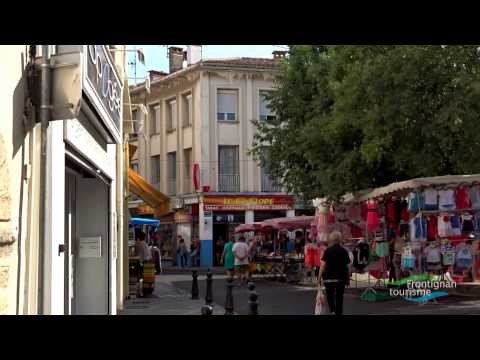 The tourism-office film shifts attention to traditional markets in Frontignan and regional food. Its description points to the Thursday and Saturday markets and the variety of local produce, complementing the beach-focused film with a view of everyday town life. Market hours can change for holidays, so use the current municipal schedule when planning a visit.