Béziers opens onto two horizons. From the old centre, the Gothic outline of Saint-Nazaire watches over the Orb valley; below, the Canal du Midi crosses the plain at the remarkable Fonseranes lock complex. Between them are steep lanes, shaded boulevards, markets and the everyday life of a regional city. The views are memorable, but Béziers is best understood as a place shaped by successive cultures and working landscapes, not as a set of monuments arranged for visitors.
INSEE counted 81,545 municipal residents across the whole commune in 2023; the total including people counted separately was 82,629. Those reference figures took effect on 1 January 2026. Béziers is the principal urban centre of its area, with 42,080 jobs located in the commune in 2023 and 3,530 employer establishments active at the end of 2024. Commerce, transport and services form the largest group, alongside construction, industry, public administration, education and health. That breadth matters to visitors: shops, restaurants, transport and civic services support an inhabited city, not only a seasonal destination.
What archaeology can say about the ancient city
Béziers has an unusually deep past, but the strongest account begins with archaeology rather than a simple foundation legend. A 2026 heritage-planning report, drawing on excavations since 1985, identifies a Greek colony on the Saint-Nazaire and Saint-Jacques hills from around 625–600 BCE, with some earlier estimates near 640 BCE. Defences, a planned street grid, homes, craft workshops and abundant pottery point to an organised settlement connected to Mediterranean exchange. The same report says the city declined in the second half of the fourth century BCE and was abandoned around 300 BCE; the cause is unknown. This evidence supports an ancient Greek urban phase, but not an unbroken line from that settlement to the present city.
Later periods left other traces. Roman-era remains and routes form part of the local archaeological record, while the hilltop became a medieval centre of power. In 1209, during the Albigensian Crusade, crusader forces took Béziers and destroyed the earlier Romanesque church on the cathedral hill. Construction of the present Saint-Nazaire began in 1215. This is a documented rupture in the city’s history, not a colorful origin tale.
A cathedral above the Orb
Saint-Nazaire and Saint-Celse is both a landmark and a viewpoint. Its southern Gothic form has the sturdy outline of a fortified church, reflecting the strategic position on the hill. Inside, fourteenth-century frescoes, a seventeenth-century organ case and an eighteenth-century Baroque choir show how the building changed over time. The unfinished fourteenth-century cloister opens onto the Bishops’ Garden, laid out in the French style at the end of the seventeenth century. Its lower terrace looks toward the Orb, the Pont Vieux and the plain. From below, the river, bridge, cathedral and former episcopal palace explain Béziers’ dramatic topography.
The old centre rewards a slower walk. The visitor route links Pont Vieux and the cathedral by a 650-metre accessible path for pedestrians, cyclists, families with strollers and people with reduced mobility. Allées Paul Riquet and the Plateau des Poètes offer another scale: tree shade, civic landmarks and gardens rather than steep medieval lanes. Les Halles, renovated in 2025 with new producers, bring food shopping back into the centre and make a useful pause between the upper town and the boulevards. Opening days and hours vary, so check the current schedule before planning around a market visit.
The Canal du Midi and the walk to Fonseranes
The Canal du Midi gives Béziers a second defining landscape. The nine-lock site of Fonseranes is an ambitious piece of water engineering that allows boats to negotiate a substantial change in level. The canal was conceived by Pierre-Paul Riquet, a native of the area, and remains both heritage and a working waterway. Along the towpath, its scale becomes clear: stone chambers, water, boats and a long view back toward the cathedral. Nearby, the canal bridge carries the water across the Orb and offers another striking vantage point.
You can reach Fonseranes on foot from Allées Paul Riquet or the railway station by following Quai Port-Neuf and the canal banks; the tourist office also describes routes via the canal bridge and Pont Vieux. A separate 650-metre accessible connection links Pont Vieux to the cathedral, while the full walk between the locks and the upper centre takes longer. The on-demand R2 bus serves the area but must be reserved by 16:00 on the preceding day. Cycling is possible along the canal, although towpath use is subject to the waterway authority’s rules. Check access, bus arrangements and any works before setting out.
Wine, Occitan culture and a living city
Vineyards surround Béziers and have shaped its economy for centuries. Regional tourism sources trace viticulture to antiquity and connect it to Greek-period settlement and later Roman trade; archaeology securely establishes the Greek colony, while the detailed story of early vines belongs to the region’s own historical account. Canal and rail transport helped the city become a major wine-trading centre in the nineteenth century. The wider wine landscape remains part of the visitor experience through producer visits and villages beyond the centre, but the urban economy is much broader. INSEE’s figures show thousands of establishments in commerce and services, construction, industry and public-sector activity.
Language is another part of Béziers’ character. French is used for most municipal and visitor information, and this local edition follows that written public use. Occitan remains visible in local culture: tourism materials introduce Biterrois expressions, while the municipal associations directory lists bilingual Occitan-French schools and language courses. Parlatz besierenc?—“Do you speak Biterrois?”—is more than a decorative motto; it opens a door into the regional language and its echoes in daily speech. The city also lives through rugby, seasonal celebrations, exhibitions and food traditions, not only through its medieval skyline.
Arriving and planning a wider visit
Béziers has a major railway station served by regional liO trains and longer-distance services. TER’s current route planner gives an average journey of about 15 minutes to Narbonne; trains also serve Montpellier and other regional centres. From the station, the canal-bank route offers a direct way to begin on foot or by bicycle, while local buses and a small tourist train provide alternatives. Check timetables and service changes for your travel date.
The city works well as a base for a wider coastal and inland itinerary. To the west, Narbonne is a short train ride; north and east, vineyards, Canal du Midi villages and the Mediterranean shore offer different day trips. Within Béziers itself, leave time for both elevations: the cathedral and old streets above, then the river and locks below. That contrast makes the place memorable—a living Occitan city between stone, water and vines.
 Béziers in three videos: Fonseranes, city life and family discovery
 The Béziers Méditerranée tourism channel presents the destination from its city side: heritage streets, the Orb and Canal du Midi, local food and music. At just over a minute, this is an atmospheric introduction rather than a detailed itinerary. It helps connect the old centre with the wider landscape, while the municipal and tourism pages remain the place to confirm current opening hours, events and practical access.
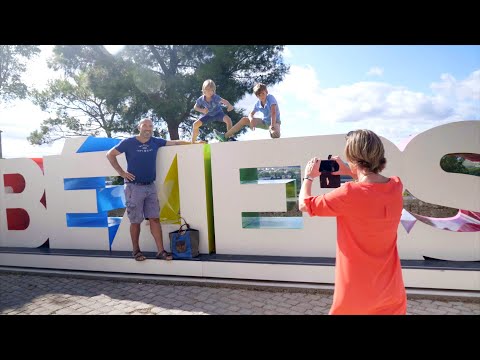 This short tourism film proposes a family day in Béziers’ historic centre, combining heritage with playful activities. Its description refers to local legends, a celebrated camel, former Roman arenas, a treasure hunt and a small tourist train; these are presented as elements of the promotional route, not as independently verified historical claims. The clip can help families consider the format of a visit, but current activities and availability should be checked with the local tourism office.