Compiano is a small walled settlement on a hill above the upper Taro valley, where the outline of the castle still defines the view from the road between Borgo Val di Taro and Bedonia. Its appeal is not a long checklist of monuments. It is the way a compact medieval centre, a fortress with an unusually layered afterlife and a working Apennine landscape remain tied to one another. A visit makes most sense on foot and at an unhurried pace.
A commune larger than its hilltop village
Compiano lies in the province of Parma, in Emilia-Romagna. ISTAT counted 1,048 residents in the whole municipality on 31 December 2024. This is the population of the administrative commune, including its outlying settlements, not a headcount of the handful of streets inside the walls. Isola and Ponte are among the named localities that form part of the wider territory. The distinction matters: the old centre is intimate, while the municipality extends into a landscape of wooded slopes, streams, farms and small communities.
In the upper village, stone lanes bend around the castle and open onto glimpses down the valley. The surviving walls and fortified entrances make the historic centre legible as a defended place, but its scale is human rather than monumental. The castle stands at the top of the settlement; below it, the streets and houses follow the shape of the ridge. Visitors who allow time to walk the whole centre see more than the familiar castle silhouette: changes in level, walls, rooflines and views explain why this was a strategic position.
What the records say about the castle
Compiano’s story should not be embellished with an unsupported Roman foundation. Archaeological work dates the oldest core of the castle to before the year 1000. The castle’s own historical account places it in the hands of the Malaspina in 1141, before its transfer to the municipality of Piacenza and the subsequent feudal arrangements. In 1257 Ubertino Landi acquired Compiano and Bardi, beginning a long Landi dominion in the upper Taro and Ceno valleys. Agostino Landi received the title of sovereign prince of the Holy Roman Empire in 1551. A marriage in 1595 between Maria Landi and Ercole I Grimaldi also connected this history with the ruling house of Monaco.
The setting helps explain the castle’s importance. Regional heritage records describe Compiano as a strategic watch over access to the upper valley and a meeting point between the Via degli Abati, a mountain route associated with Bobbio and the journey south, and routes carrying salt from the Po plain toward the Ligurian coast. The fortress was not only a residence: its position made it part of the political and commercial geography of the Apennines.
After the Landi line ended, the estate passed through other hands and was sold to the Farnese duchy in 1682. Under the Bourbons it served as a military post; after the Restoration it became a state prison, where some Carbonari involved in the 1821 uprisings were held. In 1891 Giuseppe Magnaghi bought the castle for a proposed sanatorium, a project that did not proceed. The building later housed a girls’ boarding school until 1962. Marchesa Lina Raimondi Gambarotta bought it in 1966, restored and furnished rooms for her collection, then left the castle and its contents to the municipality at her death in 1987. These documented changes are more revealing than a romantic legend: Compiano’s fortress repeatedly adapted to new institutions.
Walls, rooms and museum collections
The regional heritage catalogue describes a quadrangular fortress with corner towers, a later outer wall and a semicircular fifteenth-century entrance work known as La Rotonda. A monumental sixteenth-century portal and the central courtyard lead from the severe exterior toward the residential rooms. From outside, look for the contrast between defensive masonry and the more formal entrance; inside, the arrangement shifts again to furnished rooms and collections.
The guided museum visit brings together the Marchesa Gambarotta house-museum, with period furnishings, paintings, tapestries and decorative objects, and the International Masonic Museum, whose collection began with a donation by Compiano-born Flaminio Musa in 2002. Coins associated with the Compiano mint and objects of Eastern art add further threads to the castle’s history. An enogastronomic museum space was added in 2012. The operator currently says that the collections can be visited only with a guide and strongly recommends booking; schedules and the availability of foreign-language tours change, so check before travelling.
A rural economy and a living food culture
Compiano is not a museum village detached from its surroundings. Municipal planning documents recognize agriculture and agritourism among local productive activities, while the valley tourism service presents hiking, cycling, small-scale hospitality and regional food as part of the visitor offer. The Fiera Millenaria di San Terenziano takes place in Isola di Compiano and is traditionally also called the fig fair. The tourism service describes its medieval roots as a religious celebration and an agricultural and livestock market; the name “Millenaria” should not be mistaken for a precise founding date. Its current programme combines religious observances, stalls, food and evening events, with dates to be checked each year.
The wider Alta Valtaro is associated with the Fungo di Borgotaro PGI, a protected product whose geographical specification covers several municipalities, including Compiano. That regional identity is best experienced as a seasonal food culture rather than a claim that every mushroom picked locally carries the designation. The valley’s menus also draw on mountain dairy, chestnuts and other forest products. The castle itself offers accommodation and dining, while the regional visitor portal lists additional places to eat and stay across the valley; confirm which businesses are open during your visit.
Walking and nearby places
Compiano works well as a base for a slow day in the upper valley. A regional walking guide describes a loop beginning and ending in the village, crossing toward Isola and the neighbouring slopes: about 8.2 kilometres with roughly 240 metres of ascent. The guide warns that parts of the route are not marked and require a GPS track, so it is not a walk to improvise in poor weather or without navigation. For an easier visit, remain within the walled centre and use the castle as the anchor for a short circuit through the lanes and viewpoints.
Borgo Val di Taro is the practical rail gateway and a natural companion for its markets and food heritage. Bedonia offers another nearby town centre in the same valley; Albareto and Bardi make sense for a longer road itinerary, with Bardi’s fortress providing a second chapter in the history of the Landi lands. These are separate places rather than extensions of Compiano, so plan transport and opening times individually.
How to arrive and plan the visit
By car, the castle operator directs drivers from the A15 Parma–La Spezia motorway to the Borgotaro exit and onward by the valley roads. At the time of this check, it warns that the SP66 approach from the SP4 side is closed to vehicles and directs visitors via Strela to the free Piazzale Ilaria Alpi car park, about 150 metres from the castle, with spaces for coaches and an electric-vehicle charger. The old centre is pedestrian except for residents, and road conditions can change; check the operator’s current directions rather than relying on an older map.
By train, use Borgo Val di Taro station on the Parma–La Spezia line, then check the TEP timetable for line 2440, which serves Borgotaro station and Compiano Ponte on its route toward Bedonia. The bus stop is not at the hilltop castle, so confirm the last leg and return connection before setting out. Museum visits are guided, and the centre is steep and paved; comfortable shoes and a little extra time make the visit easier.
 Compiano in three videos: castle history, Rai’s visit and a village portrait
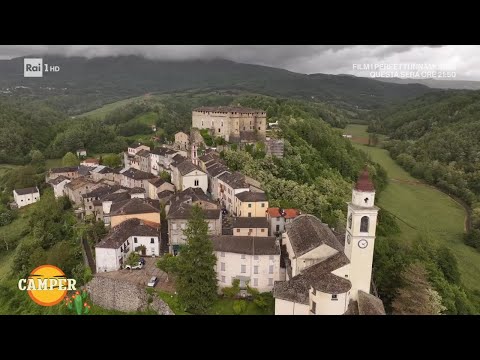 Rai’s four-minute Camper segment, published on 11 June 2025, takes a visitor-oriented view of Compiano. It introduces the castle and the village around it as a stop between Emilia and Liguria, so it offers a concise visual preview of the place rather than a detailed historical account. Use it to picture the setting; check present-day road access and museum hours separately.
 This 98-second video from I Borghi più belli d’Italia offers a brief association portrait of Compiano. It adds a compact destination view to the municipal history film and Rai’s travel feature, but its promotional format is not a practical guide and does not verify current services, opening days or transport.