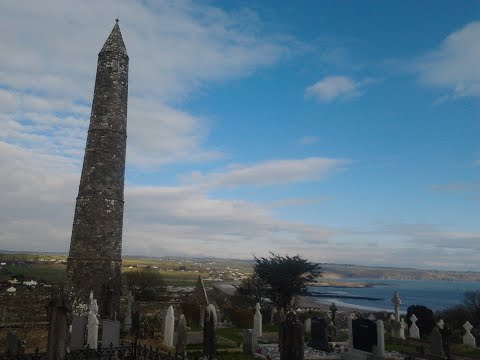
Ardmore curves around a sandy bay in County Waterford, with a monastic site on the higher ground behind the village. Beach, main street and medieval monuments are close enough to form one varied visit, while the coastal path leads into a more exposed landscape. This is Ardmore in Waterford, between the larger regional centres of Cork and Waterford, rather than one of the other Irish or Scottish places sharing the name.
| Residents | 468 |
|---|---|
| Area counted | Ardmore, Co Waterford — census built-up area |
St Declan and the medieval monuments
Ardmore’s religious beginnings are associated with St Declan and an early Christian community traditionally placed in the fifth century. That tradition should be distinguished from the surviving buildings. The cathedral developed in the late twelfth and early thirteenth centuries, while the round tower is a twelfth-century structure about 30 metres high.
Look at the cathedral’s carved arcade as well as the tower. Its biblical scenes include Adam and Eve and the Judgement of Solomon. Ogham stones and medieval grave slabs preserve further evidence of changing use. Romanesque carving belongs to the Middle Ages; it does not mean Ardmore was a Roman-founded town. The oratory associated with Declan also underwent later alteration, including work in 1716. Different dates coexist within the same enclosure.
A visit to the monastic enclosure
The site is an unguided national monument. In November 2026 the Office of Public Works reports conservation work underway, so allow for temporary restrictions and follow the signs on arrival. The churchyard and ruins are not equivalent to a staffed museum with an unrestricted indoor route. Do not assume the tower can be climbed simply because it is well preserved.
The position above the bay helps explain the relationship between religious site and settlement. Spend time on the public approach and views as well as individual carved stones. The village below provides a different perspective, with houses and businesses arranged near the beach rather than within the ecclesiastical enclosure. Combining the two avoids treating Ardmore as just an isolated tower photograph.
Beach, village and cliff scenery
The main beach is an easy way to add time outdoors without leaving the settlement. The cliff walk offers a different experience, with open sea and exposed stretches beyond the sheltered village streets. Wear footwear suited to the path and choose the outing for the conditions, especially when wind or rain makes the headland less comfortable.
The coastal route, monastic site and beach need not all be attempted in one short stop. A slower day can start with the monuments, continue through the village and leave the longer coastal section for a suitable weather window. Youghal and Dungarvan are separate nearby town excursions, useful for a broader visit to the coast rather than substitutes for Ardmore’s own history.
Accommodation and meals in Ardmore
Cliff House Hotel is in Ardmore itself, above the sea, and offers accommodation with several dining settings. Its Oceanfront Restaurant and Bar provides an option distinct from the more formal House restaurant. Choose the venue that matches the occasion and book directly for current menus, access and availability; a hotel reservation does not automatically include every dining experience.
A stay in the village allows the beach and streets to be enjoyed outside the busiest day-trip hours. For visitors arriving without a car, check the walk from the bus stop to the chosen accommodation, since the seafront and higher ground involve different gradients. The presence of a coastal hotel should not be taken as a measure of the availability or cost of ordinary long-term housing.
Connections from Cork and Waterford
Local Link route 361 connects Youghal, Ardmore and Dungarvan. Both ends are useful interchanges for the wider Cork–Waterford coastal corridor, making a complete public-transport itinerary more useful than a simple driving-time estimate. Ardmore has no railway station. The local operator’s current timetable identifies the stops and the services for different days.
Drivers approach the village from the N25 corridor on local roads. Cork and Waterford are relevant larger-city gateways; Dublin is a longer onward journey rather than the natural starting point for every visit. Anyone testing a move here should check an ordinary weekday as well as a summer weekend: access to work and regional services may depend more on the full connection than on the village’s small physical size.