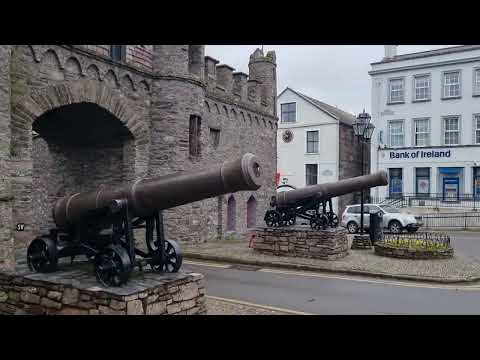
Macroom stands in the Sullane valley west of Cork city, with a broad square, a river crossing and the surviving entrance to its former castle estate. It is a service and market town with a rural hinterland, rather than simply a stopping point on the road to Kerry. Recent bypass construction has changed the way through traffic moves, while the centre remains a place for shopping, meals and a town walk. Nearby woodland and river landscapes give scope for separate outings beyond the streets.
| Residents | 4,096 |
|---|---|
| Area counted | Macroom, Co Cork — census built-up area |
A settlement around river and castle
Macroom grew beside the Sullane in the historic territory of Muskerry. Medieval castle traditions and the later influence of the MacCarthy family place it within a landscape of local lordship, agriculture and river crossings. The present town did not arise as a Roman or Greek foundation; its visible development belongs to several phases of medieval and later Irish history.
The castle site attracted successive owners and rebuilding, while the settlement developed around it. By the nineteenth century, the residence incorporated older defensive fabric within a more modern mansion. The relationship between square, estate entrance and river remains legible even though most of the house has gone. It is more revealing to follow that changing use than to assign one construction date to everything still called Macroom Castle.
War, fire and the surviving gateway
The castle experienced repeated damage during the seventeenth century and another destructive fire during the Civil War in 1922. The remaining unsafe main structure was demolished in 1967. The architectural inventory records the surviving remains as part of a country house, with older towers absorbed into the later design.
Today the gateway is the most recognisable public landmark. It should not be advertised as an intact castle museum offering rooms to tour. The former demesne acquired new recreational and educational uses, changing the relationship between the estate and the town. Looking through the entrance and following the public approaches gives a sense of this transition from private residence to spaces associated with local daily life.
The square and a town with a hinterland
The town centre is a useful place to spend time before heading towards the countryside. Shopfronts, cafés and the square express Macroom’s role as a commercial centre for the Sullane valley. The business association’s directory includes hospitality, shops and professional services as well as visitor activities, indicating a broader economy than seasonal sightseeing alone.
The Lee valley’s food businesses and nearby rural attractions offer possibilities for a longer stay. Keep their locations distinct: a brewery, forest park or visitor workshop advertised under the Macroom area may lie outside the town. Choosing one planned excursion leaves time to return for a meal and explore the centre, instead of making the village name a label for a long driving itinerary through West Cork.
The Gearagh outside Macroom
The Gearagh Nature Reserve protects an unusual alluvial woodland landscape south-west of town. Narrow channels divide islands carrying trees including oak, ash, hazel and hawthorn. The National Parks and Wildlife Service gives the reserve’s area as 300 hectares and records its establishment in 1987. That is a protected-area measurement, not the size of Macroom.
The water landscape is part of its interest and also limits access. The wildlife service notes frequent flooding and difficult or dangerous conditions within the reserve. Use recognised approaches and viewpoints rather than trying to enter channels or cross islands. A look at this riverine environment provides a strong contrast with the urban Sullane frontage, but it deserves its own planning and suitable conditions.
A stay and a meal in the centre
Castle Hotel Macroom stands on Main Street and offers accommodation in the town itself. Its B’s Restaurant and Dan Buckley’s Bar provide different dining settings within the same property. The hotel describes an emphasis on local producers, with menus and arrangements published directly by the business.
This central position is useful for visitors who want to walk to shops and return after dinner without a rural driving stage. Check the precise restaurant service for a particular booking, rather than assuming bar dining and a restaurant reservation are interchangeable. Someone considering a longer stay can also use the centre as a starting point for testing access to the bus, groceries and everyday services before comparing properties further out in the valley.
Cork, Killarney and the bypass
The N22 corridor connects the Cork and Kerry regions. Macroom’s bypass opened in stages from December 2022, changing the route taken by traffic that previously passed through the centre. The first stage connected Coolcour and Carrigaphooca, with a further opening towards Toonlane in August 2023. Use the signed town access when planning a stop rather than following an older description of through traffic on Main Street.
Bus Éireann route 40 is the operator’s corridor to check for travel between Cork, Macroom and Killarney. Macroom has no operating railway station, so a public-transport plan needs an onward bus stage from a larger centre. The 2022 census counted 4,096 residents in the built-up area. A visit on an ordinary working day helps show how this resident community uses the town, alongside visitors heading towards the lakes and mountains further west.
Sources
- Macroom Business Association: town development and local history
- National Inventory of Architectural Heritage: surviving castle residence
- University of Galway Landed Estates database: Macroom Castle
- Macroom Business Association: services and visitor businesses
- National Parks and Wildlife Service: The Gearagh
- Castle Hotel Macroom: B’s Restaurant and Dan Buckley’s Bar
- Cork National Roads Office: N22 construction and staged openings
- Bus Éireann: route 40
- Central Statistics Office: Census 2022 population, built-up areas