Andlau occupies the meeting point between the Vosges foothills and the Alsace wine-growing plain. The river that runs through the valley gives the town its name; vineyards climb the sunny slopes while woodland rises behind the rooftops. Barr, the nearest larger town, is about three kilometres away. Andlau is small enough to cross on foot, but its streets belong to a living community of residents, winemakers, shops and local services, not to a museum set.
INSEE counted 1,757 municipal residents in the whole commune in 2023. These reference figures took effect on 1 January 2026; they describe the commune, not just the old centre. A visitor can read several layers of local life in a short walk: a powerful medieval abbey, a Renaissance residence, timber-framed houses, working vineyards and forest routes leading to two castle ruins.
An abbey at the heart of the town
Andlau’s best-known origin story begins with Richarde, wife of the Carolingian ruler Charles the Fat, who founded a women’s abbey here in 879 or 880. Archaeology gives that account a firmer footing: a preventive excavation south of the abbey church found remains of an initial building from the late ninth century. Later, from the second half of the twelfth century, a larger convent complex grew around a cloister. Excavators identified at least four rooms; a large southern hall may have been a refectory, and a room with a built hearth probably served as a kitchen. The abbey was rebuilt and reshaped over centuries, before its enclosure and property were dismantled during the Revolution.
The bear that appears throughout Andlau belongs to a different register. Local legend says an animal showed Richarde where to establish the monastery. The story explains the bear’s place in the town’s imagery, but it is not a documented account of the foundation. There is, however, a real sandstone bear in the church crypt, a medieval object that helps explain why the legend still feels present in the town.
The church, now dedicated to Saints Peter and Paul and also known as the abbey church of Sainte-Richarde, rewards a slow visit. Pope Leo IX consecrated it in 1049. Look around the exterior for the Romanesque porch and its long carved narrative frieze; the eleventh-century crypt offers a cooler, more intimate space beneath the main building. A fifteenth- or sixteenth-century Virgin and a pulpit dated 1703 show how the church continued to change. Entry is listed as free and self-guided; group visits can be arranged by appointment, so check access before travelling.
From medieval streets to a Renaissance residence
Start near the town hall and follow the marked circuit of the old walls. Explanatory panels help make sense of a settlement that grew around the abbey and later lived alongside the lords who took the town’s name. The route also passes timber-framed and stone houses, the witch tower in Parc Richmond, Sainte-Richarde’s house and fountain, and Saint-André chapel. A short riverside path follows the Andlau; the municipality also describes a grotto trail. A free visitor map is available locally.
On Place de la Mairie, La Seigneurie combines a striking building with a useful introduction to the wider region. The residence was built in 1582–83 by a member of the Andlau family, although the individual patron has not been identified with certainty. Its Renaissance gables and polygonal stair turret are visible reminders of the family’s status. Today the building houses a 700-square-metre heritage interpretation centre. Its permanent displays use models and interactive exhibits to explain local architecture, religious art, winegrowing, crafts and the landscape of the Pays de Barr. A redesigned visit opened in 2023. It is a practical first stop before exploring the monuments outdoors; opening days and admission arrangements change, so verify them in advance.
Vineyards, work and everyday services
Wine is part of Andlau’s scenery and economy, but the town’s own history is careful about its earliest beginnings. Roman-era cultivation is possible, not established; the municipality says the south-facing slopes are certainly under vine from the seventh century. Eleventh-century writing praises the local terroir, and the abbeys of Andlau and Altorf developed viticulture and trade in the sixteenth century. Physician and local resident Jean-Louis Stoltz published his Ampélographie Rhénane in 1852, a work that helped classify Alsace’s wine-growing sites. Three Grand Cru vineyards lie within the commune: Kastelberg, Moenchberg and Wiebelsberg. They differ in geology and exposure, and Riesling is prominent, alongside Pinot Gris, Gewurztraminer and Muscat in some parcels. These are working vineyards: stay on paths, watch for farm vehicles and do not pick grapes. Local cellars welcome visitors, but arranging a tasting ahead is sensible.
The local economy is broader than wine and tourism. INSEE recorded 160 economically active establishments in 2023, including businesses in commerce, transport, accommodation and food, construction, specialist services, public administration, education, health, manufacturing and other services. For visitors, the municipal directory lists a small grocery, bakery, butcher, pharmacy, restaurants and winegrowers. A weekly market takes place at Parc Richmond on Thursdays from 16:00 to 19:00 according to the town’s current listing. This practical scale makes Andlau a useful base for a countryside stay rather than only a brief photo stop.
Castles, forests and routes through Alsace
Above the vineyards, Haut-Andlau and Spesbourg turn a town visit into a half-day walk. The first written mention of Haut-Andlau dates to 1274; historians place its construction around 1250–64. It is known for its twin towers framing the residential block. Spesbourg is another medieval fortress in the surrounding forest. The town describes an approach of roughly an hour and a half on foot from Andlau, by the Crax pass and Kastelberg or by the castle road. A shorter approach begins at the Hungerplatz car park and follows marked forest paths for about twenty minutes. Ruins are uneven and exposed: follow signs, keep away from unstable masonry and check local notices for closures or restoration work.
Andlau also sits on the Alsace Wine Route, the vineyard cycle route and EuroVelo 5; long-distance walkers can connect with the GR 5 and the Alsatian section of the Camino de Santiago. The nearest railway station is Eichhoffen, on the Strasbourg–Obernai–Barr–Sélestat line. La Seigneurie is 3.1 kilometres from the station; its visitor information estimates about 35 minutes on foot or 10 minutes by bicycle. From Strasbourg, take a regional train towards Obernai and Barr, then plan the final leg from Eichhoffen. Services vary by day, so confirm train times and onward connections before setting out. Barr, Mittelbergheim, Itterswiller and the wider vineyards offer natural extensions to the visit.
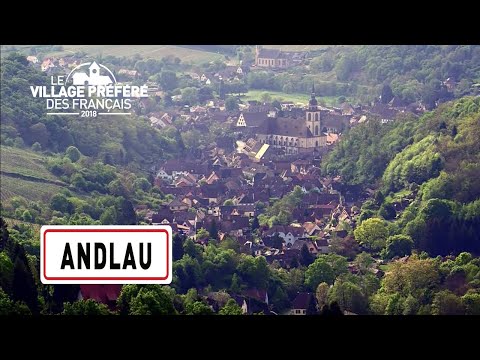 Andlau in three videos: village, castle and heritage centre
 Skypic identifies this short film as a production for the Amis du Château d’Andlau association. It focuses on Haut-Andlau, whose twin towers and forest setting make it a defining landmark above the vineyards. The film is useful for appreciating the ruin as a place, but it does not replace current route or safety information: access is on foot, conditions can change, and visitors should follow local signs.
 The Pays de Barr tourism channel introduces the heritage centre in the Renaissance building now called La Seigneurie. Its description highlights the permanent 700-square-metre exhibition on architecture, viticulture and crafts. The video uses the institution’s former name, Les Ateliers de la Seigneurie, because it predates the 2023 renewal; visitors should use the current official site for opening times and bookings.