
Vingåker is best understood as a working Sörmland town whose story has always reached beyond its shopfronts. A railway station, the grounds of Säfstaholm Castle and a trail of red story posts sit within an everyday center that visitors can cross on foot. The town's most distinctive theme is clothing: not a costume preserved behind glass alone, but a way to follow local identity from farm life into factory work and modern retail.
Population figures depend on the boundary used. Statistics Sweden (SCB) counted 4,514 registered residents in the Vingåker statistical locality for 2023, with a reference date of 31 December 2023. SCB's tätort means a continuous, closely built-up area with at least 200 registered residents. It is not the same area as Vingåker Municipality, which includes countryside and other settlements. The number here therefore describes the statistical town locality, not the whole municipality.
The documented visitor story gathers several periods rather than turning them into a single legend. Vingåker's traditional folk costume is part of a wider rural heritage; the municipality and Sörmlands Museum trace a later local clothing industry and its twentieth-century garment manufacture. Today, the Factory Outlet keeps clothing retail visible in the town's economy. Twenty-three red posts around Vingåker make this sequence tangible, with stories about dress, bodies, workers, production, commerce and changing ideals. They offer a thoughtful alternative to a conventional monument walk: each stop asks what clothing reveals about the society that made and wore it.
Säfstaholm Castle adds a different kind of history. A timber main building stood on the site in 1620, and a stone castle followed. The estate's prominent period began when Gustaf Trolle-Bonde inherited it in 1791. He reshaped the house and its setting, commissioning a Neoclassical transformation and an English-style landscape park. A celebrated private art collection grew at Säfstaholm, but the estate was sold in 1913 and its interiors and collection were dispersed. The municipality now owns and runs the castle. Restoration returned it to public use in 2020; exhibitions and opening arrangements change, so a visit is best planned from the current visitor information.
The park is an inviting bridge between the castle and the town. Its ponds, broad lawns and winding paths were designed to feel like a natural landscape rather than a formal garden. Take a slow circuit before following the red posts through the center, or continue to Västra Vingåkers Church, whose origins reach back to the fourteenth century. The local-history museum in Västra Vingåker displays traditional costumes, furniture and workshops connected with rope-making and shoemaking; its opening times should be checked in advance.
For an easy walk, Hälsans Stig is a seven-kilometre loop without a prescribed start or finish. Distance signs appear at each kilometre, so the route can be shortened or joined where convenient. Maps are available from the library, the castle and the Factory Outlet. The 23-post clothing trail is another way to explore the town at a flexible pace. Elsewhere in the municipality, Bäverstigen by Läppe and the Grävsjön loop at Högsjö offer separate outings; they are not extensions of the town-centre walk and need their own travel plan.
Vingåker suits visitors who like modest-scale places with a clear local subject and room to wander. The station and shops make practical arrival points; the castle serves as the municipal visitor-information address, while the library is another map pick-up point. Confirm train and bus times, castle exhibitions, museum access and trail conditions before setting out, since timetables and seasonal arrangements can change.
 Vingåker on film: station, folk costume and local history
 The Konfektionsmuseum channel's “Vingåkersdräkten förr och nu” is specifically about the Vingåker folk costume past and present. The checked title makes it relevant to the town's distinctive clothing heritage. The metadata does not provide further reliable detail about particular exhibits or dates, so this note stays with the verified subject.
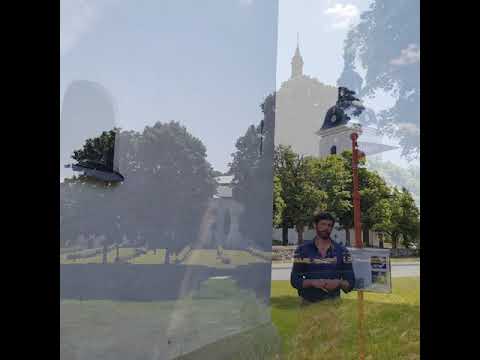 Sörmlands Museum's short “Historien i Sörmland – Introduktion till Vingåker” is introduced by antiquarian Rikard Borg. The museum describes the local clothing, body and garment-industry story and the 23 red interpretive posts around town. It is a concise orientation to the theme behind the walking route.