Vénéjan sits above the Rhône plain in the Gard, with a historic core that climbs from the lower village toward a castle, chapels and a restored windmill. It is a small municipality rather than only the hilltop: INSEE counted 1,260 residents across the commune in 2023 and a density of 67.9 people per square kilometre. The elevated lanes look toward a landscape shaped by river, vineyards and the neighboring towns of Bagnols-sur-Cèze and Pont-Saint-Esprit. The appeal is not a single monument but the way the village’s working history and walking routes meet on the hillside.
What the old stories can and cannot establish
Vénéjan’s municipal history begins with a place called Veneianum, described as a Gallo-Roman domain near the Rhône, followed by a move to the hill of Lombrun. That is a local account, but the page does not provide an excavation report or dated finds to substantiate a continuous Roman settlement. Sources also differ by about a century on the first fortified site: the Gard tourism office places one in the tenth century, while the municipal page calls the first hilltop castrum eleventh-century. It is more careful to present those as local historical interpretations than to turn them into a precise foundation date.
The castle’s later chronology is clearer in the visitor record. Gard Tourism says Pierre de Béziers began its construction in 1290 and that it was remodeled in Renaissance style in the seventeenth century. The castle and the medieval tower are prominent parts of the skyline, although access and opening arrangements should be checked locally. The town also stood on an older route between Saint-Saturnin-du-Port, now Pont-Saint-Esprit, and Bagnols-sur-Cèze; that position helps explain why the perched site looks over a corridor rather than an isolated valley.
A small chapel with a remarkable painted interior
Saint-Jean-Baptiste is one of the most rewarding stops. Tourism records describe Romanesque forms from the twelfth century and foundations reaching into the eleventh; the chapel was left behind when a new parish church took over at the end of the seventeenth century. It was rediscovered in the nineteenth century, entered the supplementary inventory of historic monuments in 1986, and was restored before opening to visitors. Its fourteenth-century wall paintings include a Christ in Majesty, Saint Christopher and a Wheel of Fortune, according to the municipality. The art matters as much as the building: it preserves a rare, local layer of religious imagery rather than a generic medieval interior.
The village’s old houses add smaller clues. Gard Tourism notes a decorative fishbone-pattern frieze repeated in parts of the former ramparts. The clock tower dates to 1843. A local municipal history also mentions a cemetery chapel of Saint-Pierre, but the accessible visitor listings focus on Saint-Jean-Baptiste; confirm access before seeking less-documented sites.
The windmill and the hillside walk
The windmill is a second landmark and a record of practical work. Built in 1813 at the request of Joseph Dumas, a miller from Bagnols-sur-Cèze, it operated for about a century. Its timber interior and roof structure have been restored; tourism information says visits can be arranged through the mairie, and demonstrations depend on the association and the wind. This is not simply a scenic prop: the mill served the surrounding farms, and its restoration keeps a piece of local production history visible.
For an introduction to the village, “Le Souffle des mots” follows a marked interpretation route. The visitor map describes an easy loop of about 1.3 kilometres and one hour, starting at the lower village parking area. It climbs the Grand Rue, passes the washhouse, church, clock tower, chapel, old keep and mill, then descends through narrow lanes. The route includes steps, rising sections and stretches that are not pedestrian-only; use the map, watch children near traffic and check present conditions. Longer hiking and cycling loops explore the Rhône valley, including a 24-kilometre out-and-back cycle route between Pont-Saint-Esprit and Codolet that passes Vénéjan.
Wine, artisans and everyday services
The landscape also supports a living agricultural economy. INSEE recorded 186 jobs located in the commune in 2023. At the end of 2024 it counted 29 employer establishments active during the final week of December; agriculture, forestry and fishing made up 31 percent, while commerce, transport and other services represented 37.9 percent. These are shares within a specific employer-based statistical field, not a count of every self-employed worker or all local livelihoods.
On the ground, the municipal directory lists artisans and trades, agricultural and landscaping work, food shops, restaurants, a pizzeria and a local winery. Domaine de Belle Feuille says it has been based in Vénéjan since 1974 and produces Côtes du Rhône, Côtes du Rhône Villages and Chusclan wines. Gard Tourism notes that several local cellars receive visitors. For travelers, the town’s directory also lists accommodation and health services; check current opening hours, wine-tasting arrangements and restaurant service directly before relying on them.
The postwar landscape widened further when the CEA site at nearby Marcoule opened in 1955. The municipality connects Vénéjan’s faster growth after the war to work on the Rhône and the arrival of that major employer in the region. Marcoule is now a scientific and industrial site rather than a visitor attraction, but it helps explain why the surrounding communities grew beyond their older farming base.
How to arrive and plan a day
Vénéjan is close to Bagnols-sur-Cèze and Pont-Saint-Esprit, but the final approach matters for visitors without a car. The official Occitanie listing identifies the nearest liO bus stop as Saint-Nazaire – Cité du Bosquet, approximately 3.16 kilometres or 37 minutes on foot from the village. It is served by routes between Pont-Saint-Esprit and Nîmes, and Pont-Saint-Esprit and Avignon. That last walking connection is substantial and may not suit every traveler; check the current liO timetable, exact stop and route conditions before setting out. By car, follow current navigation from Bagnols-sur-Cèze or Pont-Saint-Esprit rather than relying on historical route descriptions.
A good visit can combine the interpretation walk, the chapel and the windmill, then continue to a winery or a longer Rhône-valley cycle route. Vénéjan’s calendar includes community events such as the windmill day and VénéJazz, but dates and access vary from year to year. Check the current municipal agenda before planning around an event. The village rewards a little time on foot: its steep lanes make the old settlement legible, while the vineyards and nearby towns show how closely its present life is tied to the wider Rhône corridor.
 Vénéjan in three films: village heritage, a hillside walk and local views
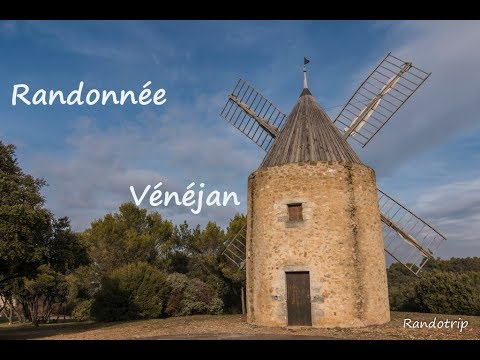 Rando Trip follows a hike through the Rhône hills around Vénéjan, passing the old village and referring to nearby heritage such as the clock tower and Saint-Jean-Baptiste chapel. The film also places the walk in a broader landscape with other ruins; it is not a complete, current trail guide. Check route markings, weather, access and walking conditions locally before following any section shown.
 The title identifies this recent upload as a Vénéjan photo clip, but its available metadata gives no detailed description. This review therefore treats it only as a brief audiovisual item associated with the village and makes no claims about particular scenes, monuments or services. Use it as a possible visual first impression, then rely on official local information for opening times and practical visit details.