Trogen sits at about 903 metres above sea level on the northern slope of the Gäbris, looking across the hills of Appenzell Ausserrhoden. The municipality recorded 1,954 residents on 31 December 2025; a further 57 people with weekly residence were listed separately and are not included in that total. The compact centre feels unusually civic for a village: a broad square, a baroque church and stone town houses recall an era when Trogen held the public institutions of the canton. Around them, farms, wooded slopes and small neighbourhoods retain a rural scale. That blend of village life and formal architecture is what makes Trogen worth a slower visit.
From an Appenzell assembly town to a textile centre
The municipality dates the first written mention of Trogen to 1168, when it appeared as “de Trugin.” Its explanation links the name to a group of houses around troughs or fountains; this is a local etymological interpretation, not a documented founding legend. After Appenzell Ausserrhoden and Innerrhoden separated in 1597, Trogen became the meeting place of the first Landsgemeinde and the historic centre of the outer canton. The textile-trading Zellweger families then shaped both its economy and its appearance. Their linen and cotton trade connected the village to international markets, and their eighteenth- and early nineteenth-century stone palaces still line the Landsgemeindeplatz. The Grubenmann church, completed in 1782, anchors the other side of the square. The Zellwegers also founded the cantonal school in 1821. Government functions gradually shifted toward Herisau from the nineteenth century onward, but Trogen remains a historic seat: courts, the cantonal school and the cantonal library still have a presence here. The contrast between a grand public square and a small community is not decorative; it records how trade and civic government made this hillside village influential.
A square to explore, not just photograph
Begin at the Landsgemeindeplatz and take time to look at the different palaces rather than treating them as one façade. The public “Century of the Zellwegers” audio trail uses sound, text and images to explain the family’s role and the buildings around the square. It can be followed independently, and guided visits are available for groups. The square and its church also reveal the architectural character of the Appenzell region: formal stone houses stand beside more modest farm, artisan and factory-owner homes in the surrounding lanes. Interior access varies, so check which buildings are open on the day you visit.
The Pestalozzi village and the surrounding hills
Above the centre, the Pestalozzi Children’s Village was created in 1946 on the initiative of Walter Robert Corti to offer a home and education to children orphaned by war. It is still an active educational foundation, with a visitor centre and exhibition that explain its history and work; its grounds and access arrangements are published by the foundation. The signposted walk from Trogen station takes about ten minutes. For a longer outing, the municipality lists a route from Trogen via the Pestalozzi village and Hohe Buche to Speicher, as well as hill walks toward the Wissegg and the Goldach watershed. These routes open views across the Appenzell hills and, in clear conditions, toward Lake Constance and the Alpstein. Weather and path surfaces matter, especially in winter.
Food, services and arrival
Trogen’s employment today is concentrated in services, including the courts and education; its outlying hamlets remain agricultural, and local shops and a post office cover everyday needs. Several inns and restaurants give visitors options around the centre, though opening days can vary. The Appenzeller Bahnen S21 links Trogen directly with St. Gallen and continues through the Appenzell region. From the station, the historic square and the Pestalozzi village are reached on foot. Trogen also makes a natural pairing with nearby Speicher or a wider Appenzell itinerary; the Grubenmann Museum in Teufen is another regional cultural stop. Check current rail schedules, guided-tour bookings, visitor-centre hours and trail conditions before travelling.
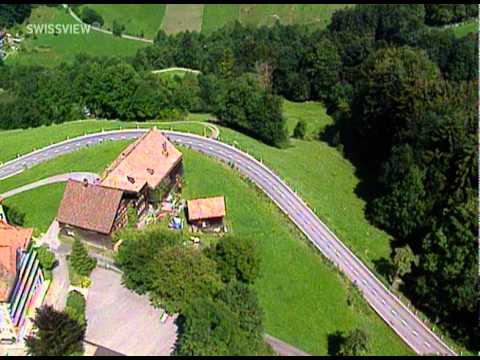 Trogen in three views: village, civic square and Pestalozzi village
 The Canton Appenzell Ausserrhoden film records the inauguration of the redesigned Landsgemeindeplatz on 25 June 2021. This is the most place-specific historical record in the selection: it captures a civic event connected with the square’s renewal. It documents that ceremony, not today’s event calendar or building access. The town’s square remains a public space, while current programmes and any interior visits should be verified with local organisers.
 The video by gsksshassas is specifically about the Pestalozzi Children’s Village in Trogen. It adds an educational and social institution to the architectural views of the village, whose identity today includes the foundation as well as the former cantonal seat and textile centre. Treat the film as an introduction, not a current visitor notice; the foundation publishes up-to-date visitor-centre hours, exhibition details and access guidance.