Lichtensteig rises above the Thur in the Toggenburg, a compact town whose medieval lanes still serve as part of everyday life. The Canton of St. Gallen counted 2,157 permanent residents in 2025. Its appeal lies in the contrast between a carefully preserved old town and a present-day cultural scene that has taken shape in former commercial and civic buildings. Visitors can spend a few hours following the arcades and town walls, or use the centre as a starting point for museums, the wooded Äulischlucht gorge and walks along the river.
A market town with a long civic record
The municipality’s historical account records Lichtensteig in 1228 as a fortified place belonging to the Counts of Toggenburg. In 1400, when the settlement had fewer than 400 inhabitants, its residents received town rights that included local administration, markets and courts. A world chronicle was produced here in 1411 for Count Friedrich VII; it was once commonly called the Toggenburg Bible. From 1468, Lichtensteig served for about 330 years as an administrative seat in the lands of the Abbey of St. Gall. The old town’s arcaded main street and tightly grouped houses still make sense as the setting of a regional market centre. The historical record also names Jost Bürgi, born here in 1552, as an influential early modern mathematician, astronomer and maker of scientific instruments. His work is substantial enough without reducing it to the oversimplified claim that one person “invented” the second or logarithms.
Architecture, museums and a living cultural quarter
Start beneath the arcades of the Hauptgasse and turn into the narrower side lanes. The old town hall on Hintergasse preserves a late Gothic council chamber; a municipal walking guide dates its structural timbers to the winters of 1410 and 1412. The Toggenburg Museum introduces the history and culture of the surrounding valley, while the Gall’sche Offizin demonstrates hand typesetting and printing. Fredy’s mechanical music museum focuses on music machines, and the Erlebniswelt Toggenburg brings together a large model railway and collections of regional technology and transport. These are distinct stops rather than one all-purpose museum, so check each venue’s opening days and booking requirements. Trade and textile work once supported the town’s prosperity; today the local confectioner Kägi still makes its wafers in Lichtensteig, while former commercial spaces host creative work, events and shared uses. The town’s historic Rathaus is one of those active cultural places. Lichtensteig received the Swiss Heritage Society’s Wakker Prize in 2023 for its work to revive the old town and reuse vacant buildings; the award recognised a continuing process, not a claim that all vacancies have disappeared.
From the Thur to the Äulischlucht
Below the centre, the Thur cuts through the Äulischlucht, where the municipality describes narrow rock walls, forest, a waterfall, gravel banks, viewpoints, fire areas and places to bathe. It offers a very different landscape from the stone lanes above and can be part of a longer day outdoors. Local storytelling includes the legend of the “Äuli dog” guarding a hidden treasure; it is folklore, not a historical account, and the town itself presents it as a tale. The river and wooded paths make the gorge attractive for a family outing, but water levels, footing and access can change; check local advice and take care near the water.
Getting there and planning a visit
Lichtensteig has its own railway station on the St. Gallen–Herisau–Toggenburg corridor, with connections through Wil and Wattwil. From the station, the old town is walkable; buses link nearby communities and visitor sites. Guided historic walks are available in English as well as German, and the municipal programme also offers themes around Jost Bürgi, churches and the town’s recent renewal. Cafés, shops and cultural venues cluster in the compact centre, while the broader Toggenburg valley provides additional hiking and village excursions. Check current rail and bus times, museum hours, tour availability and gorge conditions before travelling.
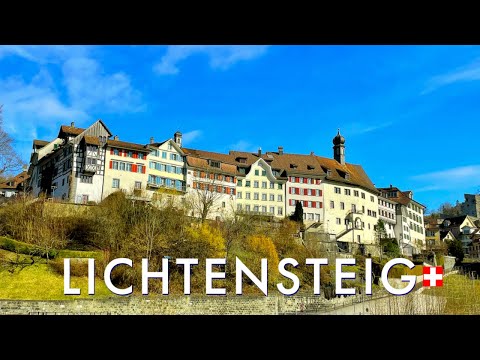 Lichtensteig on foot and across the Toggenburg
 Travel all over Europe offers another 4K walk through Lichtensteig, this time with a slower, atmospheric presentation of the medieval-looking centre. It complements the first film by giving a different visual pace and perspective, while remaining an informal recording rather than an official itinerary. The title uses promotional language; viewers should rely on historical sources, not the title, for claims about age or rank. Check current paths and access before following a route on screen.
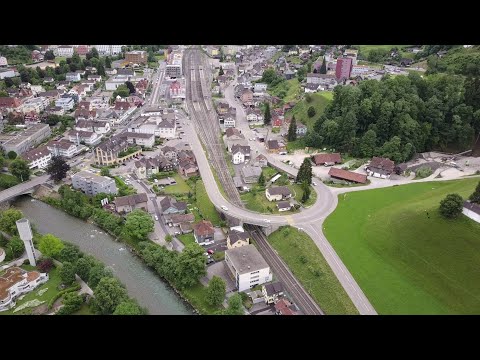 Stefan Meier’s video pairs Wattwil and Lichtensteig in the Toggenburg. This broader framing helps place the small historic town in its regional context rather than treating it as an isolated monument. The film may be useful for previewing the landscape and nearby settlements, but it does not provide a live rail schedule or comprehensive visitor information. Use current transport timetables and municipal sources to plan a trip between the towns.