Trieux sits in Meurthe-et-Moselle, within the urban unit of Tucquegnieux and the French part of Luxembourg’s wider attraction area. It is not simply a “mining village” frozen in the past: the old settlement, the mining-era neighbourhoods and today’s community life form different layers of one commune. INSEE counted 2,753 municipal residents across the whole commune in 2023, with a density of 319.4 people per square kilometre. The same release records average annual growth of 1.2% between 2017 and 2023, a recent change that should not be confused with the much older mining boom.
The local history circle reproduces the wording of a charter dated 21 May 1095, in which the fields of Troieul are named among lands granted for the foundation of Saint-Pierremont Abbey. The name changed form over the centuries, according to that account. The Ministry of Culture’s heritage record gives a separate, more specific sequence for the Grange du Sart: the farm is mentioned in 1258, and the abbey built a pavilion there in 1601. Its doorway is now the protected part of the former estate, registered as a historic monument in 1998. The site lies at the Sart; do not assume that the property is open for visits.
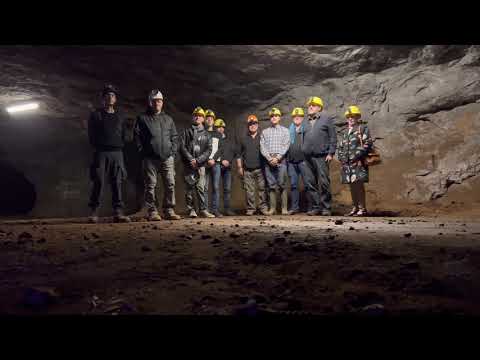
The industrial chapter reshaped the settlement. The Sancy iron mine opened in 1903 and closed in 1968, according to the municipal planning report. The local history circle describes how mine housing, schools and civic buildings followed the growth of the workforce. In October 1963, miners occupied underground workings for 79 days to oppose a plan that would remove half the jobs. Two separately uploaded videos document that episode and its commemoration; their metadata and descriptions, rather than unverified scene-by-scene assumptions, are the basis for the video notes below. The history remains a local memory, not an active industrial attraction.
Saint-Martin church offers a more visible heritage stop. The present nave was rebuilt in 1822 and its tower in 1851, replacing a late-fifteenth-century church, according to the municipal history circle. Inside, the Ministry of Culture records a retable with four statuettes of the Evangelists: the retable probably dates to 1482–83, the statuettes to the seventeenth century, and the work was classified in 1960. Check with the mairie or parish before planning an interior visit. Another listed trace of older rural life is the Grange du Sart doorway; respect private property and view it only from a public way.
Nature conservation adds a distinct contemporary story. North of the commune, the Prairettes valley contains more than 25 hectares of wet and dry meadows, a small marsh and hedgerows. The municipality reports over 250 animal and plant species, including frog orchid and marsh fritillary, and a twenty-year management agreement with the Conservatoire d’espaces naturels de Lorraine signed in February 2026. This is a protected habitat, not a promise of free access; ask whether a guided outing is scheduled rather than entering sensitive ground independently.
For a walk, municipal minutes from 2023 record support for rural-path sections between Trieux and Sancy and along the Chemin de la Clitte in the departmental walking-route plan. That record confirms paths and a planning decision, but it is not a fresh condition report or a complete route sheet. Ask the mairie for a current map, access advice and seasonal hunting notices before setting out. The town’s calendar and monthly bulletin are the best starting points for local events. INSEE’s end-of-2024 count lists 43 employer establishments in a defined scope: 27 in commerce, transport and varied services, six in construction, five in industry and five in public administration, education, health or social action. These figures describe establishments, not every job or household activity.