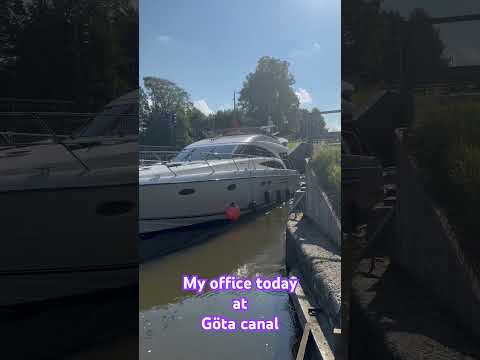
Töreboda is a working Swedish town with an unusual centrepiece: the Göta Canal and the west main railway meet here, cutting through the same streetscape. A canal boat moves slowly below the fast trains, and a hand-pulled ferry links the two sides of town in season. Statistics Sweden counted 4,731 residents in the mapped urban locality (tätort) of Töreboda on 31 December 2023. That is the built-up town, not the whole municipality, and the locality covered 440 hectares of land.
A town shaped by two transport routes
The canal came first. Work on the Göta Canal began in 1810 under Baltzar von Platen, and the full waterway between Sjötorp by Lake Vänern and Mem by the Baltic was inaugurated in 1832. At that time, the railway had not yet reached Töreboda. The West Main Line arrived in 1859 and crossed the canal, creating a rare point where boats, rail freight and road traffic shared a compact space.
Göta Canal’s historical guide describes Töreboda as a sparsely settled farming area before the railway, then a transfer and trading centre where cargo could move between ship and train. Warehouses and the substantial red-brick station building preserve traces of that period. The canal company calls Töreboda the “knot” joining Sweden’s blue waterway and black railway line: a vivid historical nickname, not a formal title. The town’s modern shape grew from this documented infrastructure and the businesses that gathered around it.
One personal story belongs to the canal’s everyday history. In 1919, retired locomotive driver Oskar Lindhult began ferrying people across in a small rowing boat, charging five öre for a crossing. Residents on the far bank had faced a longer detour to reach work and services. Töreboda’s municipal community took over the service in the 1940s. The present Lina is still pulled by hand on a rope; the short crossing takes about 20–25 seconds. The ferry operates seasonally, with a fixed pedestrian and cycle bridge in winter. These dates are recorded in the canal company’s history; they are more useful than an embellished origin tale.
Canal life in the town
The canal is not a museum piece. Leisure craft and passenger boats still pass between its banks, while the central guest harbour puts moorings close to shops, cafés and other services. From the towpath, visitors can watch bridge openings, walk beneath the railway crossing and see how a working transport corridor shares space with a public promenade. There is enough room for a short look around the harbour or a longer walk beside the water.
For a longer route, the official Göta Canal trail’s first stage runs from Sjötorp to Töreboda along the gravel towpath. It passes Lyrestad, Norrkvarn and Hajstorp before ending by the Lina ferry. Hajstorp lies roughly four to five kilometres west of town on the route. Its paired locks, former canal workshops and old service buildings make a worthwhile extension; the canal guide documents the site’s role in maintaining the waterway. Tåtorp and Jonsboda offer quieter canal stops farther east. Choose a section to suit your time and check current maps, surfaces, boat movements and seasonal services before setting off.
Nature is close to the centre, too. Borreboda Dammar is a municipal wetland area known for birdlife, with migrating birds resting there in spring and autumn. Across the wider municipality, the landscape shifts between open Vadsbo farmland, lakes, woodland and protected wetland. The municipality lists six nature reserves, each with its own conservation rules; check the reserve information before visiting. The canal itself is also a place to slow down and observe the changing light and boat traffic, not simply a route between destinations.
Industry, services and local culture
Töreboda is the municipality’s main service centre, with shops, schools, public services and places to eat. Manufacturing remains part of the area’s economic identity. The municipality highlights firms including door maker Daloc, timber company Moelven Töreboda and food producer Källbergs, alongside smaller employers and the visitor businesses that benefit from the canal. This mix gives the town a practical, year-round character beneath its busy summer waterfront.
Community life is supported by a central public library, a cultural school, a theatre and local associations. The municipality also notes that heritage societies maintain small museums around the municipality. A visit need not be built around a single attraction: combine the canal crossing with a library or theatre event, a café stop, or a walk through the centre. The library also serves as a visitor information point, though staffed hours vary.
Getting there and planning a visit
Töreboda station sits on the West Main Line between Göteborg and Stockholm, and trains pass directly over the canal. Regional buses connect the town with Skövde, Mariestad and nearby communities. Timetables and service patterns change, so check the railway operator and Västtrafik before travelling. The Lina ferry has a separate operating season; outside it, use the foot-and-cycle bridge. Café, harbour and activity opening times also vary through the year. Confirm them before making a special trip, and keep clear of moving bridges and locks while boats are passing.