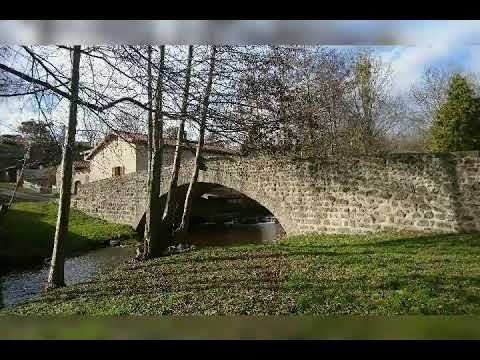
Soleymieux occupies a high, rural part of the Monts du Forez in the Loire department, with the open feel of a small mountain commune rather than a compact tourist town. The mairie places the village at about 730 metres and around 38 kilometres from Saint-Étienne. It describes the settlement as a centre surrounded by hamlets and identifies the Mare as a thread through the landscape. INSEE's 2023 reference population for the entire commune is 716 municipal residents, with 9 counted separately and 725 in total. Those figures took effect on 1 January 2026; they cover Soleymieux's full administrative boundary, not simply the village square or a single hamlet.
The most rewarding way to understand the place is to move slowly between its centre and its dispersed localities. Names such as Le Pont, Les Barges, Annézieux, Gabeloux and Mollay appear in local municipal material. Fields, meadows and wooded slopes shape the scenery around them, while the Mare links a number of these small settlements. On the Loire Tourisme listing, the Circuit des hameaux begins at Place de la Fontaine and crosses the neighbouring commune of Saint-Jean-Soleymieux. The itinerary crosses the Mare twice and is described as a rolling walk through pasture, cultivated land and woods, with views toward the Forez landscape. The listing's mountain-bike note calls that version physically demanding, so a cycling visitor should not assume that the walking description applies to a bike. Check signs, weather, access and current route information before setting out.
Water also carries Soleymieux's best documented industrial story. The Mare powered mills and silk-twisting workshops across the valley; local heritage research describes this as a network of small productive sites rather than one large factory district. At Le Pont, the Moulin Suc or atelier de moulinage Suc has a formal place in that history. The Ministry of Culture's protected-monuments list records its inscription on 4 July 2007 and specifies the mill, all its machinery, the millrace and the associated parcels. This is a significant survival of working heritage, but a legal listing is not a visitor-access notice. The site is not presented here as an open museum; respect property boundaries and ask the municipality before seeking access.
A separate local mill appears in the video titled SOLEYMIEUX : Visite du moulin du Got. The Got and Suc names refer to different sites, and keeping them distinct helps make sense of the valley's layered water-powered past. Official visitor material notes that the Mare once turned many mills and supported milling workshops. A regional guide uses the expression “Roman bridge” for a bridge in Soleymieux, with quotation marks. That wording is best treated as a local label, not proof of Roman construction: the consulted public heritage record does not establish an ancient date. This distinction between a documented industrial monument and an evocative but unverified label keeps the village's history interesting without turning a suggestion into a fact.
Agriculture remains part of the community's character. The municipality's presentation identifies cattle raising as a notable local farm activity, while the valley's meadows and open fields make the rural setting visible from the walk. The surrounding communities—Saint-Jean-Soleymieux, Margerie-Chantagret, Boisset-Saint-Priest, Chenereilles and Saint-Georges-Haute-Ville—share the landscape and everyday services of this part of the Forez. For a broader outing, Montbrison is the nearby service centre named in local information, and Saint-Étienne is the larger city connection. The department's Route départementale 5 is the main road reference; allow for country-road travel and check your exact approach rather than assuming a high-frequency urban connection.
Soleymieux also has small but useful visitor services. The municipal library began in 1973 with an 80-book collection and a bibliobus visit, according to its own history; it opened in a dedicated room in 1995 and moved to new premises in October 2024. Its current page lists Tuesday and Friday sessions, but hours can change around holidays and summer closures. Loire Forez lists a motorhome area behind the Sainte-Anne school with two parking spaces, water, electricity and a service point; its page gives a €2 token arrangement obtained from the mairie or the Le Soleym shop. Verify availability and payment details before arrival. The mairie's calendar and local association notices are the best way to find current events, because a small rural schedule can shift with the season.
For transport, begin with the RD5 road connection and then check the current Cars Région Loire and Loire Forez information for any public-transport or reservation-based service that works on your date. Schedules in rural areas can be limited, and some nearby services require advance booking; confirm departure times, stops and return options before planning a day around them. A rewarding visit can stay simple: start in the village centre, follow the marked hamlet circuit if conditions allow, and read the Mare valley through its mills, fields and hamlets. Treat the Moulin Suc as a protected landmark whose access must be confirmed, and leave time to return before the last practical connection.