Mosan houses, textile heritage and walks through the Pays de Herve
Soiron occupies a sheltered valley in Pepinster municipality, in Belgium’s province of Liège. Brick-and-stone houses cluster around an unexpectedly large church, with hedged pasture and orchards beyond. A surviving teasel-drying building connects the village with the region’s textile industry. Walking routes make it possible to combine a compact heritage visit with a longer exploration of the Pays de Herve.
| Municipality | Pepinster |
|---|---|
| Municipal registered population at 1 January 2026 | 9,382 |
| Municipal area, WalStat revision of 22 May 2026 | 24.9 km² |
National Register figure for the whole municipality, including its other settlements. It is not a count of the historic village alone.
Medieval rights and later prosperity
The local heritage association identifies a document of 1005 as the first written evidence for Soiron. Emperor Henry II granted benefits associated with its jurisdiction to the chapter of Saint Adalbert in Aachen. This attests the place and its rights, rather than proving a particular Roman or Celtic foundation.
The ban was a jurisdiction and, by extension, its territory. Soiron became part of the Duchy of Limburg, subsequently linked to Brabant after 1288. Different lordly families administered the estate; the de Woelmont family succeeded the de Woestendaedt family in the seventeenth century.
A damaging earthquake in 1692 was followed by rebuilding during a period of agricultural, commercial and manufacturing prosperity. Substantial eighteenth-century houses reflect that recovery. Later industrial concentration elsewhere altered the village economy.
A church serving more than one village
A church is recorded in 1086. The present building retains a tower partly rebuilt in 1627, while reconstruction of the main church began in 1723 after the earthquake. It was consecrated in 1730.
Its scale makes more sense when the former parish is considered. Communities including Cornesse, Xhendelesse, Wegnez and Goffontaine also worshipped here, so the church served a much larger population than Soiron’s centre alone.
Medieval baptismal furnishings survive alongside later decoration. The high altar and organ came from Boneffe Abbey; the parish guide dates the organ purchase to 1804–1805. These later additions enriched an already rebuilt church. Seigneurial chapels and memorial slabs supply further connections with local families.
Mosan architecture and two different castles
Seventeenth- and eighteenth-century houses combine brick with limestone and, in some places, sandstone. Doorways, window surrounds and building size reveal the differences between craftsmen’s homes and wealthier residences.
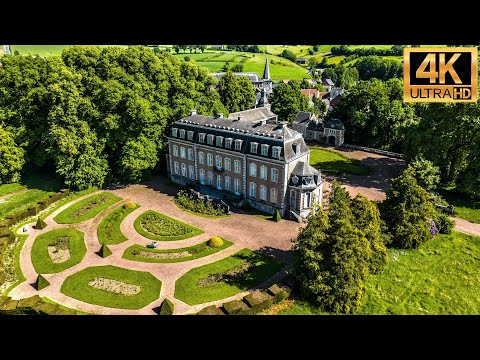
The former presbytery carries a chronogram recording 1765. Soiron Castle was rebuilt between 1723 and 1749. Sclassin Castle is a separate property with surviving late-sixteenth-century fabric, rather than another name for the same place.
These buildings have private uses. A castle’s visibility in the landscape, or photographs taken in its grounds, should not be mistaken for a permanent right of public access to its gardens.
The unusual teasel-drying building
The nineteenth-century brick drying house has openings designed to circulate air around harvested teasels. Their dried heads were used in textile finishing, raising the surface fibres of fine cloth.
That process connected a locally cultivated plant with the region’s manufacturing skills. The surviving building is therefore evidence of a working supply chain, rather than simply an unusual rural store.
Former cloth workshops, nailmaking and the old communal brewery add other elements to the economic history. At Place du Bac, a small triangular public washhouse recalls shared everyday needs alongside commercial production.
Walking beyond the centre
Hedges, pasture and orchards surround the Bola valley. A village circuit can be extended into this cultivated countryside rather than ending at the last house.
Un Air de Bourlingueurs lists a Soiron–Olne–Égypte–Soiron loop of approximately 7.5 kilometres and describes it as demanding. Gradients matter as much as distance here. The GRP 563 and regional walking networks offer longer alternatives.
Neighbouring Olne provides a separate heritage visit. Limbourg and Clermont-sur-Berwinne require a wider itinerary, while Verviers and Liège offer urban and cultural outings beyond the village itself.
Accommodation in and around Soiron
Un Air de Bourlingueurs is a guesthouse at Bouhaye in the Soiron area, offering four individually themed rooms and local walking and cycling information. It supplies a way to stay in the village landscape rather than making only a brief stop.
Hostellerie Lafarques is outside the historic centre, in the Cornesse-Pepinster area at Domaine des Douys. Its hotel and restaurant occupy wooded grounds. It is not an inn beside Saint-Roch Church.
The choice involves different accommodation arrangements and evening journeys. Include the trip back from a meal when comparing a village guesthouse with a hotel offering its own restaurant.
Meals and a dated change at the village tavern
La Taverne de Soiron is a central village address associated with beer and local social life. In September 2026 its manager announced an intended closure on 18 December 2026 and a search for a successor. Anyone planning a later visit should establish whether the business continues.
The village beer was created for the millennium commemoration in 2005 and brewed by Grain d’Orge in Hombourg. It links a local association initiative with a brewery elsewhere in the Pays de Herve.
Lafarques offers a gastronomic alternative outside the centre, with seasonal menus by chef Olivier Tucki. Make arrangements for both the table and the journey.
Connections and everyday practicalities
Pepinster and Verviers are relevant rail gateways, followed by a final local journey. Soiron has no station in its historic core. From Liège, compare a road approach with the actual train and onward connection.
Aachen in Germany is another useful major city to the east, connected with the region by road and rail towards Verviers and Liège. Reaching the village still requires that last section; limiting the discussion to Belgian cities would overlook a sensible cross-border approach.
For a possible move, weigh the quiet landscape against ordinary work and service journeys. The population figures refer to the whole of Pepinster municipality, not Soiron alone. The precise house location, slopes and connections determine daily convenience.
Sources
- Amis du Ban de Soiron : histoire, acte de 1005 et séisme de 1692
- AWaP : datations et classement de l’église Saint-Roch
- Paroisse : l’ancien territoire desservi par Saint-Roch
- Fabrique d’église : guide du mobilier et des chapelles
- Architecture mosane, chardons et châteaux
- Un Air de Bourlingueurs : hébergement à Soiron
- Hébergeur local : itinéraires pédestres et cyclables
- Hostellerie Lafarques : hôtel et restaurant hors du centre de Soiron
- Association villageoise : bière de Soiron et activités
- L’Avenir, 28 septembre 2026 : annonce du départ du gérant de la Taverne
- SNCB : gare de Pepinster
- Belgian National Register: municipal figures, 1 January 2026
- IWEPS / WalStat: superficies communales (2026)