Schongau’s old town sits on a high bend above the Lech, where the river once curved around a hill. The compact skyline of gates, towers and tiled roofs makes the town’s history visible before a visitor has even reached the market square. It is also a working regional centre: shops, services, workshops and small and medium-sized businesses share the town with its historic streets. Bavaria’s statistical office counted 12,676 residents in the municipality on 31 December 2025.
A medieval town shaped by movement
The settlement that preceded today’s Schongau lay in what is now Altenstadt. The town’s first documentary mention is dated to about 1065–1070, in a record of Benediktbeuern Abbey connected with a local nobleman called Hugo of Scongova. That is a firm written reference, not proof of a Roman or Celtic foundation. In the Middle Ages, Schongau’s position on routes linking Augsburg with the Alpine crossings and Italy helped it grow as a market and trans-shipment point. A municipal weighing scale is recorded in 1407; in 1419 the citizens received permission to build a warehouse where passing goods had to be stored overnight. The late-Gothic Ballenhaus recalls that regulated trade.
Walk the wall, then step inside the museum
A useful first outing follows the surviving wall and its gates from the tourist information office, past the Klostergarten and towers, to the Frauen- and Maxtor. Along the way, the market square and Ballenhaus lead naturally to the Baroque parish church of Mariae Himmelfahrt. The town museum occupies the former St Erasmus church. Its collection includes a medieval coin hoard, votive paintings, a rarely preserved underfloor hypocaust heating system and the Häringer altar. These details turn a short visit into a close look at how people worshipped, traded and kept warm in earlier centuries. In Altenstadt, the Romanesque basilica of St Michael offers a separate stop at the site of the earlier settlement.
A base for the Pfaffenwinkel and Lech country
Schongau works well as a measured day trip: leave time for the wall walk, a museum visit and lunch in the centre, then continue into the Pfaffenwinkel, whose nearby church and pilgrimage sites include Wies, Steingaden and Rottenbuch. The Lech valley, pre-Alpine landscape and routes toward the Allgäu and Werdenfels mountains broaden the options for walkers and drivers. The municipal transport page lists trains from Weilheim on the BRB and bus connections from Augsburg via Landsberg; it also gives road approaches from Munich and Augsburg. Services can change, so check the current railway and bus timetables before setting out.
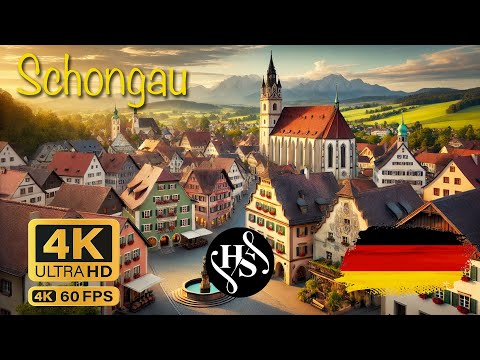 Schongau, Bavaria: a walk through the walled old town