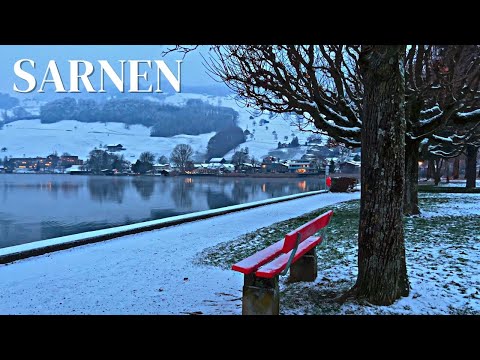
Sarnen is the capital of Obwalden, between its lake and the foothills south of Lucerne. Its centre contains shops, cafés and public offices, so it feels like a small working town as well as a departure point for excursions. Municipal figures distinguish the whole municipality from Sarnen village: at the end of 2025 they recorded 10,923 residents overall, of whom 6,330 lived in the village itself.
Towers and a contested founding story
The municipality’s portrait links Sarnen to the formative history of the Swiss Confederation. The medieval Hexenturm, now an archive tower, was built shortly before 1291 and later served as a prison, treasury and museum. The White Book of Sarnen, associated with the fifteenth-century scribe Hans Schriber, preserves an early version of the Confederation’s founding narrative. It describes an attack on the lower castle and the expulsion of a Habsburg official. The book is a historic source and part of local memory; its account should not be treated as a simple modern eyewitness report.
Later political history also touched Sarnen: delegates of Catholic cantons concluded the Sarner Bund here in 1832. Today, a walk from the centre towards the Landenberg and the tower connects several of these periods. The Museum of Obwalden, local churches and the lake shore add cultural and outdoor stops. The town’s official sights directory is useful for current access arrangements.
A practical central Swiss base
Sarnen lies on the Zentralbahn network and has an A8 road connection and PostBus services. Lucerne is the principal nearby city for a short stay; Interlaken is another possible rail approach across the Brünig route. Mountain trips towards Pilatus or the wider Obwalden region require more time than the town walk. The lake is a calmer alternative when a summit excursion is impractical.
Hotels, restaurants and cafés operate in the centre, according to the municipality, and camping is available by the lake. An overnight stay here provides everyday services and several transport choices without relying on a remote mountain hotel. Distinguish the inhabited village from the wider municipality when comparing population or accommodation figures.