From the road, Santa Severina appears less like a town spread across a hill than a stone vessel set on a ridge. The image has given it the local nickname Nave di Pietra, or Stone Ship. Its compact old centre rises above the Neto valley in the province of Crotone, between the Ionian coast and the Sila uplands. The silhouette is dramatic, but the place is not simply a castle with a village attached: cathedral square, churches, historic lanes, small museums and working countryside form a layered settlement with a living community.
A small municipality with a large historic centre
The latest census-reconciled annual count available for this profile records 1,857 residents in the whole municipality on 31 December 2024. This is the Comune’s population, not a count of people living only inside the old walls. Santa Severina is about 30 kilometres northwest of Crotone, and the valley below links the hill settlement to agricultural communities and routes across the Crotonese interior. The scale is intimate: a visitor can cross the historic core on foot, but the steep approach and uneven surfaces matter when planning a day here.
The town’s economy still has a rural dimension. Local visitor information highlights wines of the Neto valley, olive oil, citrus, saffron and preserved foods, while the town’s enoteca presents products from nearby farms and wineries. Heritage and cultural visits add another source of activity: the castle is both a monument and a museum venue, and municipal programmes use its rooms and the old centre for events. These activities complement daily services rather than replacing them; opening days for restaurants, shops and visitor facilities may vary, especially outside the warmer months.
Ancient Siberene and the limits of what can be claimed
Santa Severina is often linked with Siberene, a name associated by heritage catalogues with an ancient settlement in this area. The archaeological record supports an early past: excavations on the rocky height have found sporadic Greek and Brettian material dated to the fourth and third centuries BCE. That evidence does not identify a single founder or prove an uninterrupted town from antiquity to today. The national cultural catalogue and the municipality describe the ancient identification as a historical interpretation grounded in the landscape and finds, not as a precise foundation story.
The hill’s later history is equally layered. The municipality describes Arab rule in the ninth century, followed by Byzantine recovery and the development of a fortified kastron with religious buildings. Its own account says that current evidence does not settle whether the Byzantine stronghold began before, during or after the Arab occupation. Norman rule followed, and the castle’s central nucleus is commonly associated with the Normans and the eleventh century. Yet the present fortress is not a single-period monument: excavation and restoration point to Byzantine, Norman, Hohenstaufen, Angevin and later works. The municipality itself records scholarly disagreement over the sequence and dating of the keep and its towers, so the castle is best read as an evolving complex rather than assigned to one builder alone.
The castle, cathedral and baptistery
Begin at Piazza Campo, where the cathedral and castle face one another across the civic heart of the old town. The castle covers roughly 10,000 square metres and its square keep, round corner towers and outer defensive works dominate the ridge. The former stronghold now houses archaeological displays, a local museum, documentation on Calabrian castles and, at different times, exhibitions and cultural events. A visit can connect finds from the surrounding territory with the building’s own changing use, from defence to residence and public heritage space.
Across the square, the co-cathedral of Sant’Anastasia, also called Santa Maria Maggiore in municipal material, preserves another long chronology. The municipality dates its main medieval construction to 1274–1295, while noting later transformations, including a rebuilt façade in 1705 and substantial interior decoration in the early twentieth century. Within the church is the Byzantine baptistery, a rare survival whose exact dating remains a matter of scholarly discussion; local visitor information places it broadly between the seventh and ninth centuries. A diocesan museum in the former archiepiscopal palace adds sacred art, manuscripts and liturgical objects to the itinerary. These are active religious and museum spaces, so check access before arriving and avoid treating worship times as sightseeing hours.
Allow time for the lanes beyond Piazza Campo. The church of Santa Filomena, also known locally as del Pozzoleo, and the quarter called Grecìa extend the visit away from the main monuments. Local accounts associate caves on the descent with Basilian monks; that tradition is part of the area’s religious memory, while the remains and the rock-cut spaces are the more tangible evidence a visitor can encounter. The walk is steep in places, and the municipality warns that the castle and cathedral have architectural barriers. Anyone needing step-free access should contact the sites in advance.
Wine, local events and a day in the Neto valley
Santa Severina’s agricultural identity is visible in the products presented by local producers: wines from the Neto valley, olive oil, citrus, saffron and preserves. The municipal enoteca inside the castle has been used for tastings and food-and-wine events, but booking and current operation should be checked. A good visit can pair the castle and museum with the cathedral and baptistery, then continue on foot through the old lanes to look back across the valley. With a car and more time, the Neto countryside and nearby settlements offer a different scale of landscape from the tightly held hilltop centre.
The calendar also brings residents and visitors together. The municipality lists the feast of Santa Anastasia on 29 October, with religious observances and community events, and has hosted Castelfiaba, a programme of storytelling, theatre and activities in the castle and historic centre. These are date-specific events, not daily attractions; consult the current municipal calendar before planning around them. For practical orientation, start at Piazza Campo, ask about castle and museum access, and leave time for the slopes between the ridge and lower countryside.
How to arrive and what to check
Crotone is the nearest major urban reference point. Ferrovie della Calabria lists regional bus route 801 between Crotone, Santa Severina, Petilia Policastro and Mesoraca. Travellers arriving by train can use Crotone as a rail gateway and continue by bus, but the departure stop and connection should be confirmed for the specific date. The operator’s current timetable page lists the route and may change seasonally. Driving gives more flexibility for exploring the Neto valley and Sila foothills; use current navigation for the road approach rather than relying on a remembered journey time. In every case, confirm transport, museum opening and event schedules before setting out.
 Santa Severina in three videos: a town walk, aerial views and the orange tradition
 Aerial Pictures published this 5-minute-29-second drone film on 1 December 2020. Its description identifies Santa Severina and Calabria without presenting it as a guided history or practical itinerary. That makes it a useful visual counterpoint to the longer walking tour: it introduces the settlement from an aerial perspective, while leaving the viewer to explore the streets and monuments at ground level. Because the footage is from 2020, it cannot confirm present-day services, opening times, transport or access conditions.
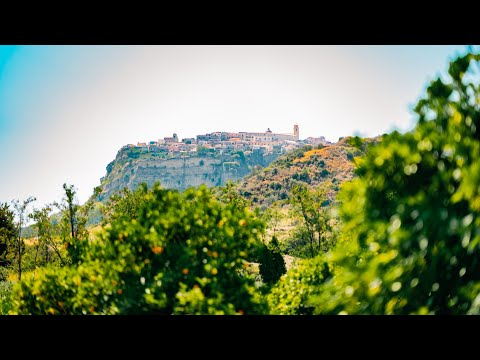 Visit Mediterraneo published this 2-minute-25-second feature, titled “Santa Severina - Borgo delle Arance,” on 2 January 2025. Its description focuses on the local aranciàru orange and frames the film as part of Ionic Tales, a project promoting traditional crafts and food products across seven villages. It adds an agricultural and culinary angle that the town walk and aerial film do not provide. The piece is promotional storytelling about a local product, not a directory of farms or a guarantee that tastings and sales are available on any given day; ask local operators about current arrangements.