Caccuri rises from a rocky spur on the southeastern edge of the Sila plateau, where the inland Calabria of forests and high ground begins to slope toward the Ionian side. The National Catalog of Cultural Heritage places the town at about 646 metres above sea level and describes its historic core as a defensive hill settlement. Its outline is shaped by the castle at the summit and by lanes that tighten as they climb. From the upper streets, the view moves across the Neto valley and the surrounding hills; the scale is small, but the setting makes clear why a strong point here mattered.
ISTAT’s 2025 demographic balance records 1,517 residents for the whole municipality on 1 January 2025. This is the Comune’s population, not a separate count for the old center. Caccuri is part of the Presila crotonese, with nearby communities including San Giovanni in Fiore, Cerenzia, Castelsilano and Santa Severina. A visit can therefore be shaped around the town itself or extended into a longer journey between the Sila uplands and the Crotone hinterland.
A history with layers, not a single founding tale
The state heritage catalogue links the early medieval growth of Caccuri to Byzantine defensive positions built inland as Lombard pressure increased. It also records the influence of three Basilian monasteries before the Norman arrival and the Latinization of the Greek rite. This is a grounded way to understand the town’s beginnings: the evidence points to a strategic settlement and a religious landscape taking shape over time, rather than a documented single year of foundation. Claims that the present castle dates precisely to the sixth century are common in tourism summaries, but the surviving complex was repeatedly transformed.
The Ministry of Culture’s heritage office says the castle developed as a military fort on the site of a Byzantine castrum and later became a residence for noble families. The Cavalcanti family almost entirely rebuilt it in the eighteenth century; in 1885, architect Mastrigli added the crenellated cylindrical tower and ravelin for Baron Guglielmo Barracco. That sequence explains why the skyline feels medieval while much of the visible architecture reflects later aristocratic remaking. The municipal heritage page identifies the building as Castello Baracco and gives its address on Via Destra. Visits and access arrangements should be checked in advance.
Churches, courtyards and the old town
The castle is a natural starting point, but Caccuri’s religious buildings make the walk richer. Santa Maria delle Grazie stands in the historic center; the local heritage account describes a medieval origin, a three-aisled plan and a chapel containing a Last Supper by Calabrian painter Cristoforo Santanna. The former Dominican complex of Santa Maria del Soccorso brings together a sixteenth-century church and the Chapel of the Holy Rosary. Its carved stone portal and baroque wooden altar are among the details that reward a slower visit. Small lanes connect these sites with houses, stairways and viewpoints rather than forming a single monumental avenue.
The castle’s interiors also carry later cultural layers. A local institutional heritage account describes painted ceilings with scenes from the Jerusalem Delivered and Orlando Furioso, historic Neapolitan tiles, an eighteenth-century palatine chapel dedicated to Santa Barbara and an old kitchen. These details are useful context, but whether every room is open on a particular day is a separate question; confirm arrangements before planning an interior visit.
Rural work, craft and a literary gathering
Caccuri’s social history is rooted in a rural setting. The region’s visitor route identifies local ceramic workshops, while the town’s current cultural identity is also linked with the Premio Letterario Caccuri, an August essay competition that has brought writers, journalists and readers to the village. The municipality’s published 2024 program shows the event based at the Accademia dei Caccuriani near the castle; the lineup and dates vary, so check the current year’s schedule. The event gives a practical reason to visit in summer, but the town is worth seeing outside festival nights too.
Food is another way the rural landscape appears in local life. Visit Sila’s profile names u quazolo, a filled pastry with sardines, and seasonal preparations using elderflower and acacia blossoms. Treat these as specialties reported by the regional visitor network rather than a fixed menu in every restaurant. Small-town services and opening times can be seasonal; visitors should check meal options, shops and any guided tour before arriving. The municipality’s official site lists heritage places and everyday services, while the regional walking route helps connect Caccuri to neighboring communities.
Getting there and planning a wider route
By road, Caccuri sits on the inland corridor between Cosenza and Crotone. The regional Cammino della Magna Graecia inventory lists the SP213 connection from San Giovanni in Fiore to Caccuri and the SS107 bis between Caccuri and Santa Severina; ANAS lists the SS107 through the municipality. These are useful route references, though mountain-road conditions and work can change. For public transport, Autolinee Romano maintains an online regional timetable and lists services around Crotone and San Giovanni in Fiore; check the exact stop and return service for your date instead of assuming every trip reaches the historic center.
Walkers can follow the regional Cammino della Magna Graecia stages that approach from San Giovanni in Fiore and continue via Altilia toward Santa Severina. The trail offers a way to read the landscape between Sila and the Neto basin, but it requires checking trail conditions and the logistics of the next stage. For a shorter visit, allow time for the castle exterior, the churches and the upper lanes, then pause to look back toward the hills. Caccuri’s character comes from the way a Byzantine-era defensive setting, later noble architecture, religious art and present-day cultural gatherings occupy the same compact ridge.
 Caccuri in tre video: castello, paese e Premio Letterario
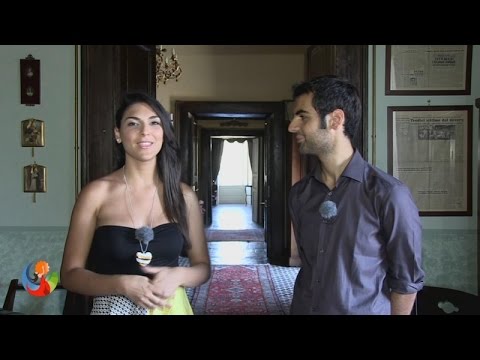 This 2014 Onda Calabra episode gives Caccuri a longer local television treatment, moving among the castle, historic center, churches and food-related stops named in its description. Its value is the breadth of local subjects and the perspective of the period. The title’s “Byzantine castle” shorthand needs qualification: heritage authorities describe a castle on a Byzantine castrum site, substantially rebuilt in the eighteenth century and altered again in 1885. Any businesses shown may have changed.
 This short report is tied to one occasion: the 2024 edition of the Premio Letterario Caccuri and the award to journalist Sigfrido Ranucci for “La scelta.” It helps explain how the annual essay prize brings public cultural events to a small inland town. It is not a general guide to Caccuri, and its 2024 dates should not be used to plan a later visit; check the current program.