a pilgrims’ church, gardens and rural heritage in the Bouriane
In western Lot near the Dordogne boundary, Salviac sits among the wooded hills of the Bouriane. The village combines old streets, a substantial medieval church, a historically inspired garden and a museum of machinery and rural life. Accommodation in the centre and surrounding hamlets provides a base between Gourdon, Cahors and the Périgord.
| Municipal population, 2023 reference | 1,231 |
|---|---|
| Approximate geographical area of the commune | ≈ 29.74 km² |
Population at 1 January 2023, within municipal boundaries at 1 January 2025; official figure in force from 1 January 2026. The area covers the whole commune, not only the built-up centre.
A settlement shaped in the Middle Ages
The Lot territorial authority places the formation of the town under the barons of Gourdon in the tenth or eleventh century. This provides a medieval reference rather than an ancient origin inferred from the name alone. Its compact core reflects development around the church and earlier seats of authority.
Philippe de Jean acquired Salviac in 1337. The church, probably built in the mid-thirteenth century, was subsequently altered in connection with this family. Privately owned Château de Lacoste, also called “des Templiers”, preserves elements of a noble residence and fortifications. The traditional name alone should not be treated as proof of the history of a Templar institution.
Saint-Jacques and the pilgrimage route
Saint-Jacques-le-Majeur recalls Salviac’s role on a secondary pilgrimage route through Rocamadour. Its substantial walls and limestone-slab roof give a distinctive expression to southern Gothic architecture. Following Revolutionary damage and nineteenth-century decline, it received protected-monument status in 1913.
Restoration completed in 2007 renewed the view of its sculpture, paintings and furnishings. A statue of Saint James in pilgrims’ clothing, attributed to the Tournié workshops of Gourdon, is a notable feature. A twentieth-century reinforced-concrete roof structure also illustrates the less obvious engineering involved in conservation. The church’s appearance records both medieval construction and much later efforts to keep it standing.
The Barry garden and Wednesday market
Jardin du Barry is a garden inspired by medieval uses, rather than an unchanged survival from the Middle Ages. Its plots include food crops, medicinal herbs, aromatic plants and species used for dyes and textiles. Flowers for bouquets occupy another section. It introduces practical plant uses alongside the village’s architectural heritage.
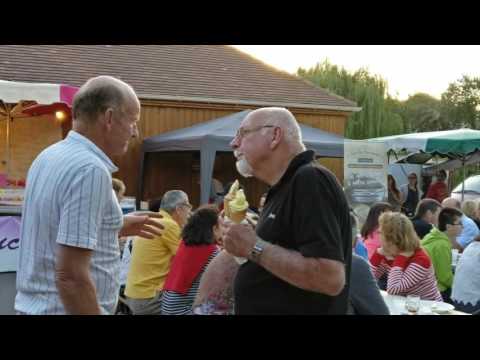
Wednesday morning brings the food market to the centre, with seasonal produce, cheeses and other local goods. It is a useful opportunity to shop before heading into the countryside. Gourmet markets and summer events follow separate calendars. A video recording of an earlier edition is a record of that occasion, rather than evidence that the same event occurs on the same date every year.
Agricultural and motoring heritage
At Pépy above the village, the Musée du Patrimoine agricole et automobile displays the collection assembled by Benoît Jouclar. Tractors, cars, motorcycles, bicycles and everyday objects trace changes in work and transport. Reconstructions of homes, trades and shops help explain how the machinery fitted into ordinary life.
Independent and guided visits follow the arrangements published for each season. Demonstrations depend on the programme and staff, and should not be assumed to accompany every admission. Allow a dedicated outing rather than expecting a brief stop between central streets. Tourist information provides seasonal dates and appointment conditions for quieter periods, useful when organising a visit outside the main holiday months.
Outdoor routes and places to stay
Salviac’s Quercy Outdoor base at La Réquillou provides information for walking, trail running and cycling. Use its departure board or application to select an appropriate route. Hills, woods and hamlets give the surrounding circuits a different character from a stroll through the village centre.
Maison de Fortitude offers guest-house rooms on Boulevard Hugon in the village. La Flânerie au Maine provides another option in a rural setting a few kilometres away. Holiday cottages add to the choice. For a conventional hotel room, consider Gourdon and nearby towns as well. Check the exact address: accommodation advertised under Salviac’s name may be central or in an outlying hamlet with different transport needs.
A local meal and arrival through Gourdon
L’Auberge du Quercy “Chez les Filles” on Rue Haute serves regional cooking using local ingredients, with a terrace near the church. Its booking information asks guests to telephone rather than reserve by email. It is a practical option for combining a market visit with a meal in the centre.
Gourdon, approximately thirteen kilometres away along the road axis described in territorial documentation, is the main nearby railway gateway. Its station connects with Paris-Austerlitz, Brive, Cahors and Toulouse on the relevant services. Arrange the onward journey to Salviac: the railway station is not in the village. During a longer stay, the two places’ shops and services can complement each other, but travelling between them remains part of the practical plan.
Sources
- DDT du Lot : histoire et géographie du bourg, juillet 2013
- Commune : église Saint-Jacques et restauration
- Lot Tourisme : marché et patrimoine du village
- Jardin du Barry : composition et accès
- Musée : collection, visites et calendrier
- Quercy Outdoor : base de Salviac
- Maison de Fortitude : chambres d’hôtes dans le village
- La Flânerie au Maine : hébergement rural
- Auberge du Quercy : cuisine et réservation
- Office de tourisme : gare de Gourdon et mobilité locale
- INSEE: official 2023 reference population
- French administrative API: municipal geography and area