monasteries, Mudéjar brickwork and everyday life on the Camino
Sahagún stands beside the Cea in south-eastern León on the French Way to Santiago. Brick towers, the remains of San Benito Monastery and the Peregrina sanctuary recall a town shaped by kings, monks and travellers. Today its role as a local service centre combines with accommodation and restaurants used by pilgrims and other visitors alike.
| Municipal population at 1 January 2026 | 2,391 |
|---|---|
| Area of the municipality | ≈ 123.64 km² |
INE Annual Population Census, reference 1 January 2026, released on 24 November 2026. The IGN area covers the whole municipality, not only the built-up centre.
A monastery and the charter of 1085
The name Sahagún evolved from the dedication to Saint Facundus, associated in local religious tradition with Saint Primitivus. That memory should not automatically be converted into a foundation date for a Roman town. The documented settlement is chiefly explained through the monastery’s early medieval development.
The community received strong support under Alfonso III in the ninth century and grew particularly influential during Alfonso VI’s reign. Cluniac reform and the adoption of the Roman rite belong to the later eleventh-century phase, rather than to an imperial Roman foundation.
Alfonso VI’s charter of 1085 encouraged settlement and trades. Monastery, fairs and pilgrimage brought merchants and artisans of different origins, creating an economy more varied than that of an enclosed religious house. Abbatial authority and the urban population also developed interests of their own.
Reading the remains of San Benito
San Benito was an important religious centre in the kingdom of León, far larger than its surviving buildings suggest. The gateway known as the Arco de San Benito, Clock Tower and remains of San Mancio Chapel are fragments of a much greater complex.
The Peninsular War and nineteenth-century changes contributed to its decline. The heritage declaration also recalls the Battle of Sahagún on 21 December 1808, a different event from the July battle at Medina de Rioseco. Plans, models and guided interpretation help explain the scale of what has disappeared.
Modern civic history adds another episode: Sahagún was among the places that proclaimed the Second Republic early on 14 April 1931. This introduces a different period beyond the medieval monastery rather than reducing the town’s past to one moment of prosperity.
San Tirso and San Lorenzo
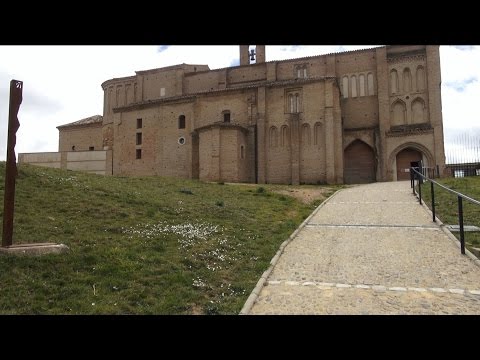
Twelfth-century San Tirso is a reference point for the area’s Romanesque–Mudéjar architecture. Romanesque forms combined with brick construction distinguish it from the great stone churches elsewhere on the Camino. Examine the tower and apses from different sides.
Thirteenth-century San Lorenzo adds another brick landmark. Comparing them reveals differences in proportions, volumes and decoration. The Mudéjar character of the buildings does not automatically mean that either surviving church was formerly a mosque.
San Tirso contains Valentín Mon Aláez’s architectural models, including representations of lost buildings. They connect the surviving town with its vanished structures. Access arrangements differ by monument; provincial information updated in November 2026 provides a useful starting point, with confirmation advisable before arrival.
The Peregrina and local museums
The Virgen Peregrina sanctuary occupies a former thirteenth-century Franciscan establishment on a hill outside the centre. The climb provides another view of the settlement and its Camino setting. It is a separate religious foundation rather than a surviving wing of San Benito.
The Benedictine nuns’ museum holds sacred art and preserves the memory of Alfonso VI’s burial after losses at the former monastery. The Holy Week Museum displays processional works associated with the Jesús Nazareno brotherhood. Choose the collections that interest you and check their individual visiting arrangements instead of assuming one common ticket.
Pilgrimage remains a living activity. Walking a short part of the route or approaching Puente Canto over the Cea reveals the connection between bridge, streets and places of welcome. A full day’s walking stage is not necessary to appreciate that relationship.
The square and its surrounding countryside
Plaza Mayor is a useful place to move from monuments to everyday life. Nearby streets contain shops, bars and services used by residents and travellers. Cereal farming and market gardening form part of the wider Tierra de Sahagún economy.
Leeks have a particular place in local food celebrations, including the San Simón fair. Check each event’s dates; outside festival periods the town has a different rhythm. Anyone considering a move should also inspect services on a normal working day rather than only during a celebration or the arrival of a pilgrim group.
The municipality includes other settlements and rural land. Its population does not live solely around the square, and an address somewhere within the municipality is not necessarily within walking distance of the station or museums.
Accommodation and meals
Hostal Domus Viatoris provides rooms in Sahagún and advertises breakfast and dinner. It welcomes tourists, travellers and pilgrims, with arrangements distinct from hostel dormitories. Confirm room types, food service and any bicycle or access requirements directly.
Restaurante Luis is listed in Plaza Mayor and offers a central option for a reserved meal. Older directories can contain closed businesses: current tourist information marks La Codorniz–San Facundo as closed. Accommodation and dining advice should therefore not depend solely on an old list of telephone numbers.
Booking ahead simplifies arrival after a long journey. Pilgrim hostels, guesthouses and rural rentals have different conditions, and a place on the Camino does not guarantee available beds.
Connections from León, Palencia, Burgos and Madrid
Sahagún has an operating railway station in Calle Tras Estación. Adif shows regional services towards León, Palencia and Madrid-Príncipe Pío. These use the conventional network and should not be confused with high-speed trains necessarily stopping here. From Madrid, compare the direct regional journey with alternatives involving changes.
The A-231 follows the Burgos–León corridor beside the older N-120 route. Palencia and Valladolid offer other regional approaches depending on the starting point. Check actual trains, engineering work and replacement coaches for the chosen day, especially when connecting with another reservation. Walking works well in the centre, while surrounding villages require separate travel arrangements.
Sources
- PARES: historia del monasterio de San Benito de Sahagún
- Ayuntamiento: nombre de la villa y fuero de 1085
- Oficina de turismo: historia de Sahagún
- BOE: declaración del conjunto histórico y memoria patrimonial
- Ayuntamiento: monumentos y restos de San Benito
- Oficina de turismo: iglesia de San Tirso
- Oficina de turismo: santuario de la Peregrina
- Oficina de turismo: museos y colecciones
- Oficina de turismo: recorrido y sepulcros reales
- Junta de Castilla y León: horarios de monumentos, noviembre de 2026
- Hostal Domus Viatoris: habitaciones y comidas
- Oficina de turismo: Restaurante Luis
- Oficina de turismo: directorio y avisos de establecimientos cerrados
- Adif: estación de Sahagún y servicios ferroviarios
- Ayuntamiento: accesos por carretera
- INE: Annual Population Census, 2026
- IGN: municipal area