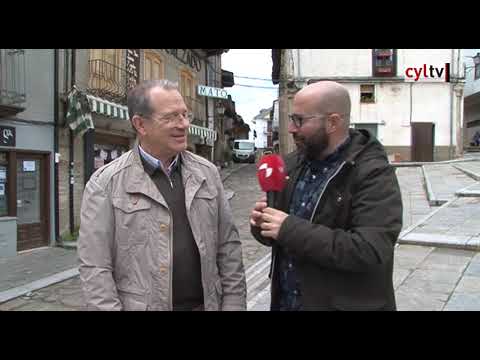
a border castle, slate-roofed streets and a gateway to glacial country
Puebla de Sanabria’s castle and Azogue church crown a hill above the Tera. Steep streets, balconies and slate roofs frame a town that continues to serve the surrounding district through shops, accommodation and public services. Close to Portugal, it makes a useful base for combining medieval heritage with Sanabrian culture, the lake and the neighbouring mountains.
| Municipal population at 1 January 2026 | 1,395 |
|---|---|
| Area of the municipality | ≈ 81.44 km² |
INE Annual Population Census, reference 1 January 2026, released on 24 November 2026. The IGN area covers the whole municipality, not only the built-up centre.
The medieval town and its charter
Local history records an urbe Senabrie in the tenth century and a fortress with named governors from 1132. Earlier references to Sanabria do not always distinguish the wider district from the settlement. Medieval documents provide a firmer route through the town’s development.
Alfonso IX organised its role as a strongpoint on the Leonese frontier with Portugal and granted a charter in 1220, later confirmed by Alfonso X. Fifteenth-century disputes between the Losada and Pimentel families changed ownership. The counts of Benavente eventually expressed their authority through the castle that dominates the historic centre today.
A fortress adapted to cultural life
The present castle was built in the late fifteenth century over earlier defences. Gun openings, arrow slits and projecting defensive features recall its military purpose, while fireplaces and latrines also reveal domestic needs. For centuries the fortress formed part of the management of a border territory.
Transfer to the municipality began in 1895. After further uses, including imprisonment during the twentieth century, cultural adaptations gradually opened new possibilities. The keep, Governor’s House and exhibitions introduce different aspects of the complex. Views from above are also useful for locating rivers and settlements across the surrounding countryside.
Walking up through the historic centre
The climb towards Plaza Mayor follows paved streets lined with coats of arms, balconies and glazed galleries. Large shaped brackets supporting the eaves and slate-covered roofs give local houses a distinctive character. These smaller details reward attention alongside the dramatic outline of the castle.
Slopes are a practical part of the visit. Travellers with luggage or limited mobility should ask accommodation providers about actual access and vehicle drop-off arrangements. Sorting out arrival first makes it easier to enjoy the town afterwards, alternating its upper spaces with a walk beside the river below.
Azogue church and San Cayetano
Nuestra Señora del Azogue preserves Romanesque doorways and walls from the late twelfth century alongside later extensions. Carved column figures and carefully represented clothing distinguish the west entrance. Inside, the Gothic east end and vaulting reveal a different construction phase.
The chapel of San Cayetano stands almost against the church. Its façade and the arms of the Ossorio-Rodríguez de Sanabria family introduce a building closely linked with Holy Week. Processional figures help explain the religious dimension of celebrations that also change the appearance and activity of the surrounding streets.
Giants and the town’s festivities
The museum in Calle San Bernardo occupies the former workers’ social hall. It houses giants and large-headed figures used in the Victorias celebrations. Historic figures and later additions present the festival through characters created and acquired at different moments.
Don Alfonso, introduced in 2020 for the eight-hundredth anniversary of the town charter, is one of the more recent arrivals. The museum makes the tradition accessible outside procession days. Check current arrangements for municipal admission and opening before combining it with the castle’s exhibition spaces, particularly on a short visit.
Lake outings and neighbouring Portugal
Lake Sanabria is a separate excursion from the urban walk. The ZA-104 leads towards the natural area and its park information centre. From there, choose beaches, walks or viewpoints according to season and conditions, distinguishing Puebla from settlements directly beside the water.
Ungilde has a mycology school in former classrooms, with exhibitions and educational activities. Robledo is home to the Iberian Wolf Centre, devoted to environmental education. Across the Portuguese border, Bragança offers a cultural outing to its citadel. Check travel arrangements and opening for each destination before trying to combine several within a single day.
Sanabrian food and dining in town
Local cooking includes large habón beans, cabbage, broth, octopus, trout and meats from the district. Garden produce and substantial cooked dishes reveal another connection with the surrounding land. Mushrooms are part of the seasonal repertoire, although collecting them requires attention to permits and should not be confused with ordering a dish in a restaurant.
The municipal list includes Mesón Abelardo, Plaza de Armas, Tierra de Lobos, Posada Las Misas and the restaurants of La Cartería and La Pascasia. Meals can be arranged within Puebla itself. Confirm available specialities and reserve on particularly busy visiting days.
Accommodation and the service town
La Cartería, Las Misas, La Pascasia, Las Treixas and other properties provide accommodation in Puebla. The Parador adds another option beside the urban area. The directory also includes addresses in Castellanos and Ungilde, so establish the location before expecting a room within a short walk of Plaza Mayor.
Shops and hospitality businesses contribute to Puebla’s role as a service centre for Sanabria. For an exploratory stay before moving, visit the lower neighbourhoods too and investigate everyday services and commuting. Hotel and holiday-house prices should not be used as an estimate of average monthly residential rent.
Rail arrivals and the final connection
Sanabria AV serves the Galicia–Madrid corridor, with connections documented by Renfe in 2026. Distinguish it from Puebla’s historic station: they are separate places. Check the station printed on the ticket and arrange the transfer to accommodation around the actual arrival time.
The A-52 provides the road approach from the Benavente corridor and continues towards Ourense and Galicia. Zamora offers other provincial connections, while Bragança adds a nearby international destination. Without a car, confirm the last bus or taxi section and plan outings to the lake or Portugal separately from the main rail journey.
Sources
- Ayuntamiento: evolución medieval y fuero de 1220
- Ayuntamiento: castillo y espacios expositivos
- Ayuntamiento: arquitectura del casco
- Ayuntamiento: iglesia del Azogue
- Ayuntamiento: capilla de San Cayetano
- Ayuntamiento: museo y tradición festiva
- Ayuntamiento: escuela micológica
- Ayuntamiento: lago, Robledo y Bragança
- Ayuntamiento: cocina sanabresa
- Ayuntamiento: directorio de restaurantes
- Ayuntamiento: directorio de alojamientos
- Ayuntamiento: itinerario y acceso al lago
- Renfe: conexiones de Sanabria AV en 2026
- Ayuntamiento: estación histórica
- INE: Annual Population Census, 2026
- IGN: municipal area