Pornainen is not a single compact attraction but a rural municipality of six villages threaded by the Mustijoki river. Kirveskoski is its administrative and commercial centre; Laukkoski, Halkia, Hevonselkä, Laha and Kupsenkylä each have a separate landscape and history. Statistics Finland counted 4,919 residents in the whole municipality on 31 December 2025. The villages occupy a broad area of fields, forests, waterways and small settlements within reach of Helsinki and the coast.
Read the place through its villages
Kirveskoski, often called the church village or centre, brings everyday services together with a striking river setting. Three rapids—Kirveskoski, Karjakoski and Myllykoski—are close to its core. Laukkoski, the largest of the official villages by area, spreads around Kotojärvi and the Mustijoki valley; it is the best-known cultural stop for its manor landscape, golf, recreation area and film history. Halkia stands in the north by its large rapids and old settlement ground. Laha follows a smaller chain of falls by the former manor and mill landscape, while Hevonselkä includes the Pornaisten Portti business area. Kupsenkylä is a quieter mosaic of fields, woodland and old cultural landscapes. A short visit to the centre will not show the character of all six.
From Stone Age ground to the 1731 bell
The municipal history pages place human activity along Mustijoki soon after the Ice Age. At Halkia, the Metsä-Nikula site is dated to about 8200 BCE, with quartz tools recorded in the area. That is evidence of early habitation, not proof of a legendary ancient founder. Laukkoski had permanent settlement by the 1200s, and a surviving court record from 24 August 1471 names people from the local villages. Sixteenth-century tax records reveal a difficult period: of 67 houses recorded in 1573, 29 were marked deserted. The municipal account links that decline to conflict, taxation and crop failures.
Local history is also preserved in a community story rather than a royal monument. When the parish built its first church in 1726–1728, local women grew flax, spun and wove cloth, and sold it to finance a church bell. The 1731 bell still belongs to the church heritage and appears with spinning tools in the municipal coat of arms. The present granite church in Kirveskoski was designed by Ilmari Launis and inaugurated in 1924; its stone came from the Jokimäki area. Confirm parish access before planning a visit.
Follow the river, but respect the rapids
Mustijoki once linked the coast with the inland and powered mills, saws and other work. The municipality's visitor loop highlights nine rapids, especially Halkiankoski, Lahankoski, Laukkoski and Itälänkoski. They can be explored by car or bicycle; the road distance from Halkiankoski to Itälänkoski is a little over 13 kilometres, before extra stops. The point is not to tick off a list: each crossing opens a different view of the valley, old mill sites, small bridges and waterside settlements. Paths and parking vary by location, so check the municipal route page and use marked access.
For paddlers, the larger Mustijoki route covers roughly 65 kilometres from Mäntsälä through Pornainen to Porvoo. The route was improved in 2025 with better landing and portage places. The full river is a multi-day trip—about two days by kayak or three by canoe according to the municipality—and several rapids must be carried around. Only about seven of the more than 20 rapids are described as runnable by skilled paddlers. Water level, equipment, landowner permissions, portages and rental availability all matter; this is not a casual beginner's float.
Laukkoski on screen, and outdoors
Laukkoski's rolling fields and river bends have served as outdoor locations for Finnish films since the 1930s. The municipality lists titles from Taistelu Heikkilän talosta and Akaton mies to the 2017 Tuntematon sotilas. Writer Mika Waltari also spent summers in Laukkoski and wrote there; the school and a narrow footbridge carry his name. The private summer home is part of the area's cultural story, not a public attraction. Near Kotojärvi, visitors can instead use the recreation area, beaches, forest paths, shelters and exercise stairs. Koto Golf has an 18-hole park course and a 9-hole lakeside course. Check course, restaurant and swimming access by season.
A working municipality with a new energy landmark
Farming, forestry, local services and industry share the six villages. Kirveskoski has the library, health centre, shops, pharmacy and cafés, while local visitor pages list accommodation and activities around the river and Kotojärvi. In Hevonselkä, an energy installation gives Pornainen a very current industrial story: a thermal storage battery for the district-heating network was commissioned in 2025. Polar Night Energy reports 1 MW of thermal power and 100 MWh of storage using crushed soapstone. A June 2026 municipal report says first-year heating emissions fell by 70 percent, quoting the operator. It is working infrastructure, so arrange access with the operator rather than assuming it is an open exhibition.
Getting there and planning a visit
The municipality estimates Järvenpää about 20 minutes away by car, Porvoo 25 minutes and Helsinki 45 minutes. Regional Road 146 links Järvenpää to Pornainen. Buses include route 82 from Porvoo toward Pornainen and routes 987/989 connecting the area with Järvenpää and Nikkilä; changes and school-day exceptions matter. Check a live journey planner for the exact date. If you want to see more than Kirveskoski, plan a full day for the rapids loop and another for the 65-kilometre paddling route; confirm trail, church, golf and service opening hours before setting off.
Useful visitor information
- Pornainen's official village and visitor guide for village maps, attractions and current local information.
- Mustijoki rapids loop for the car and cycling route between the rapids.
- Matkahuolto live journey planner for date-specific bus connections.
 Pornainen in three videos: a heat battery, Road 146 and the village from above
 Malik Explores: Finland & Beyond published this road journey on 15 April 2026 under the title “Driving Finland | Road 146 (Järvenpää to Pornainen) – Hidden Gem?” The description identifies the 17-kilometre regional road and mentions Halkiankoski power station, making it useful as a broad approach to the municipality from Järvenpää. It is a driver's perspective, not a substitute for a route planner: it does not establish current bus service, parking permissions or access conditions at individual riverside sites. Check the route and local guidance for the day of travel.
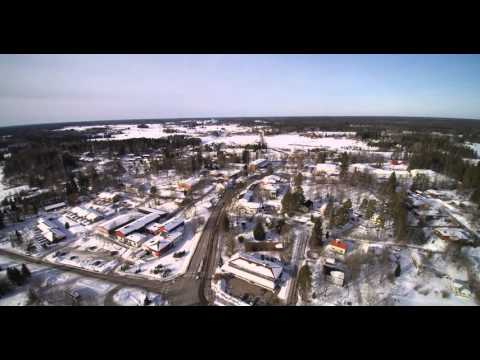 Jani Toikkanen's “City of Pornainen in Air,” published on 2 March 2016, is an older aerial introduction whose available description identifies Pornainen, Finland, but gives little further context. Its value here is as a dated, general orientation to the municipality, complementing a technology feature and a road-level approach. Because the description is sparse, this review does not infer particular landmarks or present-day conditions from it. Use current municipal maps and visitor information to identify places and services before visiting.