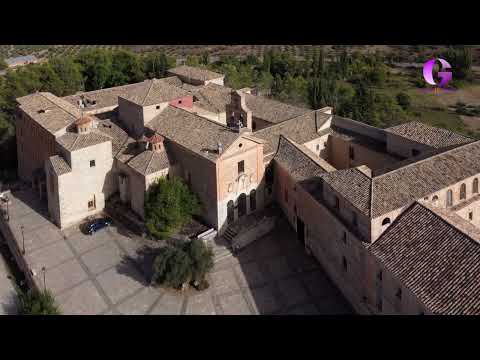
ducal power, Flemish tapestries and the working traditions of La Alcarria
Pastrana lies in an Alcarria valley south-east of Guadalajara. Its Ducal Palace and collegiate church announce the importance of this Renaissance town, while fountains, noble houses and former working districts fill the streets between them. The Princess of Éboli and Teresa of Ávila are familiar names here; tapestries, silk production and beekeeping reveal a history extending beyond their biographies.
| Municipal population at 1 January 2026 | 1,006 |
|---|---|
| Area of the municipality | ≈ 95.70 km² |
INE Annual Population Census, reference 1 January 2026, released on 24 November 2026. The IGN area covers the whole municipality, not only the built-up centre.
From Calatrava to a ducal town
Pastrana’s documented development is associated with the medieval organisation of the territory by the Order of Calatrava. Stories of a Roman foundation belong to a different level of evidence. Enrique II granted town privileges in 1369, an important change in local jurisdiction.
Ana de la Cerda’s purchase in 1541 began a period of noble lordship and disputes with the council. Ruy Gómez de Silva and Ana de Mendoza y de la Cerda, the princes of Éboli, later made Pastrana the centre of their duchy. Sixteenth-century growth combined palace building, religious foundations and productive activity.
Historic ensemble protection followed in 1966. The monuments make more sense within the street pattern, whose routes also reveal housing, former entrances and working spaces.
The palace and Plaza de la Hora
Ana de la Cerda commissioned Alonso de Covarrubias to design the palace, with work beginning in 1542. Ashlar façades, a monumental entrance and decorated timber ceilings express its Renaissance ambition. Modern restoration introduced new elements, so the present courtyard should not be mistaken for an entirely sixteenth-century survival.
The patron’s granddaughter, the Princess of Éboli, was confined here from 1581 until her death in 1592. The barred balcony and the square’s traditional name preserve that memory, alongside later stories and interpretations.
The square provides an orientation point and access to tourist information. Check palace admission sessions and the spaces currently open. Cultural events or institutional use can affect the route, while the exterior already reveals the relationship between the façade and its broad forecourt.
A church expanded over time
Nuestra Señora de la Asunción Collegiate Church developed from a medieval predecessor and grew under ducal patronage. Different phases contribute to the surviving building, whose tower is a useful landmark in surrounding streets.
The ducal burial vault connects worship with family memory and representation. The parish museum also preserves paintings, liturgical textiles and religious objects. These holdings help explain the church’s continuing enlargement and endowment.
Allow time for an interior visit rather than only a photograph outside. Confirm whether the planned admission covers church, museum and burial vault, particularly for an organised group.
Portuguese campaigns in Flemish weaving
The late-fifteenth-century tapestries relate to Alfonso V of Portugal’s North African campaigns. Scenes associated with Arcila and Tangier in 1471 show ships, troops, fortified towns and ceremonies. They do not depict a Spanish conquest or a battle fought at Pastrana.
The collection reached the collegiate church in 1667. Restoration in Mechelen, Belgium, between 2008 and 2010 preceded international exhibitions and its return to specially prepared rooms. Close observation reveals both weaving technique and the visual presentation of power.
Their Flemish production should be distinguished from Pastrana’s own silk workshops. Both textile histories can be explored here, but they represent different places and processes.
Teresa and two separate foundations
Teresa of Ávila came in 1569 for the foundations of San José and San Pedro. Relations with the ducal family and the Princess of Éboli’s later entry into San José brought conflict; the female Carmelite community eventually left that foundation. Subsequent religious uses formed further chapters.
San Pedro later became known as the Convento del Carmen. The Santa Teresa Museum occupies its church and cloister approximately 1.5 kilometres from the built-up centre, offering a different visit from the palace or collegiate church.
Include that separate journey in the day’s plan and check current admission. This museum is neither a room inside San José nor the parish tapestry collection.
Silk and the Albaicín district
Morisco families brought from the Alpujarras during the sixteenth century strengthened silk production and related trades. The Albaicín district and references to dyeing and weaving reveal a town attracting workers as well as courtiers. Manufacturing underpinned part of its ducal prosperity.
The Four Spouts Fountain, noble houses and former administrative buildings extend the walk beyond the principal monuments. Compare residential scale with streets of trade and spaces intended for public display. Different façades reveal different parts of the town’s story.
Pastrana remains inhabited and serves the surrounding countryside. Anyone considering a move should assess ordinary shopping, services, parking and commuting. An outlying address within the municipality does not necessarily provide the same proximity to facilities as a central home.
Honey, fairs and regional food
Beekeeping remains part of the town’s economic and cultural identity. In March 2026 the International Beekeeping Fair held its forty-fifth edition at the Ducal Palace and Plaza de la Hora, combining professional exchange, educational activities and visitor events. Consult the specific programme for a later edition.
Alcarria honey accompanies other local produce and sweets. Municipal food information highlights Pastrana-style migas with grapes and egg. Asking about the daily menu can reveal a different offer from a special celebratory meal.
Heritage events and fairs create busy periods. Staying overnight allows palace, church and Teresa museum visits to be spread out, and offers time in the streets after day-trip groups leave.
Staying, dining and reaching Pastrana
Hotel Palaterna is listed in Plaza de los Cuatro Caños within the town. Other hotels and rural guesthouses appear in the local directory, so a visit does not require accommodation elsewhere. Check the precise room location and final access with luggage.
Restaurante César in Calle Mayor advertises a daily menu, weekend menus and à-la-carte dining. Contact it for current service and reservations. The municipal directory provides further named alternatives.
Guadalajara and Madrid are major gateways for road travel or an intercity journey followed by a separately arranged transfer. Pastrana has no railway station. Roads through La Alcarria provide the approach from Guadalajara, with other routes available from the A-3 corridor and Tarancón.
The tourist office supplies bus and parking information. Confirm the actual connection and return before travelling without a car. Drivers can follow signs to the Camino del Hocino or Spa Rural parking areas and continue through the centre on foot.
Sources
- Oficina de Turismo: evolución medieval y ducado
- Portal de Cultura: conjunto histórico
- Turismo regional: Palacio Ducal y princesa de Éboli
- Turismo regional: colegiata y panteón ducal
- Turismo provincial: llegada de los tapices y restauración
- Museo de los Tapices: escenas y colección
- Turismo regional: convento de San José
- Oficina de Turismo: convento del Carmen
- Museo de Santa Teresa: ubicación y colección
- Cronista provincial Antonio Herrera Casado: industria sedera
- Ayuntamiento: balance de la Feria Apícola de 2026
- Oficina de Turismo: gastronomía
- Oficina de Turismo: Hotel Palaterna
- Restaurante César: carta y reservas
- Oficina de Turismo: llegada y aparcamientos
- Plano municipal: accesos, barrios y monumentos
- INE: Annual Population Census, 2026
- IGN: municipal area