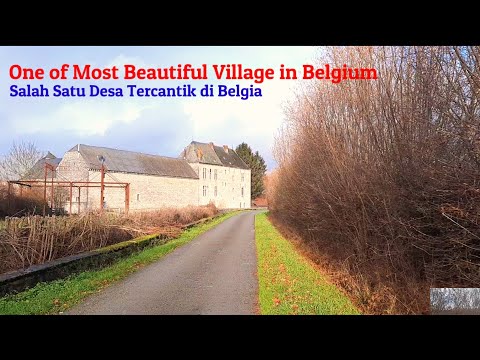
limestone houses, fountains and a castle-farm near Hotton
Ny is a village in Hotton municipality, in the Belgian province of Luxembourg. Small streams, fountains and long limestone farmhouses shape its streets. A church and a substantial castle-farm mark the historic core, while the surrounding Famenne countryside offers walks and outings towards Hotton’s caves and the Ourthe. The village and these nearby attractions make complementary visits, with travel between them.
| Municipality | Hotton |
|---|---|
| Municipal registered population at 1 January 2026 | 5,700 |
| Municipal area, WalStat revision of 22 May 2026 | 57.02 km² |
National Register figure for the whole municipality, including its other settlements. It is not a count of the historic village alone.
A medieval fief, rather than a dated foundation
A charter of 24 April 1232 in the Diplomata Belgica corpus mentions the fief of Ny. Gilles, castellan of Durbuy, acknowledges his tenure under Ermesinde, Countess of Luxembourg and La Roche. The text also refers to appointing a mayor and aldermen to exercise seigneurial rights.
It establishes a medieval community and administrative structure already in existence. It is not a foundation charter. Nor should the date of the present castle-farm be mistaken for the beginning of the settlement.
Today Ny forms part of Hotton. The registered population above covers the whole municipality, including its other settlements, and cannot be treated as a village-only count.
How the castle-farm worked
The large limestone quadrangle chiefly dates from the second half of the seventeenth century. Each side is approximately sixty metres long. Residential and agricultural functions shared a site formerly surrounded by a moat.
The entrance tower retains the recess associated with a drawbridge. Its orderly arrangement reflects the practical management of a farm as well as the status of the residence.
The ensemble illustrates an earlier relationship between landed authority and agricultural work, before later country houses increasingly separated themselves from farms. It has private uses; architectural interest should not be confused with unrestricted interior visiting.
Following water through the streets
Fountains and troughs provide an enjoyable thread through Ny. Examples beside the church and presbytery walls connect the village’s water supply with domestic life and livestock.
Limestone dominates the traditional houses and long farm buildings. Half-timbered gables with brick infill introduce variety. Rue de l’Espinette and Rue des Fontaines retain numerous eighteenth- and nineteenth-century buildings.
Notre-Dame de l’Assomption Church is neo-Gothic, belonging to a different era from the medieval fief and seventeenth-century castle-farm. A nineteenth-century mill adds the history of water power. Walking the side streets reveals these different layers more clearly than looking at one landmark alone.
Paths through the Famenne landscape
An open valley and wooded ridges surround the settlement. Streams, meadows and building stone give the village a close relationship with its terrain. A short heritage circuit can be combined with longer walking towards the Isbelle valley.
Regional cycling routes also connect Ny with Wéris and My. Those are separate villages, rather than neighbourhoods to be visited on a single short stroll. Allow for the full route and its changes in elevation.
Wéris has its own megalithic sites. Their presence makes a rewarding nearby excursion, but does not establish a Neolithic founding date for Ny. The places have distinct historical evidence.
Caves and river discovery outside Ny
Hotton’s caves are outside the village, approximately five kilometres away in the heritage association’s visitor information. Their guided route explores the underground limestone landscape; reservations and access arrangements belong to the cave operator.
RIVEO in Hotton offers aquariums, a reconstructed river habitat and an exhibition currently titled STOP INVASIONS!, examining invasive non-native species. Gardens and mini-golf provide additional options. It is a separate centre, rather than a museum within Ny.
Its November 2026 information gives a normal Tuesday-to-Sunday schedule from September to June, with January closure outside school holidays. Winter planning therefore needs the actual opening calendar, rather than a summer assumption.
Staying in Ny or Hotton
Le Loft, marketed by Les Ny d’Ange, is a holiday property in Ny. It provides an option for families or groups wanting self-catering accommodation; confirm the precise layout and capacity when booking.
Maison Demelenne is a hotel on Rue de la Vallée in Hotton, outside the village. It offers six rooms and breakfast associated with its bakery. This places guests closer to Hotton’s services rather than in Ny’s historic streets.
Those are different forms of stay. Include the journey to meals and activities when choosing between a village property and a hotel in the municipal centre.
Named places for a meal
Le Jacquemart on Rue Simon in Hotton is a family brasserie-restaurant with a terrace and loft accommodation. It suits an outing towards the Ourthe and should not be mistaken for an establishment on Ny’s main street.
La Command’Rie on Rue Haute is another Hotton bistro-restaurant listed by the provincial tourism organisation. Published hours vary between directories, so direct confirmation is useful before reserving.
A self-catering stay in Ny needs shopping and an evening return journey planned alongside restaurant choices. These practical details help make a countryside visit comfortable.
Rail connections and road approaches
Melreux-Hotton provides the regional railway gateway, followed by an onward journey to Ny. The station is not in the village itself.
RIVEO’s directions identify road approaches from Namur using the E411 and N4 towards Marche, or from Liège and the Luxembourg–Bastogne axis using the E25. These bring visitors into the Hotton area before the final local section.
For a longer-term move, examine connections with Hotton and Marche-en-Famenne for shops, services and employment. The actual property location and transport connections matter more than a straight-line measure across the map.
Sources
- Diplomata Belgica, charte 27736 : fief de Ny, 24 avril 1232
- Château-ferme : disposition, fonctions et datation
- Geopark Famenne-Ardenne : pierre, eau et habitat traditionnel
- Patrimoine du village et excursions autour de Hotton
- Circuit dans les rues de l’Espinette et des Fontaines
- RIVEO : aquariums, exposition et activités de découverte
- RIVEO : périodes d’ouverture et accès à Hotton
- Grottes de Hotton : réservation des visites
- Les Ny d’Ange : gîte Le Loft à Ny
- Hôtel Maison Demelenne : chambres à Hotton, hors de Ny
- Le Jacquemart : brasserie-restaurant à Hotton
- Ardenne Belge Tourisme : La Command’Rie à Hotton
- Belgian National Register: municipal figures, 1 January 2026
- IWEPS / WalStat: superficies communales (2026)