Nousiainen is a small rural municipality in Southwest Finland whose historic centre sits within reach of Turku yet keeps the scale of a farming community. The municipality counted 4,667 residents on 31 December 2025; that figure covers the entire municipality, whose villages and countryside extend well beyond the church-centred settlement. For a visitor, the appeal lies in how a modest local landscape carries several layers at once: a medieval parish site, a working rural service centre and paths into the broad woodland and wetland country of the Kuhankuono region.
A church above the Hirvijoki
The most recognizable landmark is the Church of St Henry, on a high bank above the Hirvijoki River. The church is not just a monument in isolation: traditional meadows frame the site, and a footbridge connects the church grounds with the rectory area. Inside, visitors encounter the medieval building's brickwork, painted brick patterns, sculpted details and historic objects, including the memorial sarcophagus associated with Bishop Henry. The parish dates that carved memorial to about 1415–1420 and describes it as a cenotaph donated by Bishop Maunu Tavast.
Its early history needs careful wording. Reliable medieval documents mention a church at Nousiainen from 1232, but the parish history says that reference belongs to an earlier church, probably a smaller wooden building, rather than the stone structure visible today. The parish associates the present church's building campaign with Bishop John I after 1286; that is an architectural-historical interpretation, not a surviving foundation date carved into the building. The story of Bishop Henry's mission, death around 1156 and burial at Nousiainen belongs to a powerful religious tradition discussed by historians, but the narrative should not be confused with a fully documented biography.
From local history to open-air country
Beyond the church, the municipality's visitor list points to a scattered set of places best explored by car or bicycle. Emovaha is a large glacial erratic in Santamala, on private land; it can be viewed from Koljolantie, so visitors should stay on the public road and not enter the property. The municipality also describes the Hirvijoki valley as a cultural landscape, identifies a local-history museum in Topoinen, and connects the area with the Kuhankuono boundary stone and the Kuhankuono trail network. Those trails reach into the forest, rocky terrain and raised bog landscapes of Kurjenrahka National Park. Check the current trail map and conditions before choosing a route.
Nousiainen is also a living service centre rather than an open-air museum. The municipal overview lists a grocery store, library, post office, Matkahuolto service, bank, gym, café and pizzeria around the centre, alongside small businesses and local producers. Farm and direct-sale outlets offer a seasonal way to meet the area's agricultural economy; the municipality publishes current information on participating businesses. The near-Turku location supports everyday commuting and makes the municipality a practical countryside excursion from the regional city, while local attractions are spread across villages and require a little planning.
Getting there and planning a visit
Highway 8 links Nousiainen with Turku, which the municipality places at roughly a quarter-hour's drive from the centre in normal conditions. Bus routes 117–119 also connect the municipality with Turku through the Seutu+ system, but departures, stops and fare rules can change; check the current operator timetable before leaving. The church is normally open around services and by arrangement, with a separate summer road-church season, so confirm access in advance. For a fuller day, combine the church and river valley with a walk in the Kuhankuono area or a stop at a farm shop, rather than assuming every rural site has staffed visitor facilities.
 Nousiainen videoilla: kirkko, kylämaisema ja kelloperinne
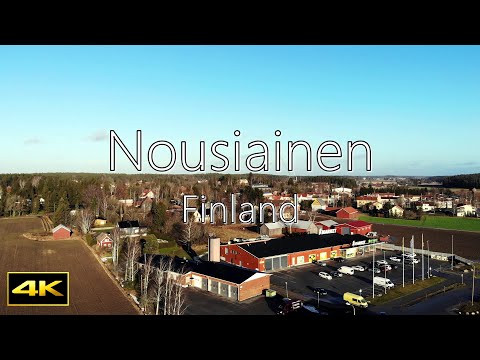 LUNITO Finland’s 2025 aerial film offers a broad view of Nousiainen and its rural surroundings. The title calls it Finland’s most historical place, a promotional superlative that should not be read as an established ranking. The footage is more valuable as a visual orientation to the settlement and landscape; use municipal and parish sources for documented history and practical details.
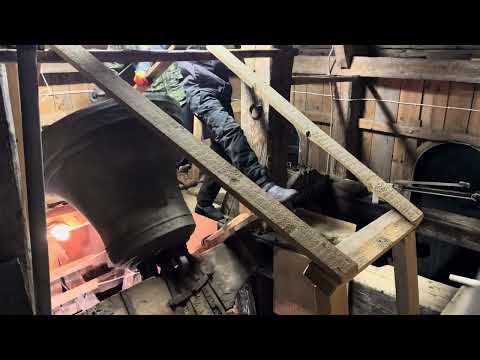 Supavit Nummelin records an old style of swinging church-bell ringing at Nousiainen. The clip focuses on the rhythm and physical movement behind the custom, rather than serving as a general tourism film. It adds a living sound to the church’s heritage story, while leaving visitors to check locally whether bell demonstrations or church visits are scheduled on their chosen date.