Neuendorf am Main is a small Lower Franconian municipality made up of two settlements, Neuendorf and Nantenbach. The Main forms its southern edge; wooded Spessart slopes rise behind the built-up places, while Lohr am Main and Gemünden am Main sit to either side. The municipal register counted 820 people across the whole 9.64-square-kilometre municipality on 30 June 2026: 793 main and 27 secondary residences. This is a dated local total, not a count of Neuendorf village alone. The setting suits a slow visit built around walking, cycling and small-scale local history rather than a resort itinerary.
Two settlements, a medieval record and a careful distinction
The municipal chronicle gives 27 May 1325 as the first written mention of both Neuendorf and Nantenbach. The municipality regards Nantenbach as the older part, and says Neuendorf probably existed before its first surviving record; neither statement supplies a precise foundation date. The town’s proposed explanation of the name Neuendorf as a “new village” is explicitly a supposition. The safer history begins with the surviving document, not a story of an ancient or Roman foundation.
For centuries, the settlements stood within shifting estates and jurisdictions associated with the Counts of Rieneck, Mainz, Hanau and the Lohr administration. The land above the river is formed from Buntsandstein, and the municipality’s history describes farming on relatively poor soils. Nantenbach’s former tithe house and barn point to a world in which agricultural dues and obligations shaped everyday life. The local chronicle also records that people from both villages joined the Peasants’ Revolt in 1526, followed by compulsory changes of confession in 1544 and 1605. These are entries from the town’s own chronology, not scenes reconstructed for a visitor.
A church and a community shaped over time
A chapel was built in Neuendorf in 1717 after negotiations for a site in Nantenbach failed. It was enlarged in 1928–29, and the present parish church of St Sebastian was dedicated on 15 September 1929. Its story matters as much as its scale: the local chronology describes earlier dependence on neighboring parishes and the community’s long effort to secure worship closer to home. The municipal coat of arms links the church’s patron saint, represented by crossed arrows, with the red and gold associated with Rieneck rule.
Work and landscape have changed together. An 1834 municipal census entry lists 22 farmers among 264 residents, alongside half-farmers, day laborers, linen weavers, fishers, shoemakers, smiths and wagon makers. The county describes Neuendorf as strongly agricultural until about 1950 and later as a residential community. Today’s municipal business directory shows a varied mix of small firms, including metal-component and concrete-product makers and vehicle repair. Mainfränkische Werkstätten also operates at Nantenbach. The historic woodworking and barrel-hoop trade survives in the town’s heraldic memory; it should not be mistaken for a claim that this is the present-day dominant industry.
Forest paths, a woodland gallery and machinery
The Neuendorfer Waldpfad is an especially useful way to understand the place beyond its river frontage. This free public route runs for about 2.5 kilometres and has 18 stations on forest management, tree species, felling and the uses of local timber. It turns the surrounding woods into an outdoor lesson in how a working forest is cared for. Families can take a different, more imaginative walk above Nantenbach: the municipal hiking page describes a 2.61-kilometre Märchenwald circuit with about 89 metres of total ascent, starting near the wetland and the Mariengrotte. The path winds through woodland to figures made from natural materials; the grotto, Kneipp basin and forest figures are reached on foot, and parking should be left before Grottensee. Some of the ground is natural forest floor, so sturdy footwear is sensible.
In Nantenbach, the Vehicle and Technology Museum adds a very different kind of collection to the walk. The county museum register describes roughly 800 square metres of restored vehicles and machinery, including cars, motorcycles, racing boats, aircraft engines, radios and a 1912 MAN steam engine. The operator currently lists opening from May to the end of October on the first Sunday of each month, 11:00–16:00; another official directory shows different hours, so check directly before making the trip. The upper reservoir of the Langenprozelten pumped-storage plant, on the higher ground, is another municipal walking or cycling destination with views across the Spessart. It is an industrial landscape, not a visitor tour of the plant.
Across the river, onward by bike or bus
Across the Main, the Schönrain ruin is the most striking landmark in Neuendorf’s view. It is not in Neuendorf: it lies on the Gemünden side. A Benedictine monastery is documented there from about 1080; after damage during the Peasants’ War in 1525, the Counts of Rieneck acquired and rebuilt the site as a residence. Later it served forestry administration before becoming a ruin. The Bavarian State Forest describes a separate approach from a public parking area on MSP 11 between Steinbach and Hofstetten: about 1.7 kilometres uphill on foot, or roughly 30 minutes. It is not a direct crossing from Neuendorf; check access conditions and forest guidance before setting out.
Neuendorf’s river connection is practical as well as scenic. A continuous riverside cycle link runs toward both Lohr and Gemünden, and the Main makes those neighboring towns natural additions to a stay. The village’s own railway station, opened in 1901, closed in 1982. Current visitor information recommends taking a train to Lohr or Gemünden and continuing by bus; the district’s timetable service is the place to check routes, request-only trips and temporary diversions. By car, the county lists approaches from the A3 via Marktheidenfeld and Lohr, or from the A7 via Hammelburg and Gemünden. Neuendorf’s municipal tourism directory lists a few holiday apartments and local food options, but opening times and availability are limited enough to confirm ahead.
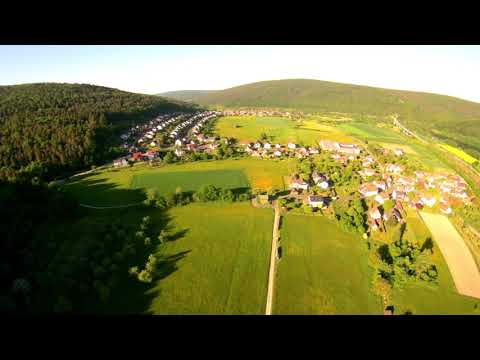 Neuendorf am Main on film: spring, oldtimers and nearby Schönrain
 This short film is titled after Neuendorf’s Vehicle and Technology Museum, and its description identifies an oldtimer gathering. It points viewers toward a local collection of historic vehicles and machinery, but does not establish museum opening dates or guarantee that every item described in the collection is shown. Check the museum’s own current visitor information before planning a visit.
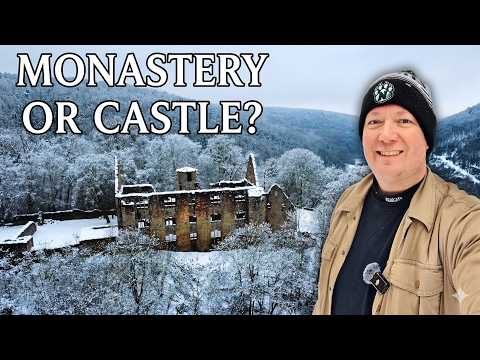 The Exploring Author’s winter episode follows snowy forest trails from Gemünden to the Schönrain ruins and considers the site’s transition from Benedictine priory to Rieneck residence. Schönrain stands across the Main from Neuendorf, on the Gemünden side; the video is a neighboring excursion rather than footage of Neuendorf itself. Its historical interpretation is a useful companion to the walk, while access and trail conditions still need checking locally.