Mönsterås is a working coastal town whose centre still carries the shape of a market place. Storgatan and the square sit between the sheltered inner harbour and the broader landscape of Kalmarsund; a short walk shifts the scene from shopfronts and civic buildings to water, boat masts and the low eastern horizon. It feels lived-in rather than staged: the old trading core is part of an everyday service town, while the sea and wooded countryside remain close at hand.
Statistics Sweden counted 5,127 people in Mönsterås tätort, on 534 hectares of land, on 31 December 2023. That figure describes the continuous built-up settlement defined by SCB, not Mönsterås municipality, which also includes several other towns, villages, islands, farmland and forest. The distinction matters when reading local economic information: the large forestry complex associated with Mönsterås is a regional industrial employer, while no comparable employment breakdown for the statistical town alone was located.
A market place shaped by the coast
The municipal heritage survey traces Mönsterås as a market place under Kalmar from 1620 and as an independent köping from 1862. Trade and settlement around the present square began in the seventeenth century. Small market sheds gave the place a particular character in the eighteenth century; by the end of the century, Storgatan had acquired a more town-like line of buildings and commerce had grown. A public square pump came into use in 1870, a practical landmark as well as a meeting point. The harbour has long connected the settlement to the coast, though its shallow approaches historically constrained larger vessels.
That layered story is still legible in the centre. The Modéerska house on Storgatan is a protected eighteenth-century merchant house and the oldest wooden building in town. Its surviving doors, tiled stoves and shop chamber recall the mixed life of a trading yard, rather than a purely domestic house. The local craft association Månsken uses the carefully restored shop space for locally made work and seasonal summer exhibitions; opening arrangements vary, so treat a visit as something to check ahead. Mönsterås Church, consecrated in 1847 in Empire style, records the growth of the parish and the replacement of a smaller church that no longer served the congregation.
Industry beside a small-town centre
Forestry and wood processing are part of the wider Mönsterås economy. Södra facility information in Swedish describes an integrated site with pulp production, a sawmill, biomethanol and forestry services. The company reports roughly 600 employees at the complex, annual pulp capacity of 750,000 tonnes and sawmill capacity of 450,000 cubic metres. Its first pulp was produced here in 1958, and a sulphate-lignin plant is planned for 2027. These are company-reported figures for the industrial site, not a census of jobs in the tätort; the plant is a major working facility, not a visitor attraction with walk-in access.
The inner harbour is more directly part of a visitor’s day. Mönsterås municipality lists a guest harbour and motorhome pitches there, with a newer service building offering toilets, showers and laundry for paying boat and motorhome guests, plus a public toilet. The waterfront is being improved and its precise access can change during works. The town library on Norra Tingsgatan is another practical civic stop. Check current opening times and harbour arrangements rather than relying on an old schedule.
Walk the town, then follow the coast
For a low-effort introduction, Hälsans stig is a seven-kilometre loop through existing paths and pavements, designed to avoid steep hills and stairs. Further afield, Mönsteråsleden runs for more than 80 kilometres across the municipality, linking with Ostkustleden in the north and Högsbyleden to the southwest. It follows rivers, shorelines, woodland and reserves; the municipality warns that rock slabs can be slippery after rain and that some sections grow over in late summer and autumn. Near Kronobäck, a signed 2.4-kilometre loop begins by the monastery ruins and circles a wetland known for spring pike, old oaks, archaeological remains and birdlife. Lövö nature reserve, about 15 kilometres from central Mönsterås, offers a different archipelago landscape of a historic village, meadows and shore paths.
Kronobäcks Johanniter monastery church was built in the late fifteenth century and is described by the municipality as a place intended to care for the sick; the surviving ruins and nearby wetland make a rewarding half-day excursion south of town. For transport, Kalmar County regional bus information and journey planner are the dependable way to check connections; services and departure times change. Confirm trail conditions, opening times and transit schedules shortly before travelling.
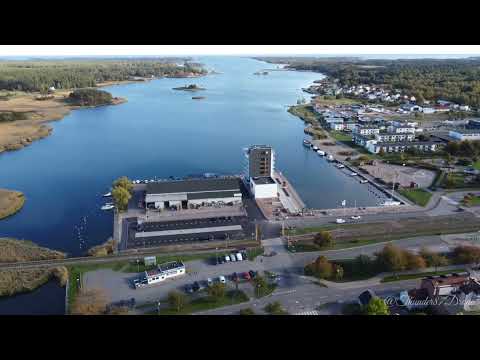 Three Mönsterås-area films: an aerial view, a town slideshow and Pataholm
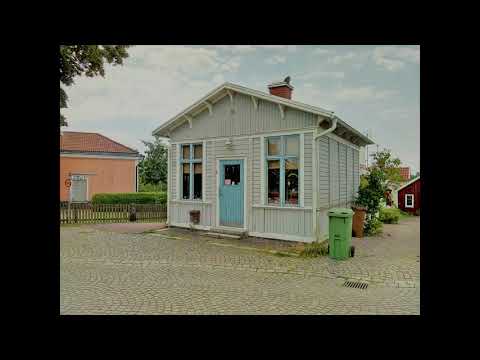 Bernardo Per Fredrik Pebaqués 13-minute-9-second presentation was uploaded on 18 July 2020. Its long title identifies Mönsterås, Småland and the Söderns Städer series; the description calls it a slideshow, walking-tour and photographic presentation with music. That makes it a slower, image-led counterpart to the aerial film, and a record of the creators photographic impressions rather than a current visitor guide. Viewers should use todays municipal information for access, opening times and services, since the harbour and town continue to evolve.
 Pataholm 27 augusti 2022 is a 3-minute-37-second film by Anders Idberg, uploaded on 29 August 2022. Its title and description concern Pataholm, a separate historic coastal settlement in Mönsterås municipality, not the town centre. The municipal heritage service describes Pataholm as a former trading place whose square and merchant yards retain much of their nineteenth-century character. This short film therefore broadens a Mönsterås visit into a nearby excursion. Treat it as a glimpse of another place in the same municipality, and check current access and seasonal opening details before setting out.