Högsby is best understood as a small service town gathered around a river crossing rather than as a monumental old city. The Emån curves through the settlement, while Högsbyåsen gives the built-up area a slightly raised spine above the valley. Roads, railway history and everyday shops meet in a compact centre; beyond it, Emådalen opens into cultivated land and wooded slopes. That mix of a working local centre and close contact with water gives Högsby its unforced, practical character.
Statistics Sweden counted 1,872 residents in Högsby tätort across 267 hectares of land on 31 December 2023. This figure describes SCB's mapped continuous built-up locality, not Högsby municipality, whose territory includes smaller settlements, forest, lakes and extensive countryside. Keeping the boundary clear matters when reading local statistics: municipal descriptions of agriculture, forestry and timber processing apply to the municipality as a whole, not to the town alone.
A crossing with a long memory
The setting explains why people met here. Högsby municipality's cultural-environment programme describes Emån as an old communication route between coast and inland, and Högsbyåsen as a travel corridor. Archaeological finds and burial grounds in the wider valley show a long human presence, but they do not prove one simple founding date for today's town. The parish name appears as Höxby in a record from 1337; the village name Högsby is recorded in 1418. A church and parish centre stood here by the medieval period, and the crossing developed into a place for commerce, administration and movement through the district.
Water also supplied work. Frövi mill is documented as early as 1344. The municipal heritage programme traces later milling, a brickworks, a sawmill and other water-powered activity around the river. The mill landscape changed as engineering and industry changed; present-day structures should be viewed as evidence of that history, not assumed to be visitor interiors. A popular local tale says that two white oxen were released to decide where the church should stand. The municipality records it as tradition, not as verified history, so it belongs to local storytelling rather than the documented chronology.
Högsby never became a city or a köping, according to the municipal history. Its role instead grew through transport and everyday services. The nineteenth-century railway era added another layer to the old road and river junction: municipal accounts note rail development in the parish from 1874 and the Kalmar–Berga line in 1897. The town hall is a visible civic landmark. Designed in 1913–14 by Kalmar city architect J.F. Olsson, built in 1915–17 and opened on 24 September 1917, its red-brick, national-romantic form reflects the confidence of a growing rural centre.
Working landscapes and a town-sized visit
The surrounding economy still reflects the landscape. Högsby municipality describes farming in the fertile Emådalen, forestry across the wooded uplands and timber industries, including pellet production. It also notes employment links with Oskarshamn and Mönsterås. Those are municipality-wide features, not an employment profile for Högsby tätort. In town, the older pattern of milling, local trade, public services and transport is the more useful lens: Högsby is a place where residents come for practical errands as well as visitors pause between the coast and inland Småland.
Lanhagen, a municipal home-history park, offers an approachable introduction to local building traditions and community memory. Paths follow the landscape beside Emån, and the municipal walking information describes Lanhagsrundan as a riverside outing in Högsby. The town's library is another active civic stop; check its current visitor information before planning around service hours. Högsby has also been associated with Greta Garbo through a former museum exhibition in an old bank building. Municipal records say that exhibition closed in November 2024 and its contents awaited a new display setting. No replacement currently open to visitors was confirmed, so treat the film and the former exhibition as historical context, not as a promise of museum access.
Follow the river, then check the timetable
For a closer look at the valley, choose a short walk by the Emån or consult the municipality's current map for Lanhagsrundan. A regional cycle route from Berga runs for about 30 kilometres through Emådalen and passes Högsby-area landmarks including the old river channel and power station, Lanhagen and the municipal building. It is a route through the landscape, not a separated cycleway throughout; municipal advice notes sections with traffic exposure, so check the map, surface and road conditions before setting out. Canoeing is possible on Emån, but the river has both calm reaches and rapids; select a section suited to your experience and check water conditions and local guidance.
Kalmar County Public Transport publishes route maps and a Högsby-area on-demand transport timetable. Use its current journey planner for actual departures and connections rather than relying on an old timetable. Openings, route maintenance, river conditions and seasonal services can change, so confirm details shortly before travel. Högsby's appeal is its scale: the river and civic landmarks are close enough to understand on foot, while the valley and forest roads begin just beyond the centre.
 Three Högsby films: Emån, Lanhagen and the Garbo exhibition
 Besök hembygdsparken i Lanhagen is a 7-minute-6-second municipal film published on 9 October 2025. The title identifies a visit to Lanhagen, Högsby's local-history park, which the municipality presents as a place to encounter community heritage and historic buildings. It adds a human-scale counterpart to the Emån film: one concerns movement through the river landscape, the other a civic green space within the town. The review relies on the film's verified title and official description rather than claiming particular scenes. Seasonal activities and access information can change, so check current municipal visitor details.
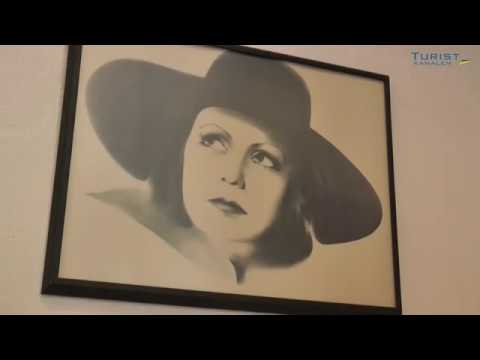 Greta Garbo museet is a 1-minute-3-second Turistkanalen upload dated 2 November 2017. Its title refers to Högsby's former Greta Garbo museum exhibition, which municipal records say closed in November 2024 after the display's previous premises ceased operating. The short film therefore belongs to the history of how the town presented its connection with Garbo; it is not evidence that the exhibition is open today. No replacement venue currently accepting visitors was confirmed. This historical distinction makes the clip useful context, while anyone planning a visit should seek a current announcement rather than travel on the assumption of museum access.