Moissac is a town of two rhythms. In the historic center, pilgrims and visitors gather around the abbey church of Saint-Pierre; a short distance away, the Tarn, the Garonne canal and fruit-growing slopes shape a more open, working landscape. That combination explains why a visit can move from carved Romanesque stone to a waterside walk, a market and the orchards that still give the place much of its identity.
An abbey town, not a legend of one day
Benedictine monks settled here near the end of the eighth century, at the foot of the Quercy slopes and close to the Tarn–Garonne confluence. The abbey grew into a major religious and intellectual center, especially after its affiliation with Cluny in the mid-eleventh century. Its Romanesque cloister, consecrated in 1100, is arranged around eight pillars and 76 carved capitals; the south portal of the abbey church carries a monumental Last Judgment. The cloister and portal are included in the heritage listing for the French routes of Santiago de Compostela. A local story credits King Clovis with founding the abbey, but the town itself presents that as a legend; the firmer historical account begins with the Benedictine community documented centuries later.
The abbey’s importance was also economic. Moissac became a port for the Quercy and neighboring uplands, shipping grain, flour and wine toward Bordeaux. The riverfront, old merchant houses and later transport infrastructure record that shift from monastic center to trading town. The lateral canal of the Garonne, part of the Canal des Deux Mers route, passes through the area and crosses the Tarn on the Cacor canal bridge. Along its towpath, the modern cycle route follows an old corridor of movement and commerce.
Fruit country and a city rebuilt
Moissac is closely associated with Chasselas, a table grape grown on the surrounding slopes. The protected designation for Chasselas de Moissac was granted in 1971. Orchards and vineyards remain part of the regional economy, alongside services and tourism. INSEE counted 13,419 municipal residents in 2023 and 5,356 jobs located in the commune. In its 2024 establishment data, agriculture, forestry and fishing made up 11.2 percent of establishments, while commerce, transport and services represented 59 percent. These are local workplaces and registered establishments, not a description of every household. The visitor can meet this economy through seasonal produce, markets and the area’s fruit-growing landscapes; availability and harvest timing depend on the season.
The town also carries the mark of disaster and reconstruction. Floods in March 1930 damaged entire neighborhoods. Their rebuilding introduced an Art Deco layer that can still be read around the Sainte-Blanche quarter and the riverfront. The Uvarium, created in the 1930s as a grape-juice cure pavilion, is a distinctive remnant of the period when Moissac promoted its fruit and climate together. The covered Hall de Paris, opened in 1932, inherited the central role of the earlier Chasselas market. These buildings show a modern chapter of the town’s history alongside the medieval abbey.
Walking, cycling and reaching the town
Begin at the abbey complex, then let the visit widen outward: the cloister and portal reward close attention, while the old streets, market hall and riverfront make the abbey part of a lived town rather than an isolated attraction. The official heritage service offers guided visits and seasonal programs; opening arrangements change, so check before setting a date. Moissac is also a stop on the pilgrimage routes to Santiago, and the intercommunal tourism office provides walking and cycling itineraries for the town and its surrounding countryside.
The Canal des Deux Mers cycleway is a natural choice for a longer day: the canal towpath and the Cacor canal bridge connect the town with the broader river landscape. The Tarn’s banks offer gentler walks, while the surrounding slopes lead toward orchards and vineyards. Moissac has its own liO train station, with services on the Toulouse–Agen corridor. The operator lists trains to Toulouse at an average journey time of about 48 minutes, but stops, schedules and service patterns vary; check the live timetable for the date you plan to travel. The station is close enough to the center for a visit on foot, though visitors with luggage should check local connections and accommodation arrangements.
 Moissac in three films: Romanesque art, fruit country and conservation
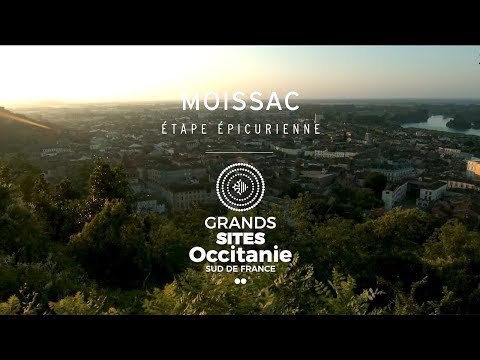 The regional tourism film presents Moissac as an “epicurean stop,” bringing its fruit-growing country and visitor identity into the foreground. It complements a close look at the abbey with a wider sense of place: orchards, local produce, the river corridor and a town made for a longer pause. Use it as an invitation to explore, while checking current harvest periods, opening hours and travel details independently.
 This municipal film focuses on the desalting of the cloister capitals, a conservation operation distinct from simply describing their imagery. Its subject makes the care behind a famous monument visible: preservation involves technical work as well as public admiration. For travelers, it adds context to the carved stone seen in the abbey and encourages a more attentive visit. It is a record of a particular conservation operation, not a timetable for current access.