Menet sits in north-west Cantal at about 700 metres, between the slopes of Puy de Menoyre and Puy d’Augoules and beside a natural lake. Its character comes from the close relationship between stone, water and village life: pale trachyte appears in houses and the church, while a lakeside path and sculptures made through local stone symposiums invite visitors beyond the central square. INSEE’s 2023 reference population is 521 for the entire commune, effective from 1 January 2026.
What the landscape and archaeology can tell us
The municipality’s heritage guide describes Bronze Age swords found at Alliès and an occupied hilltop site on Puy de Menoyre, where a fortification stood in the early Middle Ages. These are clues to a long human presence across the surrounding territory, not proof that the present village was founded in the Bronze Age or by Romans. The municipality’s own history page also notes that the lake’s geological formation has been explained in conflicting ways; its natural glacial-barrier origin is the current local description, while older geological accounts remain debated.
Church, stone and everyday architecture
Saint-Pierre is the village’s central landmark. The Romanesque church is protected as a historic monument and preserves a choir and architectural elements associated with a 12th-century priory. Its carved capitals include a pair of dancers performing the bourrée and figures interpreted as builders. A 16th-century oak Christ, also protected, adds a later layer. Nearby, the fountain built in 1863 and the surviving wash places, bread ovens and crosses make visible how shared water and food infrastructure once served a spread-out rural community.
Local trachyte and the ochre volcanic tuff of Brocq give Menet much of its distinct building texture. The municipal guide records that stone quarrying expanded with farming and construction, and that a quarry still operates today. The craft has also found a contemporary expression: sculpture symposia have taken place since 1992, placing works around the village, beside the lake and along the Chemin des pierres. This is not a single enclosed museum; it is an outdoor route woven into everyday paths.
A lake with ecology and a complicated past
The lake covers about 14 hectares at roughly 700 metres above sea level. The municipality describes reed beds, aquatic irises and white and yellow water lilies, as well as water chestnut listed as a regional conservation concern. A signposted interpretation walk introduces the landscape, wildlife and local history. The town guide also remembers 19th-century attempts to drain the lake for farmland, including an authorization in 1830; the scheme was abandoned, and the present water landscape became part of Menet’s identity. Check local notices for current access, fishing rules and water conditions rather than assuming swimming facilities.
Services, walks and the route in
Menet is small but has everyday services listed by the municipality, including a bakery and grocery, café, restaurant, bar-tabac, hairdresser, school and communal postal agency. The town also lists holiday accommodation, gîtes and guest rooms. INSEE recorded 11 employer establishments in its narrow end-of-2023 statistical scope; agriculture, forestry and fishing, and commerce, transport and services each accounted for 36.4 percent. That measure excludes much activity and should be read as a snapshot, not a full portrait of local work.
Three published walks give visitors a concrete way to explore: the Chemin des pierres is listed at 3 km, the Puy de Menoyre route at 5 km, and the Vallée du Violon at 9 km. The nearby service hub is Riom-ès-Montagnes, about 7 km away according to the municipal directory. Destination Haut Cantal lists regional coach C08 connections from Clermont-Ferrand to Riom-ès-Montagnes; for the last leg, check the Pays Gentiane on-demand service, which the mairie lists on Tuesday, Wednesday and Saturday mornings and Thursday afternoons, with booking by 18:00 the day before. Confirm route coverage, timetable, trail conditions and business openings before travelling.
 Menet on film: stone walks, village life and a lakeside stay
 This film comes from the operator of the Village Vacances du Lac de Menet and is explicitly about the holiday site. It is useful to travellers considering a stay beside the lake because it provides the operator’s own visual presentation of the accommodation setting. It is promotional material rather than an independent assessment, and a video does not confirm current opening dates, facilities or availability. Contact the operator before planning around any specific service.
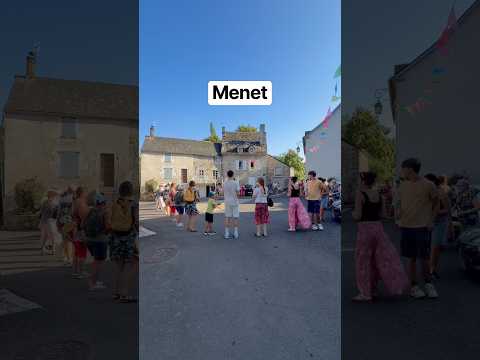 Raphaële Matthey’s 2026 video identifies Menet as a Petite Cité de Caractère and situates it within the Cantal and Auvergne. That makes it a distinct, recent local portrait alongside the regional walking report and the accommodation operator’s film. The title signals a heritage theme, but the video should not be treated as a source for archaeological claims or dates. The municipality’s heritage guide and current visitor notices remain the better references for those details.