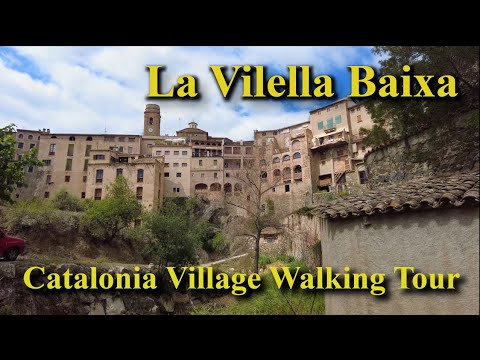
La Vilella Baixa: steep streets and tall riverside houses in the Priorat
La Vilella Baixa is a small municipality in the Priorat district of Tarragona province. Its village stands where the Montsant River meets the Escaladei stream, beneath the Montsant range. That setting shapes its appearance: unusually tall façades rise above the water, while narrow streets higher up follow the steep ground. According to Idescat, the municipality had 202 residents in 2025, covered 5.62 km² and stood at an altitude of 218 metres. The population figure is for the municipality, rather than just its historic centre.
Origins and historical memory
The town council places the village's origins in the period of Andalusi rule, while treating earlier settlement of the site as a possibility, not a demonstrated fact. It also considers the first enclosure and castle probably to have originated in that period. After the territory came under Christian rule, the settlement became part of the barony of Cabassers and its defences were altered. The municipal sources consulted do not establish a Roman, Greek, Phoenician or Celtic foundation for the present village. Possible ancient use of the site should be distinguished from the documented history of the settlement.
The older name, Vilella de Baix, appears in a 1712 marriage register from La Torre de l'Espanyol. During the Castilianisation of place names under Philip V, Vilella Baja came into use; La Vilella Baixa later became the established Catalan name. The carrer que no passa, literally the street that does not go through, still has an old entrance portal. According to the council, residents sheltered behind that gate during periods of war, including the Napoleonic invasion and the Carlist wars. It makes clear why a short dead end lane once had a defensive role.
One event firmly embedded in local memory is the Santa Tecla flood of 23 September 1874. The council recounts that the rivers rose above the bridge and caused considerable damage. The episode adds another dimension to the landscape: the confluence that makes the village distinctive has also brought danger. The available account does not justify claims about particular buildings being destroyed.
What to see in the village
The houses above the Escaladei ravine are La Vilella Baixa's best known sight. Because of the sharp change in level, some have seven or eight floors, with their main entrance on what appears from below to be the fourth or fifth level. Writer Josep M. Espinàs compared them to the “New York of the Priorat”. The expression conveys their unexpected height in a rural village. These homes are part of a larger network of streets and squares, rather than a modern high rise district.
A walk can begin at the stone bridge over the Montsant and climb towards the old quarter. The town council describes the three arch bridge as Romanesque. From there, look for the carrer que no passa and its gate, notice how the houses can be entered at different levels, and continue to the eighteenth century parish church of Sant Joan Baptista. Coll de l'Ermita provides a broad view of the façades, the waterways and the hillside. Walking through the village reveals more about its architecture than a single panoramic photograph can show.
Beyond the streets, the Priorat tourist office identifies five marked short walks around the municipality. They offer ways to explore the vineyard landscape and the Montsant surroundings; choose a route according to its signs and conditions on the day. The tourist office also notes that some family wineries welcome visitors. Check tours and opening times in advance, since small businesses may require a reservation.
Wine, food and a place to stay
Vines are a visible part of the Priorat landscape around La Vilella Baixa. In addition to wineries, the district tourism guide lists a farm shop associated with La Vilella Baixa Vinícola del Priorat. The local tourist information says Santa Quitèria is celebrated on 22 May and that the principal festival usually coincides with the second Easter period. Anyone hoping to visit during a festival should confirm the programme for that year.
For a meal, the district tourism guide lists Restaurant Ca l'Artur on Carrer Priorat. The municipality also lists a restaurant, bar and shop, though individual opening arrangements can change. For accommodation, the current Priorat directory includes Apartaments Ca la Victòria, Ca la Iolanda and Casa Victòria within the municipality. An overnight stay in the village is therefore possible without assuming that there is a conventional hotel. Check availability and terms directly with each property. Falset and other Priorat villages provide further options for a day trip.
Getting there
From Falset, the tourist office directs drivers along the T-710 through Gratallops. From Reus, its suggested road route follows the N-420 to Falset and then the T-710. The indicated connection from Cabacés is the T-702. From Cornudella de Montsant, take the C-242 to La Venta d'en Pubill, then the T-702 through Poboleda, Escaladei and La Vilella Alta. These are road itineraries, not public transport timetables. Check road conditions and parking before travelling.