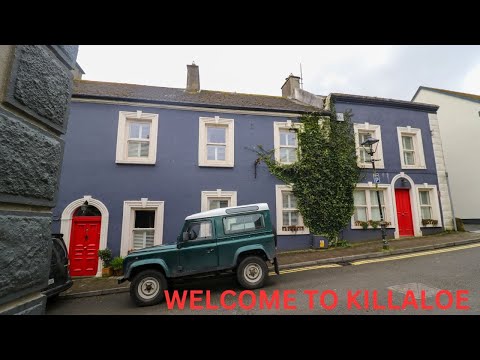
Killaloe stands on the County Clare bank of the Shannon where the river leaves Lough Derg. Across the water is Ballina in County Tipperary, linked with it as a pair of neighbouring towns. Cathedral, canal-side walks and views of the bridge give the centre its character, while the surrounding landscape preserves traces of early medieval power. Recent transport changes have also altered the visitor experience: the old bridge now belongs to pedestrians and cyclists, with vehicles using the newer crossing.
| Residents | 1,666 |
|---|---|
| Area counted | Killaloe, Co Clare — census built-up area |
A strategic river and Brian Boru
The Killaloe area was a power base of the O’Brien dynasty before its centre shifted towards Limerick. Brian Boru, High King from 1002 until his death in 1014, is closely associated with this landscape. Kincora, within the present town, and Béal Ború to the north were distinct sites; the surviving ringfort should not be presented as a complete palace preserved from his reign.
Brian Boru’s Fort is an unguided national monument overlooking the river corridor. Its banks, ditch and raised interior convey the defensive character of the site, although the buildings that once stood here have gone. The position near the narrowing waterway helps explain its strategic value. Visit for an earthwork and its setting, rather than expecting a reconstructed castle or a staffed indoor exhibition.
St Flannan’s Cathedral
St Flannan’s Cathedral brings another strand of medieval Killaloe into view. The present church contains important twelfth- and thirteenth-century architectural material, including a Romanesque doorway incorporated into the later building. Its overall history includes repeated alteration and conservation; describing everything as one original style would conceal those changes.
The cathedral remains a Church of Ireland place of worship. Its visitor information and event programme provide ways to plan a visit beyond viewing the exterior from the river. Look at the relationship between portal, nave and crossing, and allow time for the quieter details inside when access permits. A church service, concert and ordinary sightseeing visit use the same building differently, so follow the arrangements for the occasion.
Two bridges with different purposes
The Brian Boru Bridge opened on 22 May 2025 as part of the new bypass scheme. The councils subsequently made the old Killaloe–Ballina bridge permanently pedestrian and cycle only from 17 October 2025. Older descriptions of driving through its narrow arches no longer describe the present route.
For visitors, the change makes the historic crossing part of a walk between the two centres. Approach it on foot for river views and continue into Ballina, remembering that the county boundary is crossed along the way. Drivers should use the new road connection and then park for the town walk. A walking route across the old bridge and a driving route between two addresses now follow different lines.
The water, the canal and Lough Derg
Killaloe’s river frontage and canal-side paths offer a gentler outing than the surrounding hills. Boats and harbours connect the town with recreation on Lough Derg, while the position at the lake’s southern end explains the meeting of river, settlement and transport routes. A short walk can concentrate on the cathedral, waterfront and old bridge before returning through the streets.
Boat trips and water activities are separate services, with operating seasons and weather conditions to check directly. They are not guaranteed simply because boats appear in a harbour photograph. Beyond the centre, the Clare and Tipperary shores offer different approaches to the lake. Keep the distinction between a town walk, a lakeside excursion and a longer hill route when planning the day.
Where to stay and eat
Killaloe Hotel & Spa is at Kincora Harbour on the Clare side. It offers accommodation and O’Briens Restaurant, giving a dining option in Killaloe itself rather than requiring a journey to Limerick. Its published food information distinguishes breakfast, lunch, dinner and Sunday service, so choose the appropriate booking for the intended visit.
Staying near the harbour creates a different base from a room directly by the old bridge. Check the actual walk to the centre and the location of the bus stop, particularly for an evening return. Ballina also forms part of the practical visitor area, but an address there is in County Tipperary. This matters when arranging transport or comparing accommodation descriptions that use the joint destination name.
Connections and population
Bus Éireann route 323 serves the Limerick–Killaloe–Nenagh corridor, with Ballina also appearing in its stop list. Limerick is a useful city gateway, while Nenagh provides another connection with the regional network. Check the chosen stop and direction in the current operator timetable rather than assuming both sides of the river have identical departures.
The 2022 census recorded 1,666 residents in the Killaloe built-up area. That figure does not include the separate Ballina population. For someone considering a move, the combined daily geography is nevertheless important: shops, services, accommodation and routes are spread across the two banks. The new road crossing and pedestrian old bridge are therefore changes to everyday movement as well as to the view in a visitor photograph.
Sources
- Office of Public Works: Brian Boru’s Fort
- St Flannan’s Cathedral: history, visits and events
- St Flannan’s Cathedral: architecture and medieval context
- Clare and Tipperary councils: bridge opening and permanent pedestrianisation
- Killaloe Hotel & Spa: harbour accommodation
- Killaloe Hotel: O’Briens Restaurant
- Bus Éireann: route 323
- Central Statistics Office: Census 2022 population, built-up areas