Hyrynsalmi is best understood as a wide Kainuu municipality rather than a compact resort town. Statistics Finland counted 1,984 residents across the municipality on 31 December 2025; that is the population of the entire municipal area, not just the central village. The landscape moves between forested hills, rivers, lakes and scattered settlements. Its visitor experience follows the same pattern: the village centre carries parish and wartime history, while Ukkohalla, on the shore of Lake Syväjärvi, is a separate base for outdoor activities and accommodation.
For a visitor, the municipality’s strongest thread is the way work, travel and landscape have repeatedly shaped one another. A surviving wooden church, a wartime field railway built by prisoners, a tar and turpentine works, old farmyards and a modern year-round resort are not unrelated curiosities. Together they show how people have made a living in a sparsely settled interior where distances, water and forest mattered every day.
A church that outlasted the burning of the village
Hyrynsalmi’s wooden church was built in 1786, the year its parish became independent of Paltamo. Jaakko Rijf designed and built the cruciform church, a notable example of the wooden church-building tradition of the period. The bell tower followed in 1840 under Jaakko Kuorikoski; the smaller bell dates to 1787 and the larger to 1873. The altar painting by Gustaf Hedman of Oulu belongs to the 1830s. Visitors can read the building as a layered place of worship rather than a single-period monument: the church’s late eighteenth-century structure contains later fittings and generations of local use.
That continuity was tested in September 1944. The municipality records that German forces burned almost the entire parish village on 20 September; the church was the only building to survive intact. The main bridges were destroyed, and around one fifth of the municipality’s building stock was lost. The municipality is explicit that the reason for the burning is uncertain. An accident, fear that Soviet forces would follow, and a scorched-earth policy are possibilities it lists, not a proven explanation. A local model of the village before the fire, displayed in the municipal building, gives visitors a way to imagine what was lost without turning an unresolved event into a legend.
The field railway and the human cost behind it
Between 1942 and 1944, German forces built a 178-kilometre narrow-gauge supply railway from Hyrynsalmi toward Vanttaja near Kuusamo. The plan was to continue toward Kiestinki, but the September 1944 peace agreement ended the project. The municipality states that 3,521 prisoners from eight countries built the line with forced labour, using picks and shovels rather than construction machinery. At Hyrynsalmi, the railhead developed into a large complex of sidings, workshops, barracks and prisoner facilities. On retreat, German forces destroyed the infrastructure they had built.
This history makes the old station area more than an abandoned transport site. Municipal scale models reconstruct the wartime yards and the pre-fire village from surviving maps and records. The route also asks a more difficult question about infrastructure: who built it, under what conditions, and what remained after the army left? There is no present-day passenger railway service to plan around here. Arrive by road or check current coach options, and do not confuse the field railway’s dramatic past with an operating tourist line.
Water, rock and forest trails
Komulanköngäs is among Hyrynsalmi’s most distinctive natural stops. The two-part waterfall runs in the Syväjoki, which flows from Lake Lauttajärvi, a few kilometres from Ukkohalla. Its earlier name, Lauttaköngäs, came from the nearby lake. An old mill stands beside a channel cut away from the river; local tradition called that mill race “rosvohotu”. The name is a piece of local vocabulary, not evidence of a robber story. The falls can be combined with a visit to the resort, but water levels, trail conditions and access should be checked before setting out.
Vorlokki’s deep rock fissures lie on the UKK hiking route between the centre and Komulanköngäs. Snow and ice can remain in their shaded bottoms into the warmth of midsummer, so sturdy footwear and care matter even on a summer walk. At Hakokylä, Hiidenkirkko sits at the eastern end of Lake Ylä-Tervajärvi; a lean-to is on the opposite shore. Its name invites folklore, but the municipal visitor account offers a location and access information rather than a documented ancient origin. Treat the place as a striking geological and landscape feature unless stronger evidence says more.
Several shorter outings help visitors choose a scale. Vuorilampi is reached by a marked path just over two kilometres long from the Kuhmo road, about ten kilometres east of the centre; a loop, lean-to, tables and fireplace make it a practical picnic destination. The Mustarinda trail crosses old-growth forest on Paljakanvaara, with route options totalling about three kilometres and a 700-metre marked spur to a lookout. In favourable weather, the tower offers views toward twelve of Kainuu’s highest fells. Luvankoski is a circular route by rapids and the old Niskala farmstead, roughly a fifteen-minute drive from the centre. These are different experiences, from a short viewpoint walk to a fuller riverside loop.
Farm life, tar and a modern visitor economy
Kaunislehto homestead museum offers a close-up of rural life around the turn of the twentieth century. Its farmyard layout preserves the arrangement of the original site, even though some buildings were brought from elsewhere in the municipality. It is a useful companion to the landscape outside: rather than presenting a grand estate, it shows the scale and working character of an ordinary local farm. The museum has traditionally opened in summer, so check the municipality’s current dates before making it the anchor of a trip.
Further from the centre, the Löytöjoki tar and turpentine factory was built in 1924 by Johan Alfred Heikkinen, known as Hallan Ukko. It connects the regional forest economy to a specific place along the river. Visits are arranged as guided excursions, not assumed walk-in access. A separate Jääkäripirtti site is also open only with a guide. The municipality’s economic plan describes a present-day mix in which services are the largest employment sector, with forestry and other bioeconomy activity, agriculture, berries, tourism and wind-power construction also shaping local livelihoods. Those figures and projects have dates; they should not be mistaken for a promise that every development is complete or every service open year-round.
Ukkohalla concentrates many visitor services beside Lake Syväjärvi: the resort lists lodging, restaurants, a market and café, ski slopes, mountain-bike and walking routes, water activities, bowling and wellness facilities. Offerings change by season, and reservations or opening hours should be checked directly. The annual Swamp Soccer World Championships give the area a more playful public face; the municipality describes roughly 2,000 participants in a typical summer edition. Hyrynsalmi can therefore suit both a quiet walking break and a busy event weekend, but visitors should plan around the exact season.
Getting there and planning a visit
The municipality’s transport study gives road distances of about 70 kilometres from Kajaani, 37 kilometres from Suomussalmi and 52 kilometres from Puolanka. Highway 5/E63 is the principal north–south approach; regional roads connect the centre with villages and attractions. Matkahuolto’s nationwide planner is the place to check coach options from Kajaani or other cities for a particular day. Rural distances are considerable, and no regular visitor shuttle between the centre, Ukkohalla and every trail should be assumed. The municipality’s own service-transport routes serve selected villages on certain weekdays, have no fixed itinerary and require advance contact on the travel day; ask the municipality whether a specific journey is available to you.
A rewarding first visit could pair the church and wartime models in the centre with Kaunislehto, then leave a separate half-day for Ukkohalla, Komulanköngäs or a walk at Vorlokki. The tar works, Jääkäripirtti and dispersed trailheads need more planning. Check transport, guided-visit availability, seasonal services, weather and trail conditions before leaving the centre. Hyrynsalmi’s appeal lies in the contrast between a village that carries a difficult history and a landscape that invites unhurried movement through forest, water and hills.
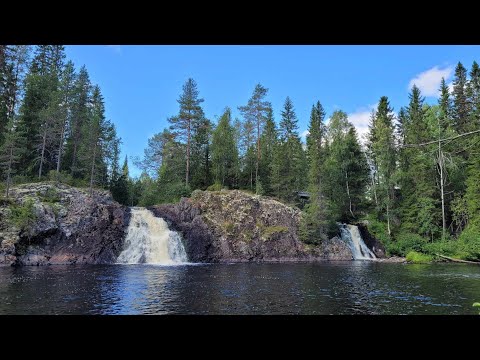 Hyrynsalmi on film: a waterfall, a gorge walk and a stay at Ukkohalla
 Jan Björk’s 2022 upload records a personal trip to the Vorlokki gorge near Ukkohalla. Unlike a resort promotion, it centres on a walk in a rugged natural feature and gives viewers a sense of why the shaded fissures are a different outing from the waterfall stop. It is an older, individual travel record, so conditions in the footage should not be treated as a current trail report.
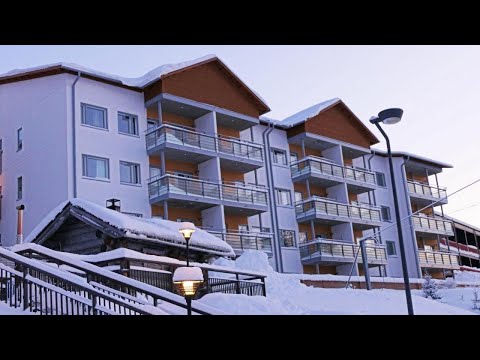 Travel Deewane published this hotel-focused presentation of Ukkohalla in April 2023. It gives a visitor-oriented view of the accommodation hub by Lake Syväjärvi and complements the two outdoor videos with a place to begin planning an overnight stay. Its description advertises particular hotel facilities at the time of filming; services, ownership and availability can change, so confirm current details with the resort before booking.