Hennebont grew where a route had to cross the Blavet. The river, the old bridge and the walled town still explain the shape of the place better than any legend about its origins. The municipality traces the name to the Breton words Hen-pont, “old bridge”, and records Hennebont in a document of 1029. INSEE counted 15,910 municipal residents across the whole commune in 2023; that reference population became legally effective on 1 January 2026. The city’s character is a mix of river port, medieval stronghold, horse heritage and a modern town rebuilt after wartime destruction.
What the archaeology does and does not tell us
Local archaeology has identified a settlement at Polvern with evidence from the late La Tène period and the first century CE, alongside Roman-era coins found elsewhere in the commune. These finds document earlier occupation in the wider landscape; they do not establish that the present town was founded by Rome. The municipal account instead points to medieval growth around the crossing and the appearance of the name Hennebont in written records around the turn of the first millennium.
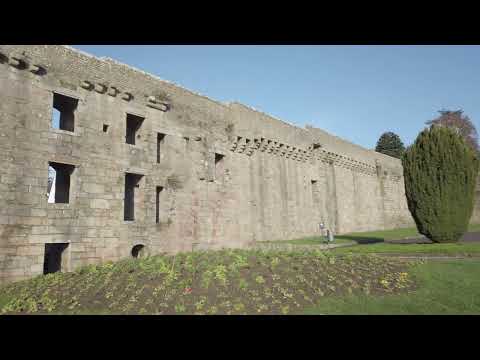
On the left bank, the Ville-Close preserves the strongest medieval outline. The ducal enclosure was built from the late thirteenth century, controlling both road and river. Its towers and the Porte Broërec’h frame a walk through walls, streets and the gardens that replaced the defensive ditch. Hennebont was involved in the Breton War of Succession; the famous siege of 1342 and the sortie of Jeanne de Flandre are recorded episodes. Her later nickname, “Jeanne la Flamme”, belongs to nineteenth-century romantic retellings, a useful reminder of how documented history and legend can become entwined. Notre-Dame-de-Paradis, whose first stone was laid in 1514 and which was consecrated in 1524, brings a later Gothic landmark into the same walk.
From river trade to horses and industry
The Blavet changed from a natural river route into a canalized transport artery in the nineteenth century. Locks, quays and the towpath connected the inland country around Pontivy with the coast. The waterway supported Hennebont’s port activity and later the movement of materials and finished goods for the Forges of Kerglaw. The municipality describes the older town as heavily damaged during the fighting around the Lorient Pocket in 1944, followed by reconstruction and new public services. This layered industrial and postwar history helps explain why the town’s identity is broader than its medieval walls.
The National Stud is another major nineteenth-century legacy. Founded under Napoleon III and inaugurated in 1858, the Haras is now a visitor and cultural site with historic stables, a ceremonial tack room, forge courtyard, exhibitions and equestrian performances. INSEE counted 5,468 jobs located in Hennebont in 2023 and 438 employer establishments at the end of 2024. Commerce, transport and services represented 63.5% of those establishments; public services, education, health and social action 16.7%, with construction and industry also visible. Shops and cafés in the centre, the heritage museum at Porte Broërec’h and the Haras give visitors practical stops as well as sights.
Walking the towpath and reaching Hennebont
For a slower view, follow the Blavet towpath past the quays and canal works; it is a local walking route that continues upstream toward Pontivy. The river edge contrasts with the enclosed streets and makes clear why the crossing mattered. Hennebont is served by TER BreizhGo on the Vannes–Lorient–Quimper line, so Lorient and Vannes are rail approaches; regional buses connect the station area with the wider Lorient network. By road, the municipality points to the N165 and the N24 from Rennes. Check current train and bus schedules, and the Haras calendar: guided visits and performances run on selected dates rather than every day. The medieval centre, Blavet and Haras can each take time, so an overnight stay makes sense for visitors who want to combine all three.
 Hennebont in three chapters: old town, horses and medieval life
 The Haras National’s own video focuses on the equestrian site that has shaped Hennebont since the nineteenth century. Stables and horse-related activity show why this is a living heritage venue rather than only a collection of historic buildings. The current programme is seasonal, so check the official calendar for guided visits, shows and opening dates.
 France 3 Bretagne’s report covers the Médiévales, the town’s festival that brings medieval culture into the present through public events. It gives a sense of the streets and atmosphere when the event is underway. The report is tied to a particular edition, not a promise of the current programme; check the municipality’s calendar before planning around the festival.