Hausjärvi is best understood as a municipality of villages rather than a single historic centre. Oitti, the administrative hub, sits among open fields and rail lines, while Hikiä, Ryttylä and Mommila each have their own station and local character. The countryside between them is not empty space: old farms, manor landscapes, a wooden church, a village-shop museum, summer dance floors and community-run culture make a visit feel rooted in everyday Kanta-Häme. Statistics Finland counted 7,862 residents across the whole municipality on 31 December 2025. That figure describes the municipality, not Oitti alone.
A landscape shaped by fields, ridge and river valley
The terrain explains much of Hausjärvi’s history. The Salpausselkä ridge crosses the municipality, while the Puujoki valley spreads into broad clay soils suited to cultivation. Historic surveys identify Turkhauta, Puujoki and Oitti among the area’s oldest settlement places, and trace the Old Häme road through villages including Turkhauta, Hikiä and Erkylä. The name Hausjärvi originally referred to a lake and the village beside it, near today’s church village. A municipal heritage study records that the shallow lake was drained and turned into farmland during the period of railway construction around the turn of the twentieth century. The story here is one of an inhabited working landscape, remade gradually by transport and land use.
Parish, school and the beginnings of local public life
Hausjärvi’s historical milestones belong to different institutions. The area was separated from Janakkala as a chapel parish in 1611, and the present parish became independent in 1855. The municipality dates its own founding to 1868. Near Erkylä, General Johan Munck established Eskon koulu in 1856. The municipality describes it as Finland’s first public elementary school, a distinction that places local history within the wider arrival of organised schooling. It also reflects the role of estates and local benefactors in shaping services before modern municipal government.
The main church stands in the old church village, not in the administrative centre of Oitti. Completed in 1789, Hausjärvi church is a wooden cross-shaped building set in a rural churchyard. The parish describes it as the congregation’s principal church and records its renovation in the early 2010s. Nearby stands the local-history museum, and Kotiseututalo Koskela hosts changing summer exhibitions as well as rooms devoted to Karelian evacuees and veterans. Together they offer a compact way to encounter local memory: parish life, rural households and the upheavals that brought new residents to Häme.
Railways transformed a scattered district
Hausjärvi’s several centres took shape as railways changed how people and goods moved. The Helsinki–Hämeenlinna line opened in 1862; the Riihimäki–Lahti railway followed in the later 1860s. The stations brought trade and new services into villages that had previously relied on older roads and waterways. Local clay also supported brickmaking, and heritage surveys document brickworks around Oitti and Ryttylä alongside the growth of station-side commerce. Oitti became the largest settlement and, in the 1980s, the municipal administrative centre. Hikiä and Oitti still preserve railway-era station buildings and residential architecture that help visitors read this change in the landscape.
Four stations serve the municipality today: Oitti, Hikiä, Ryttylä and Mommila. This is a real advantage for reaching the district, but not a guarantee that every attraction is walkable from a platform. The official transport page links to VR’s timetable search. Oitti station itself has no ticket office, ticket machine, toilet or step-free platform access according to VR, so check accessibility and facilities for the specific station before travelling. From the capital region, plan the journey to the exact village rather than assuming a direct connection; routes and transfer patterns change. The municipality’s service bus runs from Oitti through Hikiä to Riihimäki on Wednesdays and requires advance booking, so it is not a substitute for checking ordinary visitor transport.
Small-scale culture and places to linger
Hausjärvi’s visitor experiences are spread across its villages and often follow the seasons. In the church village, the local-history museum lies beside the church. Mommilan Kyläpuoti occupies a former village shop and combines a summer café, second-hand goods and a small village-shop museum; the place also hosts events. In Turkhauta, Miinan Monttu is a covered summer theatre developed by the local youth association, giving a small village a substantial cultural venue. Ryttylä’s Kolmilammi dance pavilion sits among three ponds and brings a traditional Finnish summer-evening setting into the present. Oitti’s rural-style market is held annually on the first Saturday in August, organised by local Lions clubs.
These are not interchangeable attractions: one is a heritage collection, another an active performance venue, and another a dance pavilion or seasonal gathering. Their schedules vary, so a good itinerary starts by checking what is open on the date of the visit. The municipality’s tourism pages also list cafés, restaurants, local food producers, accommodation and leisure options such as karting, outdoor gyms, ski tracks, swimming places and frisbee golf. Some enterprises are summer-only. A visitor who allows time to move between villages will find more than a quick stop at the station.
A practical village-to-village visit
For a first day, combine the church village with the wooden church and local-history museum, then take time in Oitti for a meal or a walk through the railway-side centre. A second outing can head to Mommila for the village shop and surrounding rural landscape, or to Turkhauta for a performance at Miinan Monttu when the summer programme is running. Ryttylä offers Kolmilammi and its café on dance evenings. Driving makes it easier to connect dispersed sites, while rail can bring visitors into the four station villages; use current timetables and plan the final leg separately. Check opening days, performance dates, local transport, accessibility and weather before setting out. Hausjärvi’s appeal lies in that modest scale: a network of lived-in villages where church history, farming, railways and local initiative remain visible in the same landscape.
 Hausjärvi on video: a municipal portrait, Miinan Monttu and Mommila
 This episode in Suomen kasvukäytävä’s regional series turns attention to Miinan Monttu in Turkhauta, a covered summer theatre run by the local youth association. It helps explain how a village venue contributes to local identity and cultural life, complementing the municipality’s own listing of the theatre as an attraction. The video is a regional promotional feature, not a programme or ticket notice; check Miinan Monttu’s current season and access details before travelling.
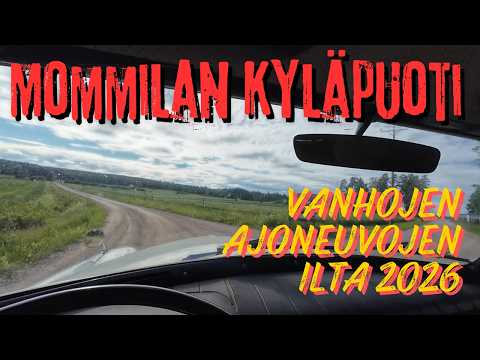 Kooilari’s June 2026 recording follows an old-vehicle evening at Mommilan Kyläpuoti. Its description specifically mentions the former village shop, the village-shop museum and a shop-van museum, giving the viewer a glimpse of the site’s nostalgic, event-based character. This is an individual visitor’s dated record, not an official opening announcement or a complete inventory of the collections. The local visitor page confirms the site’s summer café and museum role; check the operator’s current dates before making the trip.