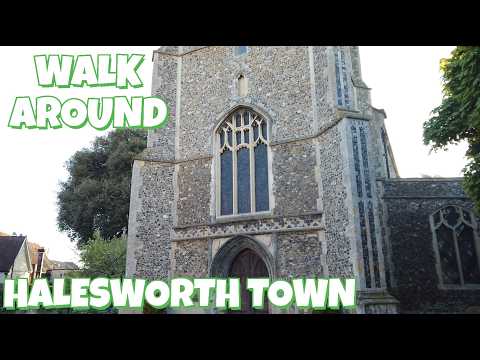
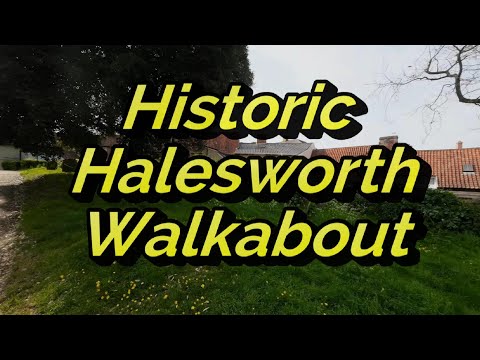
Halesworth offers a compact town centre, an operating railway station and a broad green landscape close to the shops. The Thoroughfare and Market Place preserve the shape of an old commercial settlement, while converted buildings support galleries, hospitality and the arts. It is a useful base for inland East Suffolk and the Blyth valley, with a more varied daily economy than a purely coastal holiday stop. A walk can connect church, historic streets, museum and Millennium Green before an evening performance or meal.
| Residents | 4,930 |
|---|---|
| Area counted | Halesworth civil parish — civil parish census area |
From a Saxon settlement to a market town
The town’s origins are generally placed in the Saxon period, around a river crossing and land close to the water. Earlier objects found locally indicate activity in the surrounding area, but should not be used to assign a prehistoric foundation date to the present town. A market and annual fair established in 1223 helped its transition into a commercial centre.
Trades developed around that role, including metalworking, leather work, agricultural produce and textiles. Surviving buildings in the Thoroughfare and Market Place date from several centuries, sometimes with later Georgian or Victorian fronts covering older structures. The changing façades therefore show continued adaptation as well as prosperity. Looking above the shop windows can reveal a different building history from the one suggested at street level.
Malt, water and routes of trade
Malting and brewing were important parts of Halesworth’s economy, with buildings and routes still recalled in local heritage interpretation. The town’s commercial links followed water and later railway connections as well as roads. These industries connected surrounding farms with processing and markets, helping explain why substantial premises developed in a relatively small settlement.
The local Malt Experience heritage trail gives a way to connect places in the present town with that working history. Rather than trying to reconstruct an entire industrial landscape from a single surviving building, follow the different sites and see how they now fit among houses, shops and public spaces. The reuse of former industrial buildings is itself a significant part of Halesworth’s more recent development.
The station museum and the Hooker connection
Halesworth and District Museum is housed at the railway station. Its volunteer-run displays cover local life and people, with changing exhibitions rather than one unvarying collection arrangement. Check the current opening or contact the museum before making a special journey; being able to use the station does not mean the museum doors are open at the same time.
The town has notable botanical connections through William Hooker and his son Joseph, who was born here. The museum has interpreted their work alongside more everyday subjects such as a local tailor’s workshop. This mixture of internationally connected lives and ordinary working experience is a good reason to allow time for the museum rather than treating the station solely as a transport stop.
The Cut and Millennium Green
The Cut Arts Centre occupies converted maltings near the station. Theatre, cinema, music, dance, exhibitions and classes give it a role in the town’s current life. Its café and galleries have their own opening arrangements, while performances require checking the programme and, where appropriate, booking a ticket. It is a destination for an evening or a workshop as well as a quick coffee.
Millennium Green offers a different pace close to the centre, with paths through a landscape linked with the town’s waterways and former transport routes. Use its current information to choose an accessible circuit and respect wildlife and managed areas. The ability to move from shops to green space is part of Halesworth’s appeal for residents, not simply an extra attraction for a day trip.
Rooms and dining on the Thoroughfare
The Angel stands in the centre and offers seven first-floor twin and double bedrooms. Its bars, glazed courtyard and Cleone’s Italian Restaurant provide several different settings for food and drink within the same property. Check room access and the appropriate menu when booking, particularly if stairs or an early departure affect the stay.
The position allows a visitor to explore the centre on foot and return after dinner or a performance at The Cut. Staying in town also leaves space for a separate excursion towards the coast, without having to treat Halesworth as a brief refuelling stop. The restaurant is an example with current operator information; individual menus and service times should be confirmed directly for the chosen date.
Rail access and the resident community
Greater Anglia serves Halesworth on the East Suffolk line between Ipswich and Lowestoft. Ipswich provides connections with the wider network, including London services. The station is unstaffed and has its own passenger facilities, so plan ticketing and assistance through the operator when needed. The short relationship between station and centre is useful for a visit without a car.
The 2021 census recorded 4,930 usual residents in Halesworth civil parish. Local shops, the library, arts organisations and hospitality serve that resident community alongside visitors. For someone comparing places to live, an ordinary weekday and a real rail journey can be as informative as a festival visit. The historic streets and green spaces are close at hand, while employment and services further afield depend on the actual connections available from the chosen address.
Sources
- Halesworth heritage partners: Malt Experience trail
- Halesworth and District Museum: station museum and local collections
- The Cut: performances, galleries, café and visiting
- Halesworth Millennium Green: management and public use
- The Angel: central accommodation and Cleone’s Restaurant
- Greater Anglia: Halesworth station
- Halesworth Town and Country: current services and cultural activity
- Office for National Statistics via Nomis: Census 2021 usual residents, civil parishes