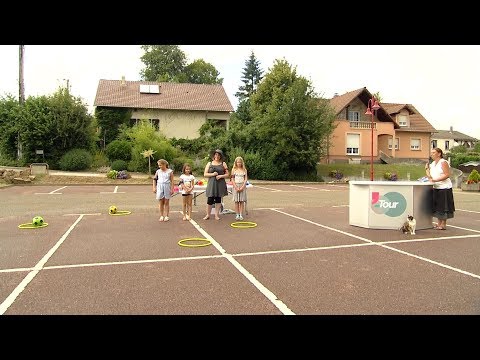
Guebenhouse is best read along its main street, where houses and farm buildings follow the old line of Rue de la République and Rue des Alliés. The traditional Lorraine form is called a village-rue: homes stand close to the road, with gardens and orchards behind them. Some older farm blocks retain an usoir, the open strip between a building and the street once used for everyday work. The result is modest rather than monumental, a lived-in settlement whose character comes from its rhythm of houses, church, yards and green edges.
A commune of its own, not a wider population figure
INSEE counted 417 municipal residents in the administrative commune in 2023, with a density of 93.5 people per square kilometre. That is Guebenhouse itself, not the larger Sarreguemines Confluences agglomeration. The commune covers about 421 hectares; its intercommunal profile says roughly three tenths are communal woodland. Rolling ground, meadows, fields, orchards and small streams make the village feel connected to its surroundings rather than separated from them.
What the records say about its past
Guebenhouse’s approved planning report says local history may reach back to about 800, a cautious claim rather than a documented founding date. It gives firmer medieval markers: the local lords, within the seigneury of Puttelange, recognized the sovereignty of the Bishop of Metz in 1275 and the Dukes of Lorraine in 1379. The same report says the settlement was destroyed during the Thirty Years’ War, still deserted in 1661, and repopulated only late in the seventeenth century.
The local authority’s account records another sharp rupture in the Second World War. Residents were evacuated to Champagne-Mouton in Charente from September 1939 to October 1940; miners from the commune were sent to Lens. Bombardment followed in 1940 and again in November and December 1944. US troops liberated Guebenhouse on 4 December 1944. In 1948 the commune received the Croix de Guerre with a bronze star. The same account records three people killed, fourteen deported, five expelled and damage to 42 percent of buildings. These are historical statements in the local authority’s record, not village legend.
Everyday heritage and a green setting
Saint-Materne church, the school in the former mairie building and the newer town hall form the civic centre; the approved planning document dates the new mairie to 2015. It describes several farms and houses as part of the general heritage inventory, while noting that no building was listed or classified as a protected Monument historique when the plan was approved. The interest lies in the whole street pattern and the continuity between homes, work yards and gardens, rather than in a single grand monument.
Woodland and water give visitors a natural counterpoint. The local plan names the Altwiesenbach and the stream of the Welschhof pond, and describes wooded slopes and cereal fields around the settlement. The Welschhof pond itself is in neighbouring Puttelange-aux-Lacs, where Moselle Attractivité lists an easy 4.1-kilometre circular walk. The reservoir formed part of the Aquatic Maginot Line, a 1930s defensive system. Treat it as a nearby outing, not a walk starting in Guebenhouse, and check current signs and conditions before setting off.
Local life, places to stay and getting around
Guebenhouse is a small working and residential commune. INSEE counted 14 jobs located there in 2023 and 176 employed residents; its 2024 business register records a modest mix of industry, construction, trade and services. The 2024 equipment inventory lists one school and one hairdresser, but no grocery, bakery, doctor or pharmacy. Puttelange-aux-Lacs is the nearest practical service centre: the state directory lists France Services there 2.6 kilometres from the mairie.
Camping d’Oberwiese, a private site on Rue des Vergers, advertises overnight pitches and a pond setting for fishing; check dates, availability and rules directly with the operator. The current CABUS network lists the Alliés stop on line 11-125 between Sarreguemines and Diefenbach. Confirm the timetable, service disruptions and return journey before travelling. Guebenhouse rewards a short, unhurried visit: read the street, notice how the wooded land meets the houses, then continue to the neighbouring pond if time and conditions allow.