A town turned toward the Tarn
Gaillac is not simply a stop between Toulouse and Albi. It is a lived-in town whose old centre, river edge and vineyards still explain one another. The Tarn bends around its setting; from the streets near the former port, the land rises toward the vine-covered slopes. INSEE counted 16,162 municipal residents in Gaillac in its 2023 reference population. That figure describes the commune, not the wider wine-growing area or the seasonal visitors drawn by tastings and festivals.
The river gave Gaillac a practical role as well as a landscape. Its port once connected local produce with downstream markets, and the old quarters preserve traces of that exchange. Today the visitor can move between the market squares, the abbey, the riverbanks and the vineyards without treating them as separate attractions: together they form the town’s character.
From an ancient site to a medieval trading town
Saint-Michel Abbey stands on the site of a Gallo-Roman villa, and the city’s museum presents a Roman mosaic among the evidence of that earlier occupation. This is a meaningful archaeological layer, but it does not make the present town a Roman foundation. The documented story of Gaillac’s urban life belongs chiefly to the medieval period, when the abbey, the Tarn port and the market helped the settlement grow.
The Place du Griffoul appears at the centre of a 1562 plan of the town. Municipal historical material describes it as a political and commercial heart: a former timber market hall held stalls below and a meeting room for elected consuls above. Gaillac also had the right to hold three annual fairs and used its own weights and measures in the thirteenth century. The surviving arcades offered shelter to merchants and shoppers. At the square’s centre, a sculpted bronze group from the late sixteenth century rests above a marble basin from the eighteenth. The fountain gives the place its name; the Occitan word griffoul refers to a fountain or water source.
An abbey tied to the vineyard
The Benedictine monastery was founded in the tenth century and helped shape the town’s wine-growing history. Its church is a layered building, with Gothic construction from the late twelfth and thirteenth centuries and later repairs after periods of conflict. Restoration work has been proceeding in phases; access to the church can change, so check the latest local notice before planning an interior visit.
The former abbey buildings later served as a cooperative wine cellar, and since 1903 the site has been closely associated with the Gaillac wine trade. The Maison des Vins and the Abbey Museum now make that relationship tangible. The museum connects the settlement’s port and vineyard history with sacred art and local craft traditions. The appellation has been recognised as an AOC since 1938. Its grape varieties include mauzac, loin de l’œil, ondenc, braucol, duras and prunelart, used across still, sparkling, dry and sweet styles. A visit to the Maison des Vins can help a newcomer understand why Gaillac is more varied than a single red or white label.
Markets, museums and everyday culture
Gaillac’s present-day centre still revolves around its public spaces. A recent municipal update lists three weekly market occasions, divided between Place de la Libération and Place du Griffoul. The arrangement was revised in autumn 2026, so visitors should confirm the current day and location rather than rely on an older guide. The market is a good place to see the town as a service centre for the surrounding villages, where local food, wine and ordinary errands share the same square.
The city’s cultural offer is unusually substantial for a town of this size. The Musée de l’Abbaye explores local history, the river port, wine and sacred art. At Château de Foucaud, begun in 1634, the Museum of Fine Arts presents paintings, sculpture and graphic and decorative works, including nineteenth- and twentieth-century collections. A third municipal museum, the natural history museum, adds geology, fossils and natural collections. The surrounding park gives the château a green setting for a slower walk. Gaillac has held the national Ville d’Art et d’Histoire label since 2018, and the city runs guided visits and heritage activities through the year; dates and museum opening seasons vary.
Work, services and the wine country nearby
Wine is an important part of Gaillac’s identity, but the town is not a vineyard museum. INSEE counted 6,913 jobs located in the commune in 2023 and 670 employer establishments at the end of 2024; 68.4 percent of those establishments were in trade, transport and other services. These are different measures, and neither should be read as a count of vineyard workers. The municipality lists activity zones linked to wine, circular economy, digital businesses and renewable energy. Shops, schools, public services, sports facilities and cultural venues also support a town that serves residents across the Gaillac-Graulhet area.
To understand the wider landscape, continue beyond the centre to the small vineyard roads and villages of the Gaillacois. The Maison des Vins and local tourism office can help visitors arrange a cellar visit; many estates receive guests by appointment, so plan ahead and choose a designated driver. Albi, about 20 kilometres away, is an easy nearby city for a combined stay. Cordes-sur-Ciel and Lisle-sur-Tarn offer further excursions into the surrounding heritage landscape, but transport connections vary; check local bus and regional travel options before setting out.
Getting around and planning a visit
Gaillac is on the A68 corridor between Toulouse and Albi. The municipal site places it roughly 60 kilometres from Toulouse and 20 kilometres from Albi. SNCF liO lists an average train journey of about 50 minutes from Toulouse and a direct line linking Gaillac with Albi-Madeleine; the published average for that segment is about 16 minutes. Actual departures, engineering work and journey times change, so use the live timetable. The town’s bus network has five routes and a cross-town service, with on-demand transport to nearby villages and hamlets. Check current routes and service days, especially if visiting a vineyard outside the centre.
Gaillac rewards a visit that leaves room for both the market and the quieter details: the arcades at Griffoul, the abbey’s stonework, the port quarter and the vineyards visible beyond the river bend. The visitor office, museums and wine cellar provide practical help, while the railway makes it possible to arrive without a car. Confirm seasonal opening hours, guided-tour dates, market locations and transport timetables before travel.
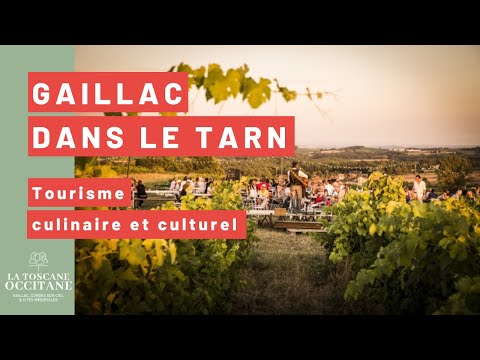 Gaillac en trois regards : terroir, patrimoine et route des bastides
 This Iter Vitis episode looks at the Gaillac vineyard as a landscape shaped by wine-growing know-how. It offers a heritage perspective on how viticulture and local identity are connected, complementing a walk through the abbey quarter or a visit to the Maison des Vins. It is a thematic film, not a current list of estates or visitor services.
 Tarn Tourisme follows a 2CV outing through the bastides and vineyards of the Gaillacois. The short film conveys the slower road scale of the wine country and suggests why a car can help reach villages and estates beyond Gaillac. It does not provide present-day schedules or guarantee that every shown stop is open.