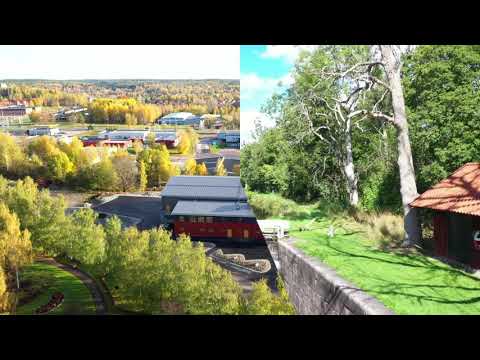
A town along the water
Fagersta sits in the wooded Bergslagen region, where the built-up town follows a valley toward the Kolbäcksån. Its character is neither a preserved open-air museum nor a town detached from its industrial past: streets, parks, surviving works settings and the nearby Strömsholms canal make the iron story part of the everyday landscape. SCB counted 11,771 residents in the statistical built-up locality of Fagersta on 31 December 2023. That figure refers to the defined urban area, not the whole municipality, whose population is larger.
Water explains much of the setting. The river powered early production, while the canal’s locks and towpaths later linked inland settlements with routes toward Lake Mälaren. Around the centre, the park and civic buildings offer a calmer counterpoint to the former industrial scale; beyond it, forest and lakes are close at hand across a municipality whose land is predominantly wooded.
Documented history, rather than a founding legend
Local records place ironworking in the district in the medieval period and identify a hammer at Kolbäcksån in 1611 as a documented starting point for Fagersta’s later works. The three works at Semla, Fagersta and Västanfors have early-seventeenth-century roots. Fagersta became the leading operation in the nineteenth century; Fagersta Bruks AB was formed in 1873, and the company developed a reputation for steel. Its engineer Johan August Brinell devised the hardness test that bears his name. These dates describe the documented industrial chronology; they should not be confused with a single, unverified tale of the town’s origin.
The settlement grew around the works and their social infrastructure. The manor on Andra Sidan dates from the eighteenth century, while four-family workers’ houses were built at Skansen between 1908 and 1918. Fagersta received town status in 1944. The historic works stopped operating in 1984, but successor firms continued production and the town remains an industrial centre.
Steel, architecture and nearby excursions
Today the municipality describes activity in hard metal, mining and drilling tools, wood products and stainless goods. The old works are best understood through the surviving urban fabric and collections rather than an active factory tour. Fagersta Bruksmuseum occupies the former fire station designed by Cyrillus Johansson and interprets the town and steelworks, but the museum is currently under renovation; check for a reopening notice before planning a visit. Vilhelminaparken’s fountain, made for a 1930 Stockholm exhibition and later given to the town, recalls the 1944 civic milestone.
In Västanfors, the canal-side hembygdsgård gathers furnished cottages, a manor wing, a historic shop, café and lock setting. Farther out, Engelsbergs bruk is a UNESCO World Heritage ironworks landscape; guided access and opening periods are limited, so reserve or check current details. Oljeön, near Ängelsberg across Lake Åmänningen, preserves an oil refinery visited by ferry and guide. Its 2026 season ended on 26 September; verify the next season’s dates and boat arrangements.
Getting around and planning
Fagersta Centralstation is a useful arrival point: the municipality is served by rail corridors between Ludvika and Västerås and between Gävle and Örebro, while Riksväg 66 and 68 cross the wider area. Check current train, bus and ticket information before departure. A walk or cycle beside Strömsholms canal, or a section of Bruksleden, adds a landscape route to the industrial heritage; confirm trail conditions and access. Visit Fagersta provides tourist information by phone throughout the year but has no walk-in reception. Brochures are available at the InfoPoint in Handelsboden at Västanfors hembygdsgård; opening times can change.