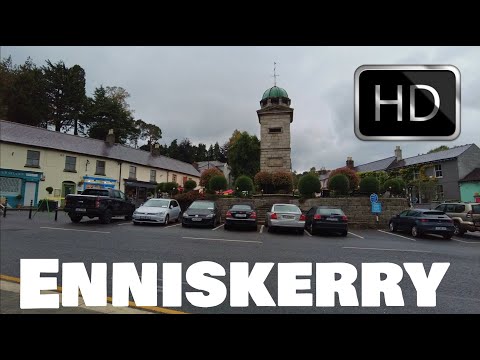
Enniskerry sits at the foot of the Wicklow uplands, with a compact centre arranged around its familiar clock monument. The village and Powerscourt Estate belong to the same historical landscape, but offer different experiences: cafés and everyday businesses around the square, formal gardens beyond the estate entrance, and wooded walks close by. Dublin and Bray make useful gateways for a visit without a car. An overnight stay leaves time to explore the village itself instead of treating it solely as the entrance to Powerscourt.
| Residents | 2,000 |
|---|---|
| Area counted | Enniskerry, Co Wicklow — census built-up area |
How the estate shaped the settlement
A river crossing preceded the planned streetscape visible today. The Wingfield family’s long association with Powerscourt influenced the village’s development, and the nineteenth century brought the cottages, public buildings and carefully composed centre that give Enniskerry its recognisable character. This is an estate settlement with medieval antecedents in the surrounding landscape, rather than a Roman town or a village founded on a single documented day.
The clock tower and triangular centre provide a useful starting point for a walk. Look at how buildings face the shared space and how the streets lead away towards the hills. The old school building, subsequently adapted for art, illustrates how the settlement continues to find uses for its historic fabric. Houses and businesses remain part of a working village; the streetscape is not an enclosed heritage attraction.
Powerscourt: gardens and a house transformed by fire
Powerscourt Gardens cover 47 acres, a measurement of the gardens rather than of Enniskerry village. The Italian terraces descend towards Triton Lake, with the Great Sugar Loaf forming a striking backdrop. The walled garden offers a more enclosed setting, while the Japanese garden and woodland areas change the pace of the visit. Allow a substantial part of the day for the grounds instead of expecting one quick circuit to reveal everything.
The house suffered a major fire on 4 November 1974. That event matters when interpreting the estate: the exterior, gardens and present visitor facilities should not be confused with a complete suite of untouched historic interiors. The waterfall is another Powerscourt attraction with its own location and admission arrangements, not simply the next feature on the garden path.
Knocksink Wood and a different landscape
Knocksink Wood Nature Reserve lies close to Enniskerry, in a wooded valley with a very different atmosphere from the formal estate. Its conservation interest includes wet woodland, springs and a rich invertebrate habitat. The appeal is in the living woodland and stream environment as well as the walking itself.
Use the reserve’s recognised access and paths, and choose footwear for damp woodland conditions. Combining Knocksink with a village stop offers a manageable outing without turning the day into a mountain expedition. The wider Wicklow uplands are a separate prospect: a sheltered village morning does not establish the conditions on an exposed hill later that afternoon.
Sleeping and eating in the village
Powerscourt Arms Hotel is in the village centre and currently offers fifteen rooms. Its position suits visitors who want to walk out into Enniskerry rather than stay entirely within the estate. Powerscourt Hotel is a separate property on the estate; the similar names are worth checking when booking accommodation or arranging a pickup.
The Kingfishers Kitchen faces the clock tower on the main street. Wicklow County Tourism lists breakfast and lunch as part of its offer, making it a useful stop before or after a walk. For evening dining, confirm the venue and service for the actual date rather than assuming a daytime café or a hotel bar serves a full dinner. Accommodation, garden admission and transport are separate bookings.
Arriving from Dublin or Bray
Dublin Bus route 44 links Enniskerry with Dublin. Another practical approach is to travel by rail to Bray and continue on Go-Ahead Ireland route L15, which connects Bray Station and Enniskerry. The L15 is the route to look for in current timetables; older references to service 185 describe an earlier network.
For a longer stay, these connections are as relevant as the scenery. Test the onward walk from the stop to the property, including its gradient, and check the return service after an evening out. Enniskerry’s mix of accommodation, cafés, estate attractions and proximity to Dublin gives it a broader daily rhythm than a purely seasonal rural stop. Its compact centre can be explored on foot, while destinations dispersed through the surrounding countryside require more planning.
Sources
- Enniskerry: village history and historic buildings
- Powerscourt Estate: garden layout and extent
- RTÉ Archives: the Powerscourt fire and reopening
- National Parks and Wildlife Service: Knocksink Wood
- Powerscourt Arms: accommodation in the village
- Wicklow County Tourism: The Kingfishers Kitchen
- Dublin Bus: route 44
- Go-Ahead Ireland: route L15 to Bray Station
- Central Statistics Office: Census 2022 population, built-up areas