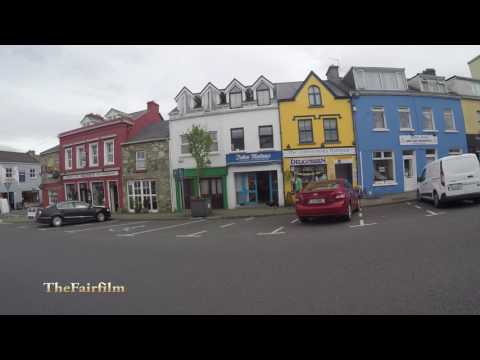
Clifden stands on Ireland’s Atlantic side in western County Galway, with streets rising above the Owenglin estuary and routes leading into Connemara. Colourful façades and churches give it the appearance of an old market town, but its foundation is comparatively recent. It is also connected with wireless communication and the first non-stop transatlantic flight. The centre provides shops, food and accommodation for the wider region, while the coast and surrounding bogland remain separate landscapes to explore.
| Residents | 1,259 |
|---|---|
| Area counted | Clifden, Co Galway — census built-up area |
John D’Arcy’s nineteenth-century town
John D’Arcy founded Clifden in 1812 on his Connemara estate. It was a planned attempt to develop a town rather than the gradual survival of a medieval urban foundation. Roads, trade and a harbour connection were central to making a remote western location into a commercial centre.
The streets and squares express that relatively modern origin. Walk through Market Street and the surrounding centre to see how shops, houses and churches were arranged on rising ground. Clifden Castle, D’Arcy’s residence outside the centre, is a separate ruin; its appearance should not be taken as evidence that the town began as a medieval castle settlement. The town’s later buildings and changes in ownership add further layers to the initial plan.
Derrygimlagh, wireless and aviation
On 15 June 1919 John Alcock and Arthur Whitten Brown landed their Vickers Vimy aircraft in Derrygimlagh bog south of Clifden after the first non-stop transatlantic flight. The landing site is outside the town, so it requires a separate excursion rather than a short walk between central shops.
The surrounding landscape also held a Marconi wireless station, connecting this apparently remote part of Connemara with international communication. Together, wireless and aviation show why Clifden’s history cannot be reduced to isolated rural life. Visit the interpreted landscape to understand the setting; an aircraft monument alone does not convey the bog, distances and infrastructure involved. Keep the historic achievement separate from the present-day transport network: it does not mean Clifden has a commercial airport.
Conflict and the present townscape
Clifden was caught in the War of Independence. In March 1921 an attack on police was followed by reprisals in which crown forces burned buildings in the town. Galway’s commemoration work records this episode and the wider West Connemara conflict. The centre therefore also tells a story of damage and rebuilding, not simply the untouched plan of 1812.
Today, the churches, bridges and shopping streets can be explored as a town walk before travelling farther out. The Sky Road provides a coastal excursion from Clifden, while Connemara National Park at Letterfrack is a separate destination. Choose one wider outing rather than assuming every attraction promoted under Connemara is beside the town centre.
Where to stay and eat
Abbeyglen Castle Hotel offers accommodation on the Sky Road approach near Clifden, together with its own restaurant. Its setting differs from a room directly among the main shopping streets, so check the precise walk or transport arrangement that suits your plans. Dining availability and a hotel stay should be coordinated with the day’s excursion.
Clifden’s central food businesses and shops make it useful as a base for several days. A town morning, an afternoon in the Derrygimlagh landscape and a separate coastal day allow each story space. For anyone considering a longer-term move, it is worth comparing a busy holiday period with an ordinary weekday, when the pattern of daily transport and services can feel different.
Galway connections and travel beyond the centre
Galway is the principal larger-city gateway. Bus Éireann route 419 runs to Clifden through Oughterard; check the current timetable and any changes to the intermediate routing. Rail passengers arriving in Galway need this onward bus or other road transport. Clifden has no operating passenger station.
The N59 is the main road corridor into the area. A journey from Dublin normally needs the western leg planned independently of the faster intercity section. For a home outside central Clifden, consider how groceries, work and appointments would be reached in practice. The short distance between two points on a map can conceal a very different road journey around a bay or through the Connemara landscape.
Sources
- Galway County Council: Clifden architectural heritage assessment
- Fáilte Ireland: Derrigimlagh, wireless and the Atlantic flight
- Galway Decade of Commemoration: Clifden and the War of Independence
- Abbeyglen: restaurant and setting
- Abbeyglen Castle Hotel: accommodation
- Bus Éireann: Galway–Clifden
- Central Statistics Office: Census 2022 population, built-up areas