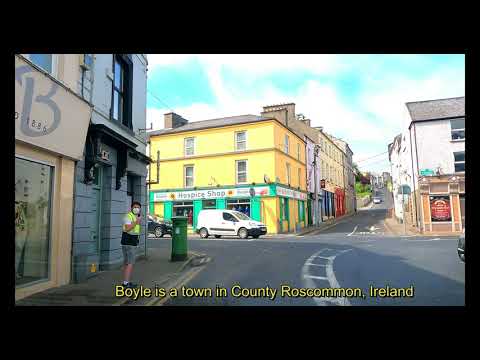
Boyle sits beside its river in northern County Roscommon, with railway access from Dublin and Sligo and a countryside attraction at nearby Lough Key. The abbey and King House represent very different kinds of power: a medieval monastic community and the later landed family. Between them are streets, shops, a clock tower and the river crossing of a working regional town. Its visitor sites make most sense when explored together rather than as unrelated stops.
| Residents | 2,915 |
|---|---|
| Area counted | Boyle, Co Roscommon — census built-up area |
The abbey and the medieval settlement
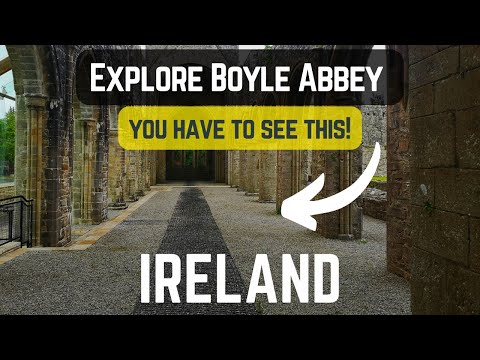
Boyle Abbey was founded in the twelfth century by Cistercian monks from Mellifont under MacDermott patronage. It became an important monastic house in Connacht. The surviving church, columns and carved capitals show the skill invested in the building, while the layout helps explain a community organised around worship and collective life.
The complex also records disruption. Military occupation in 1659 and later use as a garrison damaged the buildings. A restored gatehouse now provides interpretation when the visitor site is open. In November 2026 the Office of Public Works states that the abbey is closed for the season, with visitors expected again in 2027. Do not build a winter itinerary around guaranteed internal access.
King House and later town development
The town became a borough in 1613, and the King family shaped much of its subsequent development. King House, built around 1730, survives as a major Georgian town residence. It later served military purposes and now presents exhibitions on the family, the region and the Connaught Rangers, alongside other cultural collections.
Its scale is striking within an ordinary street setting. The courtyard, library and visitor facilities connect the house with present-day Boyle rather than leaving it as a remote estate. Exhibition access, events and the courtyard’s food businesses have their own arrangements. A market or performance on one day should not be assumed to run every day of the week.
The railway arrived in 1860, contributing to development towards the station and adding another link beyond the river and road network. Together, abbey, residence and railway explain why Boyle contains several different historical centres within one walkable town.
A day outside at Lough Key
Lough Key Forest and Activity Park lies outside Boyle, in the former Rockingham estate landscape. Woodland, lake views and historic remains provide a different outing from the town’s buildings. The operator lists activities and visitor facilities, with particular attractions booked or charged separately.
Plan the transfer from Boyle to the park rather than assuming it begins beside the abbey. The park’s own visitor information distinguishes parking, activity tickets and combinations that exclude some independent providers. A walk, a guided visit and a high-level activity are different experiences. Choose them for the group and available time, allowing the weather to influence the outdoor part of the day.
Rooms, tea rooms and time in town
Linsfort Bed & Breakfast occupies a period house on Main Street and offers accommodation in Boyle itself. Its position is useful for the town attractions and railway, although the exact walk and room access should be checked for the individual booking. There is no need to assume that every visitor must sleep in Sligo or Carrick-on-Shannon.
King House Tea Rooms provide a central option for breakfast, lunch or a break during a cultural visit. Evening dining is a separate choice among the town’s businesses rather than something automatically included with a museum ticket or B&B stay. A longer visit can divide the town and abbey from Lough Key, avoiding an unnecessarily hurried itinerary.
Dublin–Sligo rail access and everyday connections
Boyle station is on the Dublin Connolly–Sligo intercity route. Carrick-on-Shannon is on the same corridor, providing a useful pairing for a regional visit. Check the full timetable and engineering notices, and allow for the walk between the station and the centre. The N4 is the principal road connection for the area.
For someone considering a move, direct rail access is a significant practical distinction from villages without a station. It still needs to be tested against actual working hours and the address of a home. The town centre, station and lake park are separate destinations. The census figure describes the built-up area, not every rural address using Boyle in its postal description, and should not be used to infer the scale of the wider catchment.
Sources
- Office of Public Works: Boyle Abbey and seasonal closure
- Roscommon County Council: historical development of Boyle
- King House: collections and visiting
- King House Tea Rooms
- Lough Key Forest and Activity Park: location and access
- Lough Key: ticket inclusions
- Linsfort B&B: rooms and location
- Iarnród Éireann: Boyle station
- Central Statistics Office: Census 2022 population, built-up areas