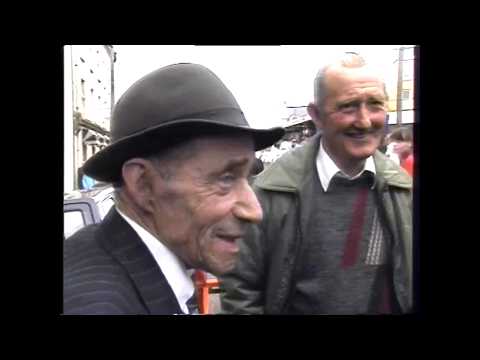
Ardara is a small market settlement on the Owentocker River in southwest County Donegal. Shops and public houses gather around the Diamond and along its approach streets, with open country close behind them. Its importance comes from work as much as scenery: handwoven tweed, knitwear, trading fairs and, more recently, distilling connect the town with the surrounding countryside. The Irish name Ard an Rátha recalls a ringfort, while the present centre records several later periods of growth.
| Residents | 785 |
|---|---|
| Area counted | Ardara, Co Donegal — census built-up area |
A river settlement shaped by trade
Ardara developed at a crossing of the Owentocker. A surviving ringfort explains its name, but does not supply a precise foundation date for the modern settlement. The Nesbitt family arrived in 1669 and influenced its later development. Market permission granted to George Nesbitt in 1760 helped establish the commercial role still visible around the Diamond.
Cloth linked farms, domestic workshops, traders and customers beyond Donegal. Improvements supported by the Congested Districts Board in the late nineteenth century included inspecting and marking good-quality tweed. A dedicated market building followed in 1912. This was a working system of production and sale, rather than a craft invented for visitors. Walking between the shops, river and market spaces makes that relationship easier to see.
Weaving and a newer industry
The Heritage Centre introduces the processes behind Donegal tweed, while textile businesses in the town continue the association with making and selling woollen goods. Look beyond the finished jacket to the cloth, its weave and the skills required to produce it. A demonstration, where available, is a different experience from a shop visit; ask the business what is actually taking place that day.
The Ardara Distillery adds a contemporary manufacturing story. Its operator offers tasting and non-tasting tours, with advance booking and age conditions. This is a useful complement to the textile history because it shows a new enterprise within a place often described only through older crafts. The tour information also identifies a ramp and lift for access. Follow the operator’s arrangements rather than assuming the production building can be entered independently.
Churches and the streets around the Diamond
The Church of the Holy Family opened in 1903. Its Evie Hone stained-glass window, completed in 1954, is a reason to look inside when the church is accessible. St Conall’s Church of Ireland and the Methodist church add different strands to a town walk. These are places of worship, so services take precedence over sightseeing.
The heritage trail also identifies an old building that combined school and chapel functions and later became a private residence. View such buildings from public space. Together, churches, ordinary houses and shopfronts reveal a more varied settlement than a row of souvenir shops. The town’s musical traditions can form another part of a stay, but a particular performance depends on the venue’s programme, not simply on arriving at any pub.
Where to sleep and eat
The Nesbitt Arms Boutique Hotel stands in the centre of Ardara and currently lists accommodation together with McCafferty’s Bar & Restaurant. Staying here means the town itself can be explored on foot before taking longer trips into the surrounding country. Book dining separately when necessary, especially during festivals or busy holiday periods.
Ardara is also a practical base for exploring the landscape towards Glengesh, Narin and the coast. These are excursions outside the town, with different weather and transport demands. An overnight stay gives room for a craft visit and local walk on one day, then a separate outing, rather than trying to fit the whole southwest Donegal coast into an afternoon.
Getting here and considering a longer stay
Donegal Town is the useful regional interchange for journeys arriving from Sligo and other larger centres. Bus Éireann route 492 serves Ardara on the Donegal–Glenties–Dungloe corridor; use the current timetable to check your precise day and return. Ardara has no railway station. A road itinerary can use Donegal Town or Letterkenny as a gateway, but the onward rural section deserves its own allowance.
For someone considering a move, the central question is how the town’s compact services connect with work, school and the wider county. Try the actual bus journey or road commute rather than judging access from a scenic touring route. Craft retail, hospitality and distilling are visible parts of the economy. A stay in the centre followed by time in the surrounding rural area gives a fuller impression of how these different parts of the community fit together.