A village shaped by a canal
Cassinetta di Lugagnano is a small municipality west of Milan where the Naviglio Grande is part of the town’s street plan and history. The canal separates the two old nuclei of Cassinetta and Lugagnano; a seventeenth-century granite bridge joins them. From the bridge, the visitor sees the village’s defining contrast: water, old residences and working countryside close together, with the metropolitan area still within reach.
ISTAT counted 1,967 residents in the whole comune on 31 December 2025. That figure describes the municipality, not just the houses beside the canal. Cassinetta is a lived-in place with a municipal center, library and everyday services, rather than a museum village built only for visitors. Its attraction lies in how a compact settlement grew around a waterway and the agricultural land it served.
Two historic nuclei and the work of water
The documented local story does not require a Roman or classical foundation legend. Città Metropolitana di Milano describes Cassinetta and Lugagnano as two old settlements. One named figure in the record is Maffiolo Birago, a court official under the Visconti: the metropolitan history attributes to him the foundation of Cascina Biraga and the church of Sant’Antonio in 1435. In 1428, according to the same account, he diverted water from the Naviglio to drive the mill now known as Mulino Gerli or della Pazza Biraga. The building still exists and is described as functioning, though visitors should not assume that its interior is open.
The canal also changed the social landscape. In the sixteenth through eighteenth centuries, Milanese families established country residences along the water, where land, gardens and access to the city could be combined. The villa group includes Nai, Krentzlin, Visconti Maineri, Mörlin Visconti, Eusebio, Trivulzio and Clari Monzini. They are not a row of public museums: many remain private homes, and Villa Visconti is explicitly listed by the Comune as inaccessible to the public.
Villas to read from the street
Villa Visconti Maineri shows how a country residence could grow out of an older rural building. The metropolitan account says the land belonged to the Visconti from 1392 and that major works were completed around the middle of the seventeenth century. Its Italian garden runs alongside the Naviglio; a raised park and orchard lie beyond. The municipal description adds the villa’s H-shaped plan and a chapel at the street corner. These details are best understood from public space unless a specific guided visit has been arranged.
Villa Trivulzio adds a useful note of uncertainty to the architectural story. The official municipal-history page dates it to the late eighteenth century but lists Giuseppe Piermarini and Simone Cantoni only as possible designers. That unresolved attribution is more accurate than assigning the villa to a celebrated architect as settled fact. Across the village, the houses and gardens show changing tastes, but the public experience is chiefly an exterior walk through streets and along the canal.
Mill, park and a slower itinerary
The Mulino Gerli connects the canal to practical work rather than ornament. Città Metropolitana describes it as still functioning and among the oldest working mills along the Navigli belt. The watercourse powered equipment, supported farming and linked smaller settlements with Milan. Because no general public timetable for the mill was verified, treat it as a landmark to see from outside unless the Comune or an organizer confirms access.
For an open public stop, Parco De André faces the Naviglio and is described by the Comune as free and accessible around the clock. A simple visit can cross the granite bridge, follow the public canal-side streets, pause in the park and look for the villas’ changing façades. The regional tourism portal also lists an exterior guided walk among the “case di delizia”; it lasts about three hours, requires booking and is offered to groups of at least 20. It does not grant automatic entry to private houses.
Getting there and nearby places
One public-transport approach is to take the train from Milano Porta Genova to Abbiategrasso and continue by STAV bus on the Z559 route, which links Abbiategrasso FS with Magenta and serves Cassinetta at Via Matteotti. The same line makes it possible to combine the village with nearby Robecco sul Naviglio or Magenta, subject to the day’s service. The published operator timetable is dated, so check STAV’s latest timetable and notices before travelling. For a broader day out, Abbiategrasso offers a larger historic center and rail connections; the surrounding canal landscape lends itself to a planned walk or cycle outing, but confirm the route surface and access where you go.
Cassinetta rewards attention to the relationship between settlement, water and land. Its houses are not all open attractions, and the mill is not a guaranteed interior visit. What is reliably available is the public view of the canal, the granite crossing, the park and a streetscape that makes the area’s history legible without turning the village into a stage set. Check transport, guided-walk dates and any access arrangements before setting out.
 Cassinetta in video: il borgo, il mulino e il Naviglio
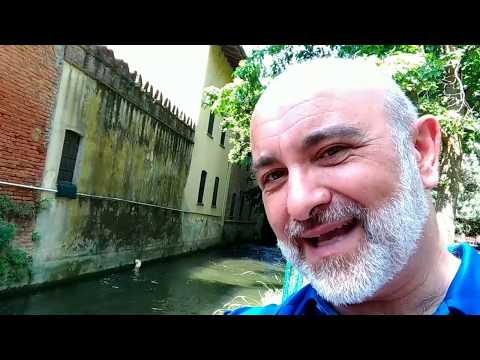 At 5 minutes 36 seconds, this video focuses on the Mulino della Pazza Biraga and the history of water-powered mills in the Navigli area. The date and subject connect with the documented 1428 diversion associated with Maffiolo Birago. It adds context to the canal landscape; it does not establish visitor access or opening hours.
 This five-minute local television itinerary is devoted to Cassinetta di Lugagnano. Its description presents it as an exploration of a notable corner of Italy, making it a broader companion to the more focused mill video. Use it for a sense of place, while checking current transport and attraction access separately.